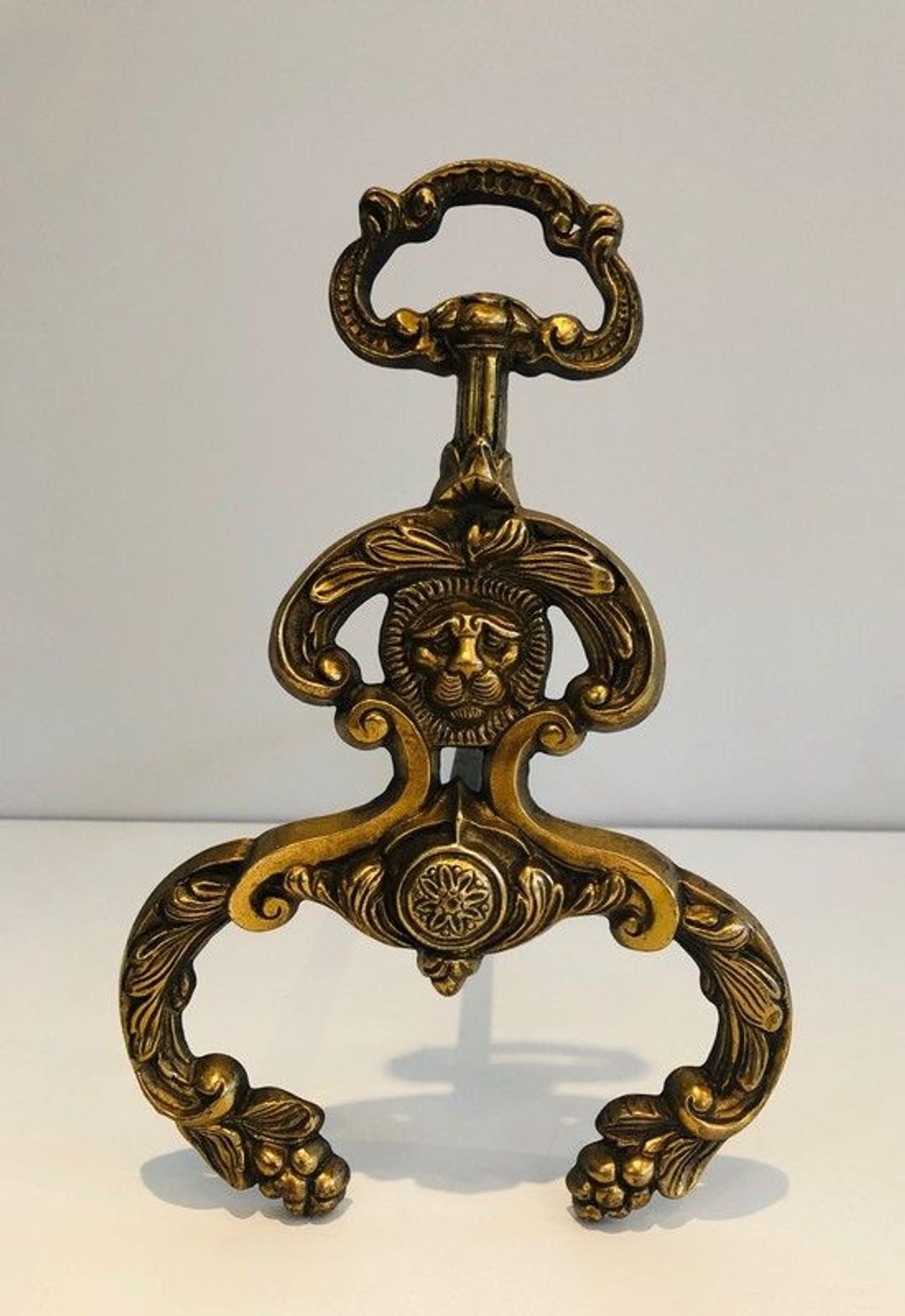
Pair of Neoclassical Bronze and Wrought Iron Andirons with Lion Mascarons. France. Circa 1940.
A pair of ornate bronze andirons in the neoclassical taste, each body composed of scrolled acanthus volutes, a central lion mascaron in bold relief, and a leafy arched crown, with wrought iron log-rests. W. 20 × D. 43 × H. 32 cm. France, circa 1940.
This handsome pair of bronze and wrought iron andirons, made in France around 1940, continues the long tradition of neoclassical revival bronzework that flourished in Parisian decorative arts from the Restauration onwards and found a renewed audience in the interwar period. Each piece is conceived as a tiered composition of extraordinary plasticity: at the base, two robust C-scroll acanthus volutes provide stability and visual weight; at the centre, a lion mascaron — its mane rendered in bold relief, its expression combining strength and decorative fantasy — serves as the focal ornament; and at the crown, a delicate arched handle with leafy scrollwork completes the vertical rhythm.
The casting is of high quality, the surfaces worked with fine chasing that articulates the acanthus leaves, the lion's mane and the decorative mouldings with confident precision. The patina is a warm, slightly variegated gilt bronze, darkened in the recesses to emphasise the ornamental relief — a treatment characteristic of the best Parisian workshop production of the period. Behind each decorative front, the wrought iron log-rests extend to their practical function.
The lion mascaron as a decorative motif carries a long history in the French decorative arts, deployed with particular frequency in the Louis XIV and Empire periods as a symbol of royal power, martial courage and protective vigilance. Its presence here, framed by acanthus scrolls and surmounted by a bow-shaped crown, places these chenets firmly within the neoclassical vocabulary that French craftsmen of the 1930s and 1940s continued to deploy with great surety, drawing on centuries of accumulated technical and iconographic knowledge.
In excellent condition, this distinguished pair would make a handsome and historically resonant addition to any period fireplace — equally at home in a neoclassical interior of the nineteenth century or a more eclectic contemporary setting in which the weight and richness of traditional French bronzework is sought.