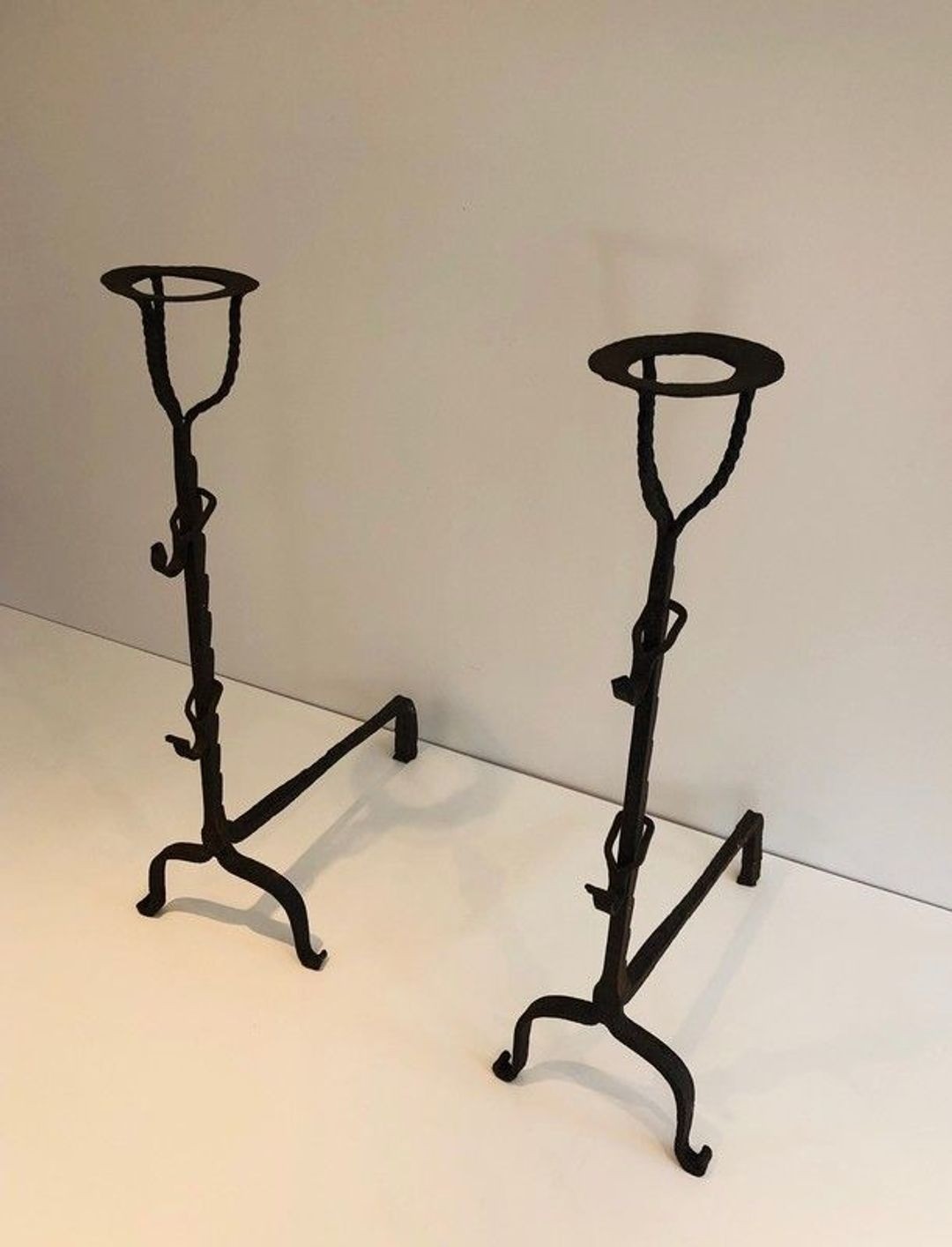
Pair of Tall Wrought Iron Landiers with Cup Finials. France. 17th Century.
A pair of tall wrought iron landiers of slender form, each with a tapering forged shaft punctuated by collar rings and terminating in a wide circular cup finial, raised on a splayed tripod base. W. 24 × D. 46 × H. 74 cm. France, 17th century.
These imposing wrought iron landiers, standing nearly three-quarters of a metre tall, are characteristic examples of the blacksmith's art in seventeenth-century France. Each piece rises from a splayed tripod base of hand-forged iron — the legs spreading with the organic irregularity of work shaped directly at the anvil — through a slender, slightly tapering shaft punctuated by wrought collar rings, to terminate in a wide circular cup or gobelet at the crown. This cup, open at the top, served the double function of ornamentation and utility: placed before the fire, it would hold a vessel of wine or broth to warm, a custom deeply embedded in the domestic culture of the Ancien Régime.
The craftsmanship throughout is that of a skilled rural or provincial ironsmith working in the tradition that stretched from the medieval period through to the seventeenth century with little fundamental change. The hammer-marks and slight irregularities in the shaft speak of hand-forging at high temperature, each element worked individually and assembled by collaring and riveting rather than welding. The collar rings — distributed at intervals along the shaft — serve both a structural and decorative purpose, a hallmark of the period's approach to functional ornament.
Landiers of this tall, cup-crowned type are among the most characteristic products of the French ironwork tradition, found in the great hearths of farmhouses, manor houses and lesser châteaux throughout the provinces. Their height was calibrated to the scale of the generous open fireplaces of the period, in which logs of considerable length were laid across the bar connecting each pair. The cup finial distinguishes this type from the simpler spit-hook landiers more commonly associated with kitchen use.
In fine untouched condition, with a deep, even black patina commensurate with their age, this pair of landiers represents a rare and distinguished survival of seventeenth-century French domestic ironwork — an object of both practical beauty and considerable historical interest.