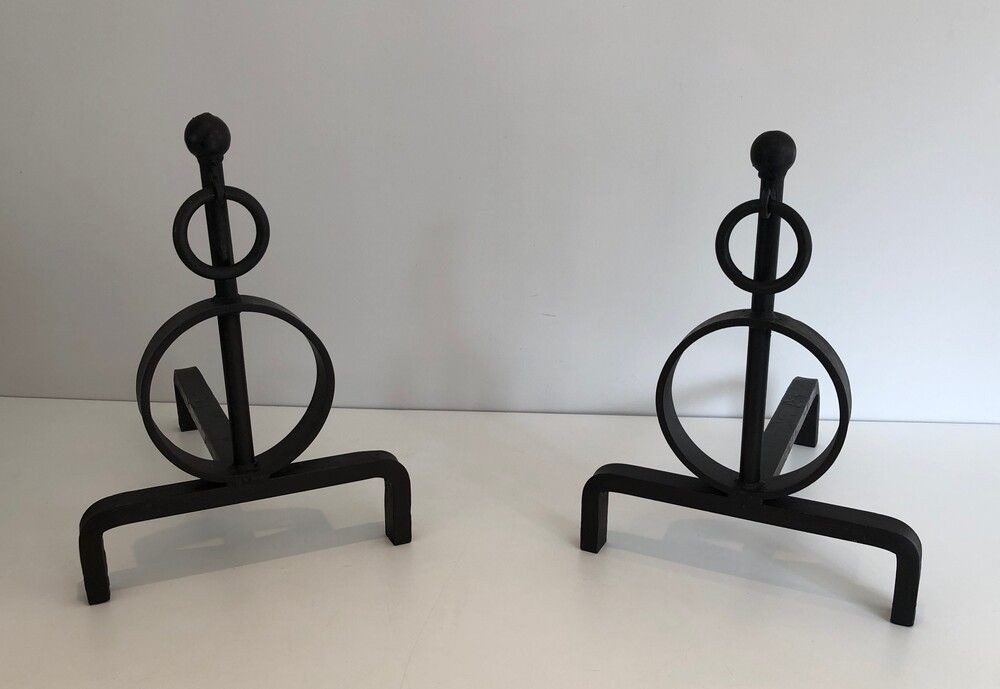
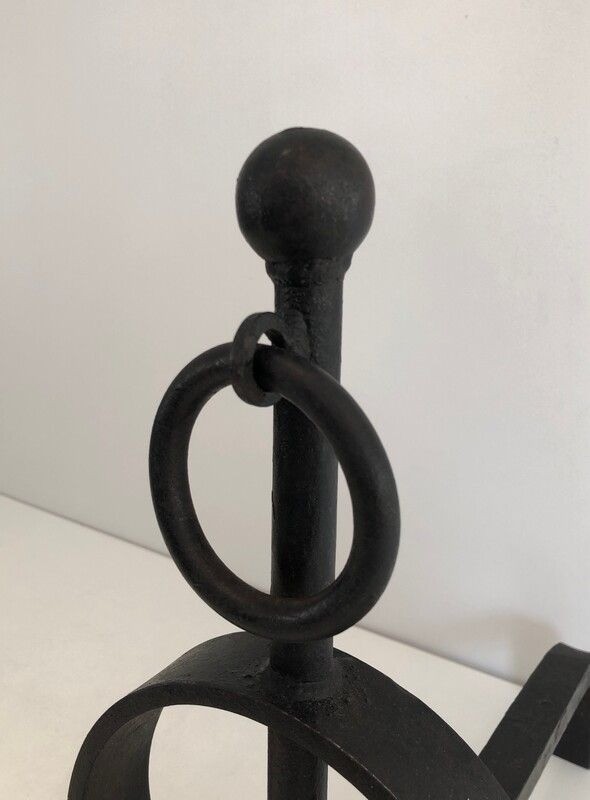
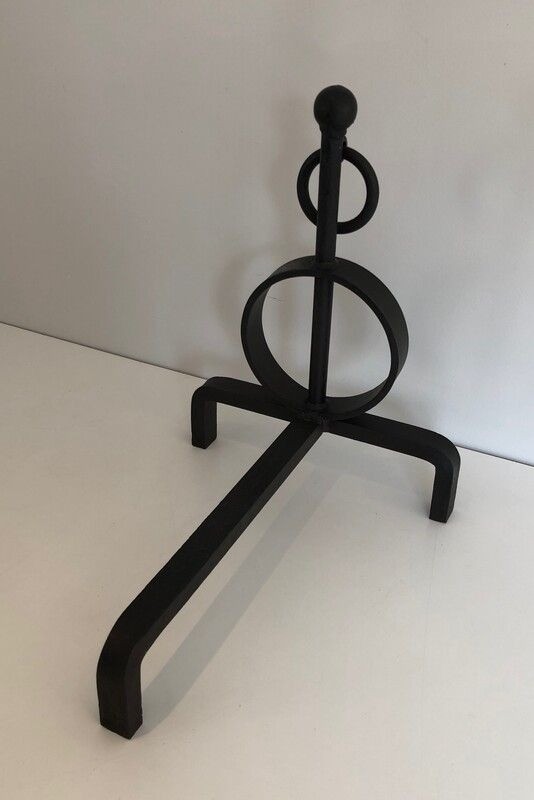
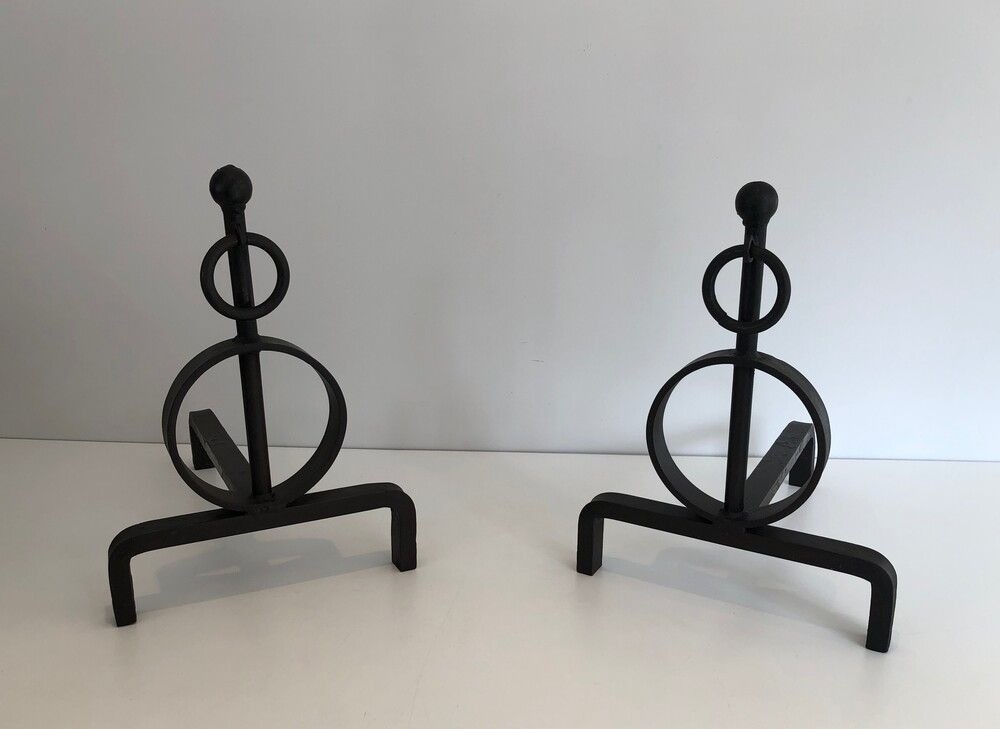
These wrought iron andirons represent the modernist programme at its most concentrated. Where other fireplace accessories of the period combined brass and iron, gilt metal and grille, or chrome and lacquered wood, these pieces commit entirely to a single material: wrought iron, dark and direct, shaped by the forge into forms that answer the question of what an andiron needs to be without recourse to supplementary ornament. The uprights, at 32 centimetres tall, have a real physical authority; the bars extend 42 centimetres behind, generous in their proportions; and the overall depth of 46 centimetres ensures stability before a substantial fire. What remains when decoration is removed is structure — and structure, when it is honestly resolved, has its own beauty.
Wrought iron is one of the oldest and most demanding of the materials available to the metalworker. Unlike cast iron, which is poured in a liquid state into moulds, wrought iron is shaped by the smith while hot, hammered and bent on the anvil through a process of repeated heating and working that requires both physical strength and refined skill. The forms it permits are consequently different in character from those of casting: more direct, more responsive to the particular gesture of the hand, more visibly marked by the encounter between the craftsman and the material. A wrought iron object of quality carries within it the record of its making in a way that a cast object cannot.
In the context of French design around 1970, purely wrought iron furniture and accessories occupied a specific aesthetic position: aligned with the craft revival that was occurring in parallel with the more industrial design culture of the period, and with a tradition of smithwork that had produced, in the previous generation, the monumental ironwork of Edgar Brandt, Raymond Subes, and their contemporaries. Modernist wrought iron of this period is leaner, less decorative, more architectural than its inter-war predecessors, but it shares with them a commitment to the hand-made object as a category of value distinct from the machine-produced.
In good condition with the natural, slightly uneven surface characteristic of hand-forged iron. These andirons would complement a fireplace of plain architectural character, a modernist or contemporary interior, or any room in which the emphasis is on material honesty and formal economy. Height: 32 cm. Bar length: 42 cm. Depth: 46 cm.