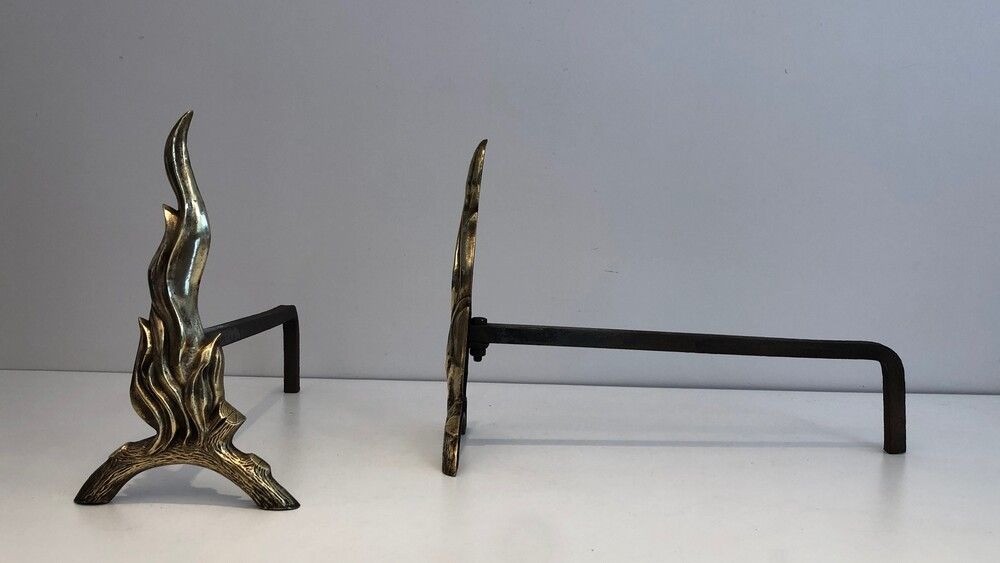
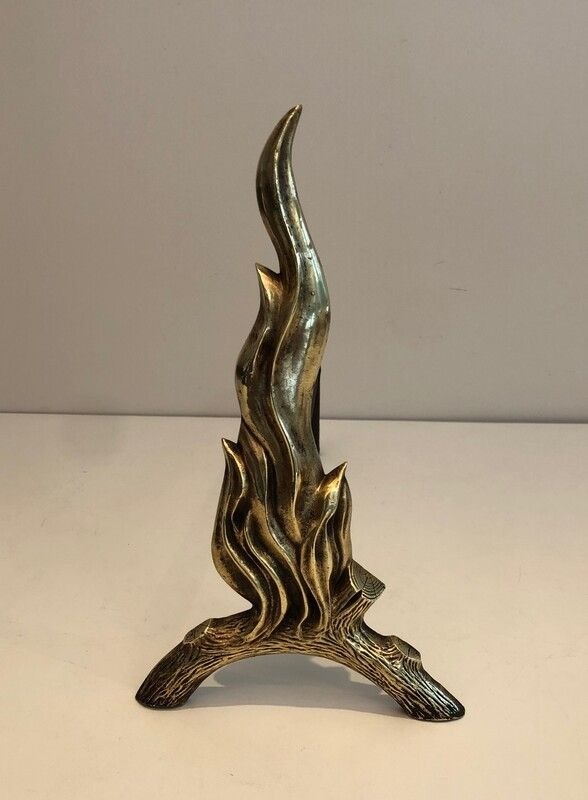
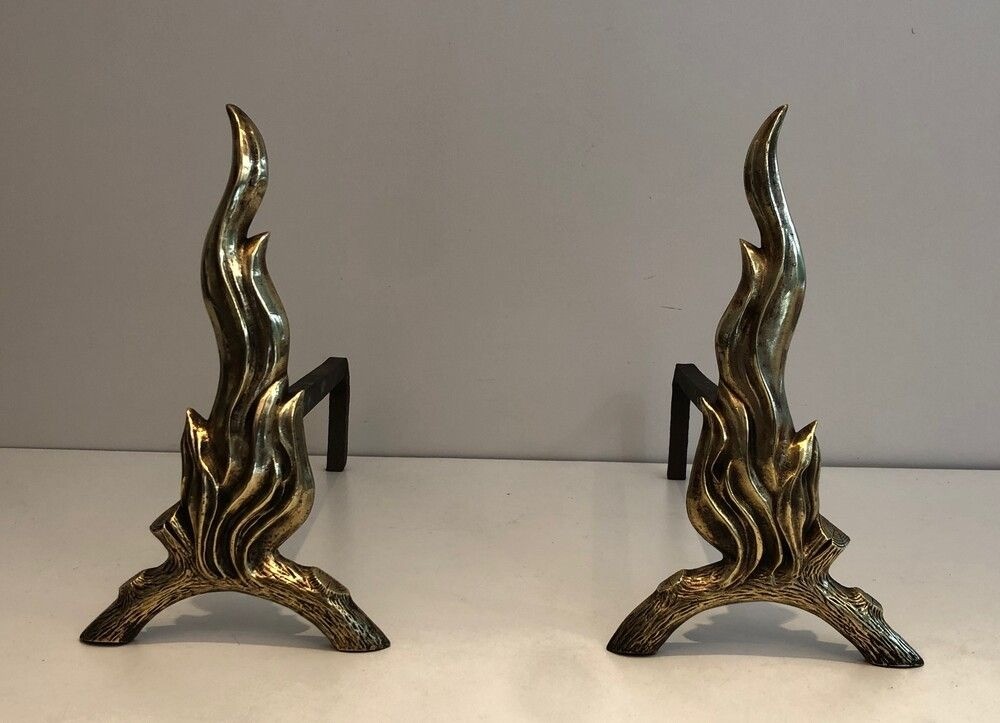
Of all the motifs available to the maker of fireplace andirons, the flame is perhaps the most inherently satisfying. There is something undeniably right about an upright modelled in the form of the element it is designed to support — the fire echoed in the bronze before it, the living flame answered by its cast likeness. These andirons carry that conceit with grace: the bronze uprights, stylized into an elongated flame form that rises to 17 centimetres, combine sculptural quality with a clarity of purpose that is entirely at home in a mid-twentieth-century interior. The wrought iron bars extend behind to a length of 43 centimetres, functional and sure.
The flame as an ornamental motif has ancient roots in European decorative art. In classical antiquity, the eternal flame burned at the altar of Vesta and was represented in architectural ornament as a mark of sacred continuity. In the neoclassical vocabulary of the late eighteenth and early nineteenth centuries — the age of the flambeau, the torch, and the brazier — the flame was a constant presence on clocks, candelabra, andirons, and furniture mounts, its upward movement suggesting aspiration, purification, and vitality. This tradition passed through the ornamental vocabulary of the Art Déco period into the post-war decades, where it was reinvented in cleaner, more abstract forms but never entirely extinguished.
The combination of cast bronze for the decorative upright and wrought iron for the functional bar is the classic pairing of French fireplace hardware. Bronze — cast, chased, and patinated — allows the sculptor’s hand to shape forms of real complexity; wrought iron, beaten on the anvil, provides the structural rigidity and heat resistance that the grate demands. Each material performs its proper role, and the boundary between them — where the warm gold of bronze meets the dark resilience of iron — is itself a small moment of visual interest. It is a combination that has been in continuous use in French metalwork since the seventeenth century.
In good condition with a warm, gently oxidised patina on both elements. These andirons would be at home beside a classical fireplace, in a modernist interior that appreciates formal wit, or anywhere that the decorative programme of the room touches on fire, light, or the natural world. Height of upright: 17 cm. Bar length: 43 cm. Depth: 29 cm.