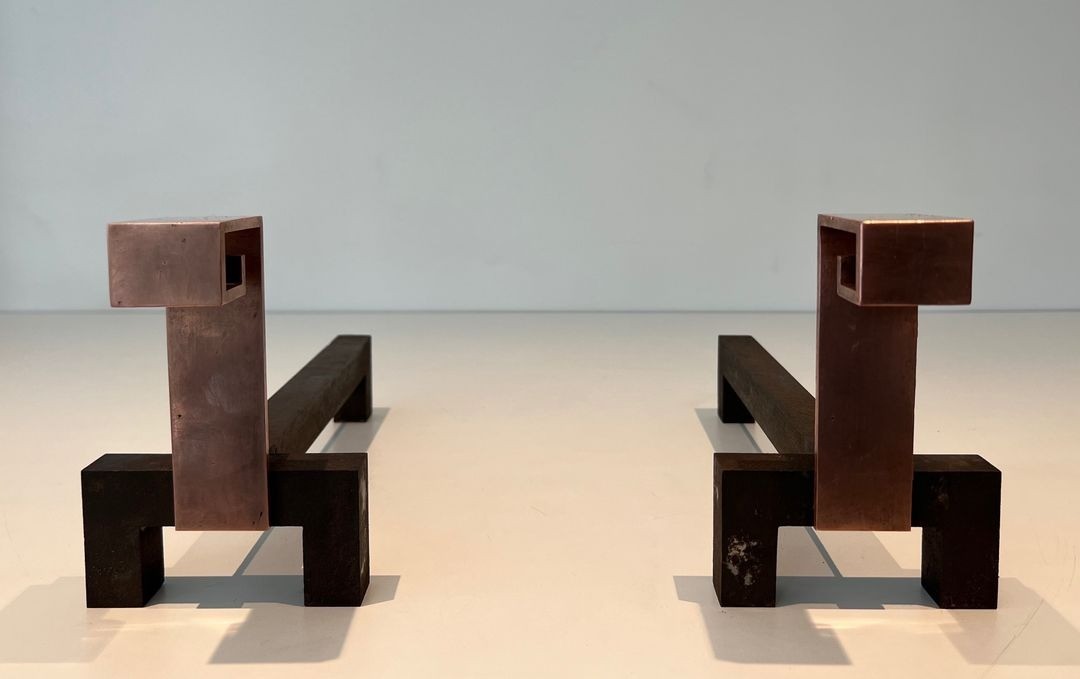
Pair of Brutalist Copper and Wrought Iron Andirons with Geometric Block Finials
Pair of sculptural modernist andirons in copper and blackened wrought iron, each comprising an angled diagonal iron support surmounted by a geometric copper block finial. France. Circa 1970.
This remarkable pair of andirons stands apart from virtually every other object in the repertoire of French decorative hearth furniture: they are, in the fullest sense, works of sculpture that happen also to function as andirons. The design dispenses entirely with the traditional vocabulary of the form — no scrolls, no balls, no urns — in favour of a purely constructivist vocabulary of geometric solids. Each piece is composed of an angled iron bar rising diagonally from a flat base, topped by a copper element of bold rectangular block or spiral form, creating a composition that reads simultaneously as an abstract sculptural study and a functional object.
The two materials — blackened wrought iron and copper — are deployed in stark, deliberate contrast. The iron is angular, structural, directional; the copper is warm, weighty, planar. Together they create a dialogue of opposing properties that gives the piece much of its visual tension. The copper elements, with their warm reddish-brown patina, sit at the summit of each andiron with an effect of concentrated material presence, as though each piece is a small monument to the intrinsic beauty of the metal itself.
At just 17 cm high and 12 cm wide, these are exceptionally compact andirons. This scale enhances rather than diminishes their sculptural quality: their proportions recall the maquettes and studies of twentieth-century abstract sculpture, and they are entirely convincing as objects of formal invention in their own right. They would be equally at home displayed as objects on a shelf as positioned before a small fireplace.
Objects like this reflect the most adventurous tendency within 1970s French decorative arts — a willingness to question all received assumptions about what a given object must look like and to begin the design process from first principles. These andirons have no predecessors and no successors; they exist as a self-contained formal proposition, completely resolved, entirely original.