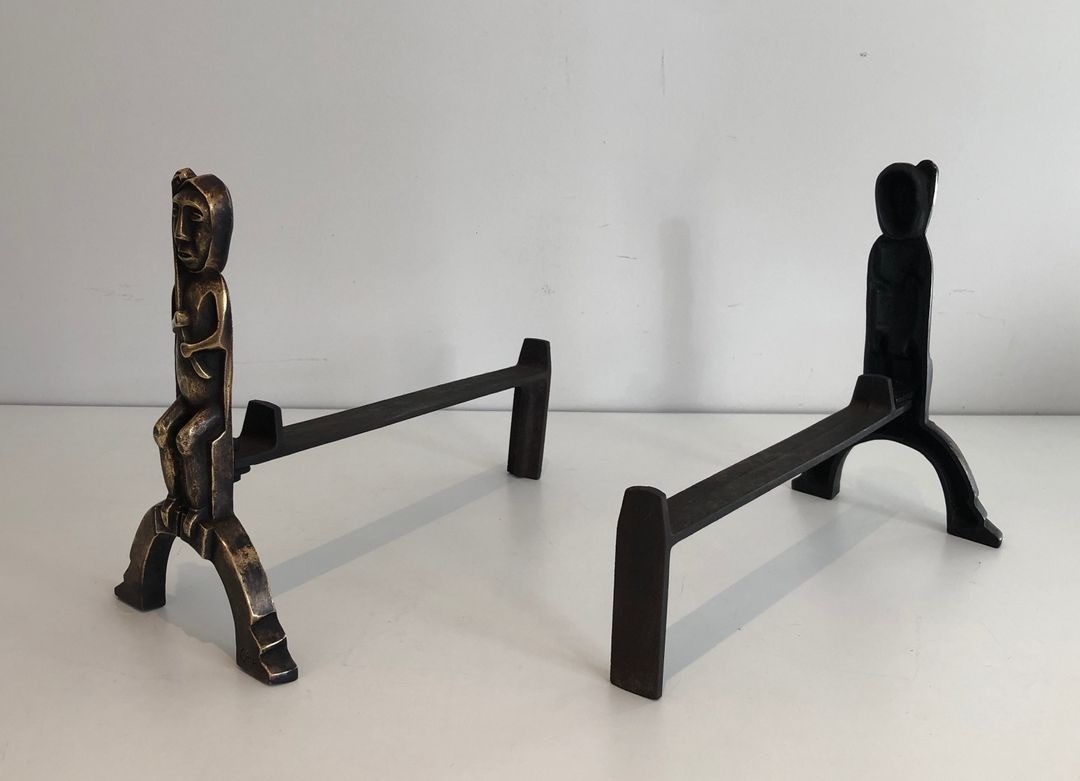
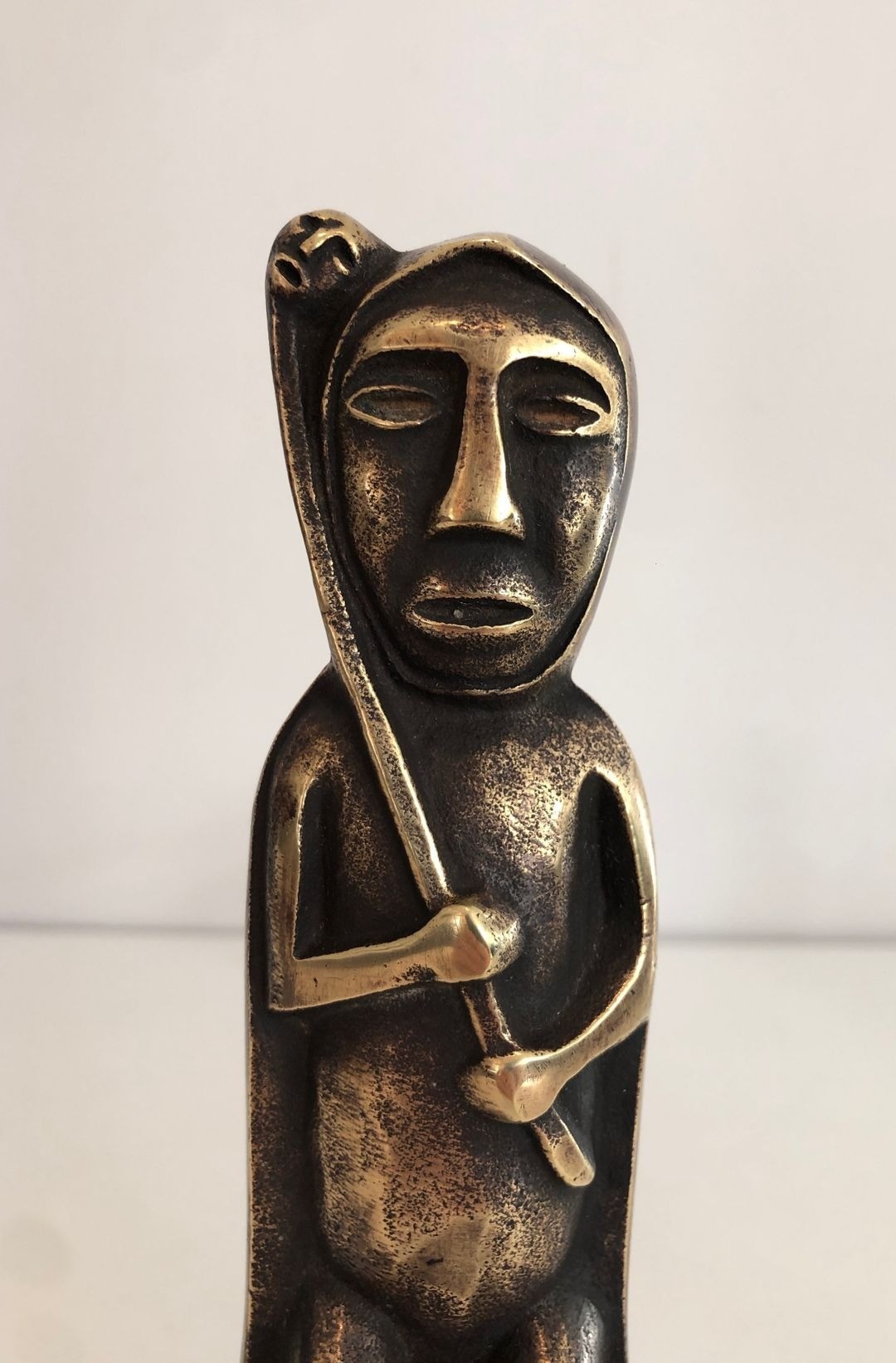
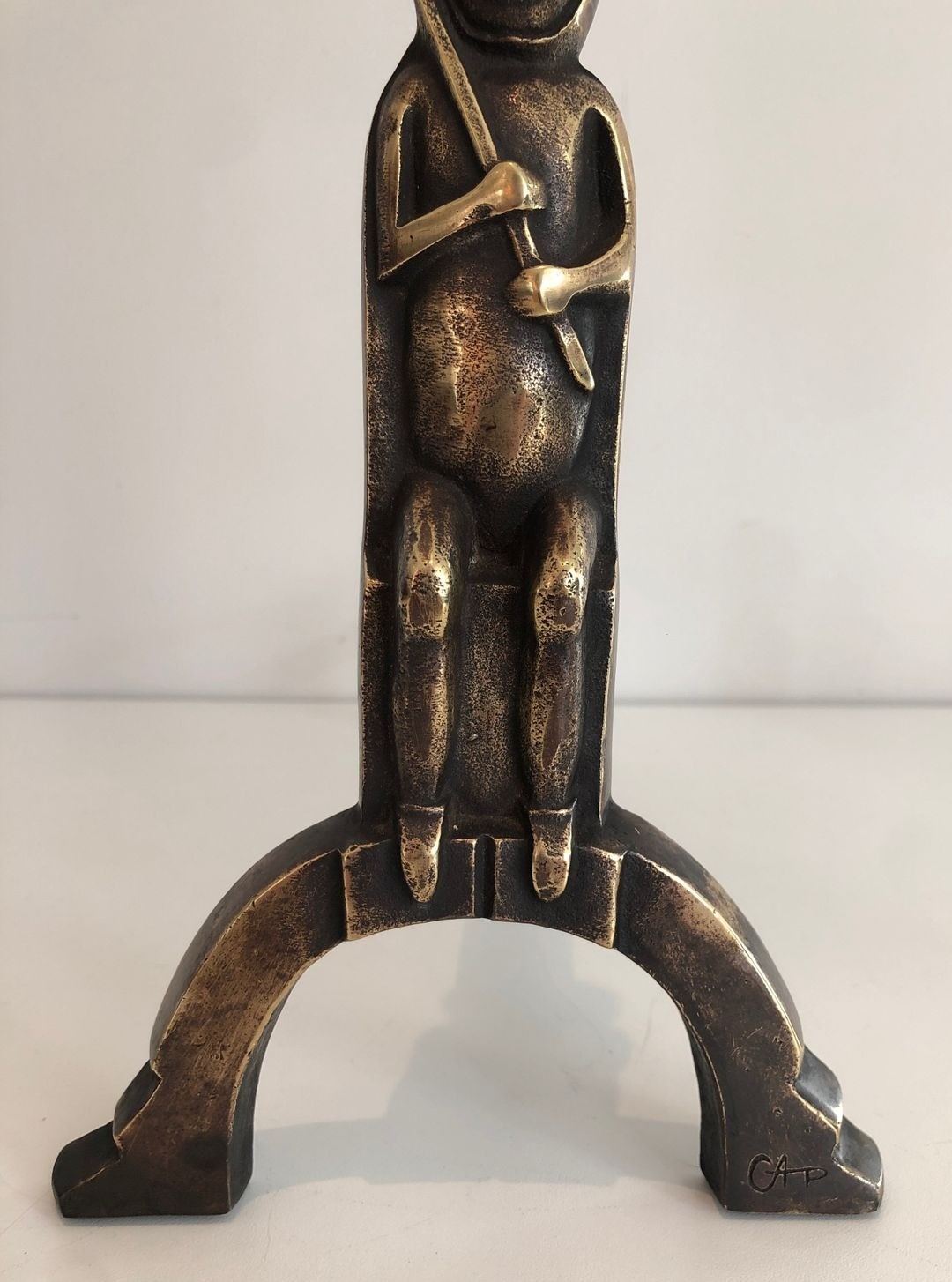
These exceptional andirons, monogrammed by the sculptor and draughtsman Anton Prinner, represent a rare and significant encounter between the art of the ferronnier and the avant-garde sculptural imagination of 1930s Paris. Each upright is modelled as a seated shaman figure — a stocky, powerful personage rendered in patinated bronze with a deliberately primitivist reduction of form. The figures are seated with legs outspread above wide arching base legs, their arms folded in a ceremonial posture, their features simplified in a manner recalling pre-Columbian, African, and Oceanic sculptural traditions. The iron log bars, slender and plain by contrast, serve only to anchor the mythic presences of the two bronze figures.
Anton Prinner (Budapest, 1902 – Paris, 1983), born Anton Pinner, arrived in Paris in the 1920s and established himself as a distinctive figure within the School of Paris. Drawn to archaic and non-Western sculptural traditions, he developed a personal idiom of bold, compact figuration with strong overtones of shamanism, animism, and mythic narrative. His monogram — found on these andirons — is attested on a range of his sculptural and decorative works from the 1930s onwards. The present pair represents an unusual and compelling intersection of his sculptural practice with the applied arts.
The patinated bronze surfaces carry a rich, dark tone with warm highlights that animate the sculptural modelling of the figures. The casting quality is assured and consistent, with well-defined surface detail in the faces, bodies, and hands. The wide arching base legs, forming an open arch below each figure, are both functionally stable and formally integrated into the overall sculptural concept. The iron log bar joining the pair is deliberately spare, its restraint concentrating full attention on the bronze figures above.
The shaman — intermediary between human and spirit worlds, keeper of fire — carries particular symbolic resonance as the subject of a fireplace accessory. Prinner’s choice is thus not merely decorative but conceptually apt: the fire tender and the fire spirit united in a single functional object of genuine artistic ambition. This pair is a work of art as much as a piece of applied metalwork, and it stands as a memorable example of the vitality and inventiveness of the Parisian decorative arts milieu in the years before the Second World War.