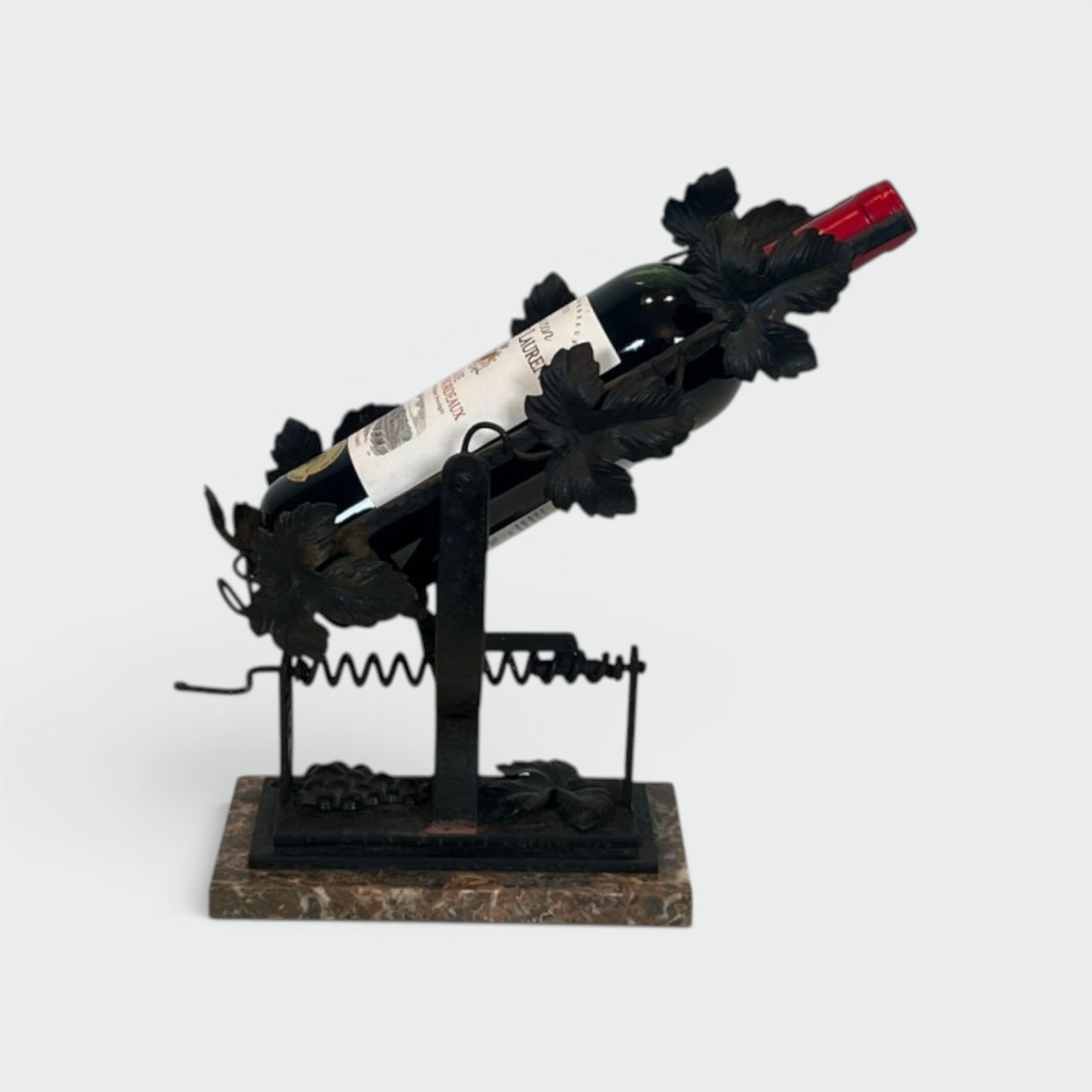
Wrought Iron Wine Decanting Cradle with Vine Leaf Décor on Marble Base, France, circa 1920
Decorative wine decanting cradle in hand-forged wrought iron. The structure is modelled as stylised vine branches and leaves, cradling a bottle at a tilted angle for gentle pouring.
This striking wine decanting cradle combines the rustic vitality of hand-forged wrought iron with the refined tradition of French table arts. The piece takes the form of a sculptural vine, its branches and leaves wrought with confident, fluid strokes by a blacksmith's hand, curling outward to cradle the body of a wine bottle at a carefully inclined angle. This deliberate tilt is the hallmark of the porte-carafe or berceau décanteur: by holding the bottle in repose at an angle, it allows aged wines bearing sediment to be brought to table and served in a single, controlled gesture without disturbance.
The ironwork reveals a high level of craftsmanship. The vine branches are hammer-forged and hand-finished, their surface preserving the characteristic texture of the anvil. The individual leaves are cut, shaped and riveted to the stems, each slightly distinct from its neighbour, lending the composition an organic, naturalistic quality. The deep black patina, acquired over a century of careful use, gives the piece a gravity and depth that contrast beautifully with the pale tones of the marble plinth below.
The piece rests on a rectangular slab of veined marble, its neutral ochre and beige tones grounding the dark iron silhouette with an air of permanence. The base provides both stability and a sense of presentation befitting the object's role at the table, elevating what might otherwise be a purely utilitarian device into a work of decorative art worthy of a fine cellar or sideboard.
Dating to around 1920 and attributable to French regional ironworking tradition, the piece stands at the intersection of the Arts and Crafts revival of hand-forged metalwork and the enduring Belle Époque taste for naturalistic motifs drawn from the vineyard. Its generous proportions make it both a functional object and a sculptural presence — an ideal addition to a wine cellar, a dining room sideboard, or a collection of decorative ironwork.