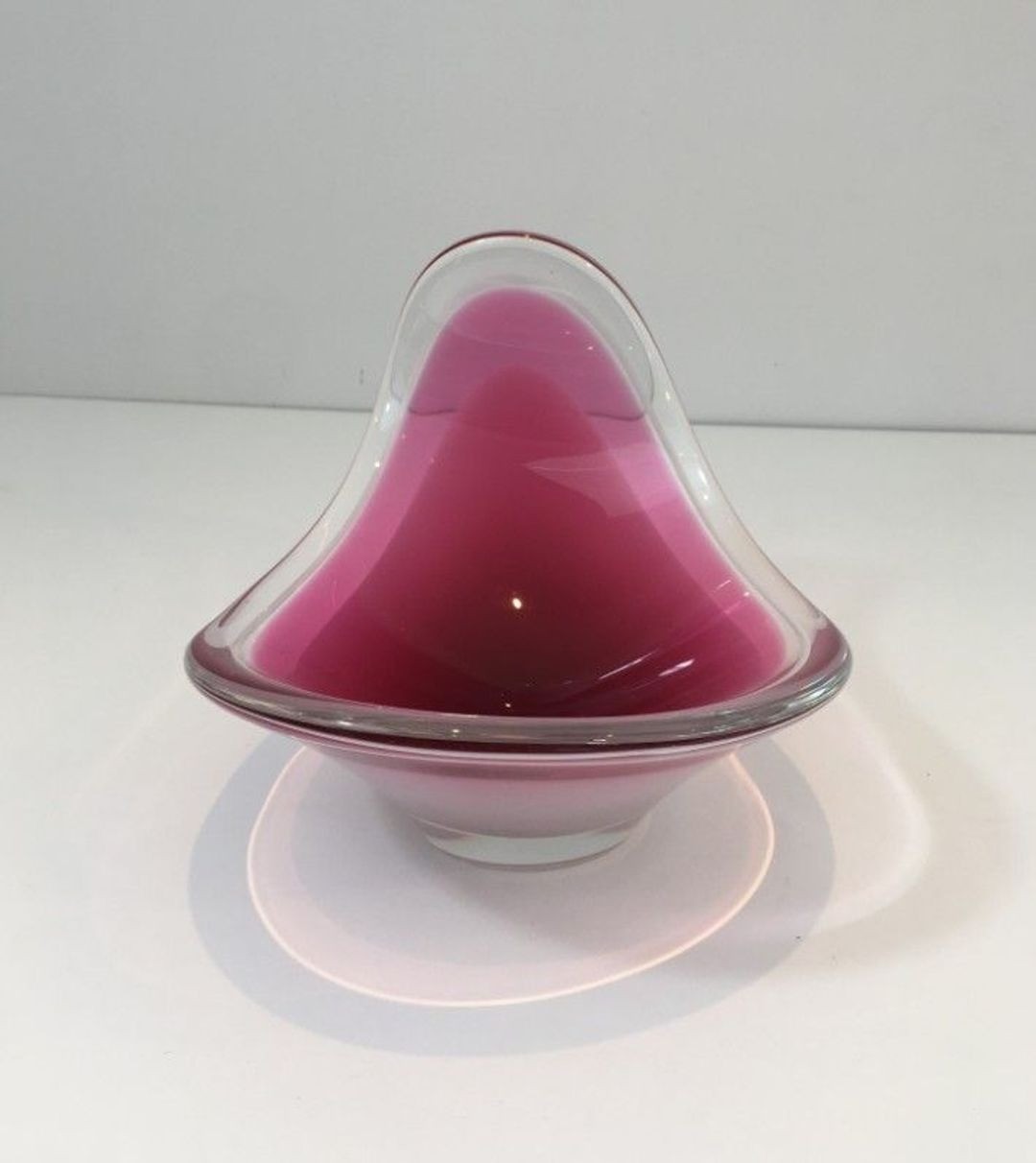
Free-Form Cased Crystal Bowl in Deep Raspberry Pink — Signed, Scandinavian Work, Circa 1970
A free-form sculptural bowl in cased crystal, the deep raspberry-pink inner layer visible through the clear outer glass in a dramatically asymmetric biomorphic form — low and leaf-like on one side, sweeping upward to a curved peak on the other. Signed. Scandinavian work, circa 1970. Dimensions: 26.5 × 20.5 × 19 cm.
This bowl is a work of glass sculpture as much as it is a vessel. Blown in the cased glass technique — a deep raspberry-pink layer encased within clear crystal — the form is entirely free: asymmetric, biomorphic, and resolved with the confidence of a master glassblower working at the height of his powers. On one side, the rim sweeps low and thin, like the edge of a leaf or a wave about to break; on the other, it rises in a tall, curved arc that gives the piece a dynamic upward energy entirely at odds with the stability of its base. Seen from above, the form suggests the cross-section of a pebble or a cell; from the side, it recalls something between a crescent and an open hand.
The piece exemplifies the approach that made Scandinavian decorative glass one of the most influential bodies of applied art produced in the twentieth century. Beginning in the 1950s and intensifying through the 1960s and 1970s, designers and glassblowers at studios including Orrefors, Kosta Boda, Riihimäki, and others elevated the utilitarian bowl and vase into a vehicle for formal invention of the highest order — pursuing organic, biomorphic silhouettes, rich colour layering, and an expressive use of the material's fluidity that no other medium could replicate.
At 26.5 centimetres wide and 19 centimetres tall, this bowl has a substantial presence on a sideboard, console, or coffee table. The deep raspberry tone of the cased layer, reading through the clear outer glass, produces a colour that ranges from translucent pink at the thin edges to dense, almost opaque carmine at the centre of the form. The signature on the base confirms the intentional authorship of the piece — a reminder that this is a designed and crafted object, not a commodity.
A beautiful and significant example of Scandinavian art glass from the post-war decades, this bowl rewards sustained attention and improves with every change of light.