The use of tortoiseshell — real or simulated — in the decorative arts has one of the longest continuous histories of any material in Western design. André-Charles Boulle, cabinetmaker to Louis XIV, elevated écaille de tortue to the status of a supreme luxury material in the late seventeenth century, inlaying it in alternation with brass in the marquetry that would bear his name for three centuries. The motif was revived repeatedly in subsequent periods: under the Restoration and Second Empire as a component of luxury boxes and small furniture, in the Belle Époque for combs and frames, and again in the 1960s and 1970s, when its simulation in amber-toned plexiglass became one of the most characteristic decorative gestures of the decade.
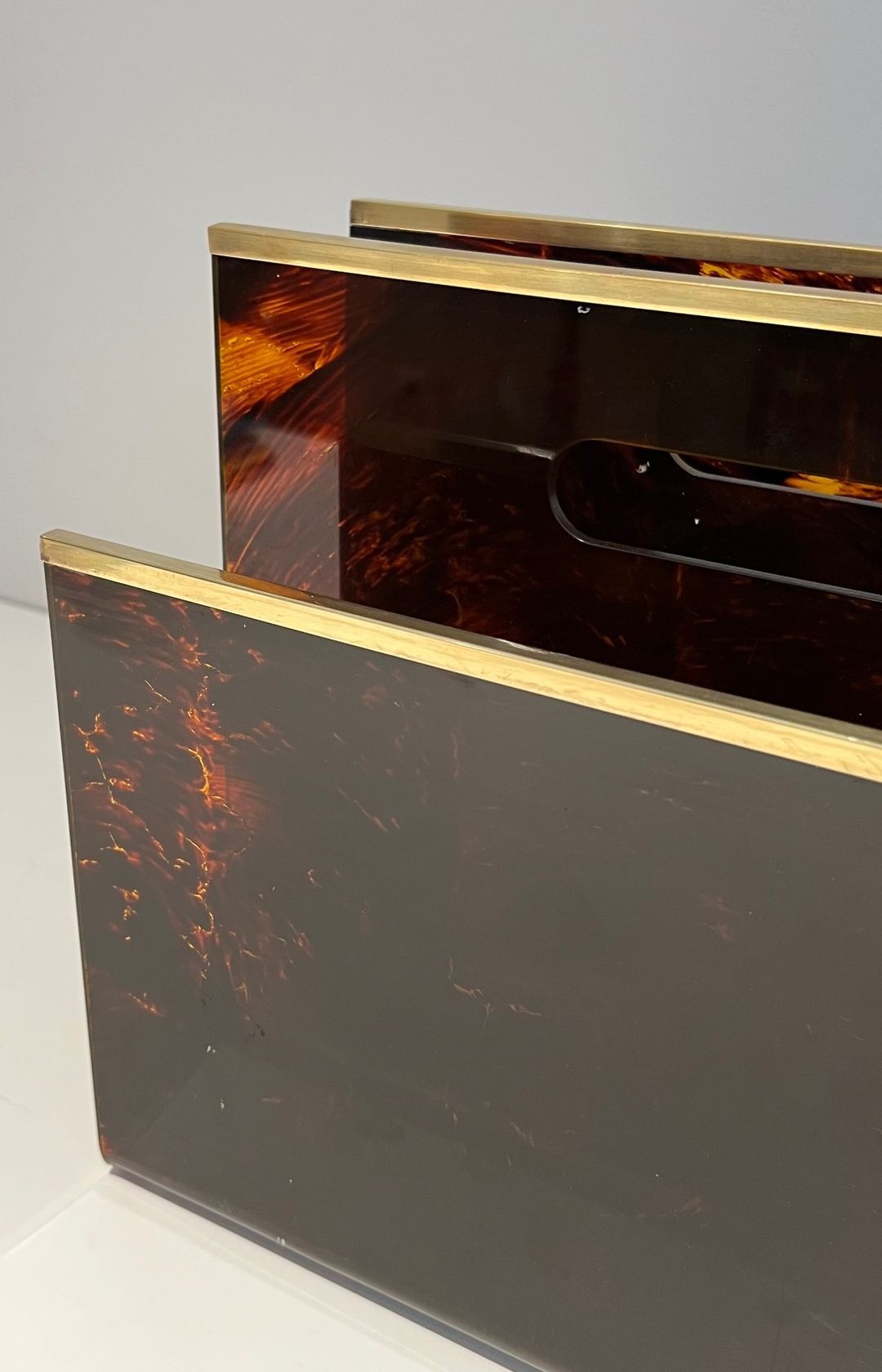
This magazine rack, in faux tortoiseshell plexiglass and brass, belongs to the 1970s chapter of that long tradition. The amber-brown patterning of the plexiglass panels — warm, translucent, with a suggestion of organic depth — creates a visual richness that few synthetic materials achieve. Combined with the precise brass framing, the piece inhabits the intersection of the natural and the manufactured, the ancient and the contemporary, that distinguishes the best decorative objects of the period. It is a piece that could have entered a Jansen interior of the time without the slightest discomfort.
Modest in scale — 32.5 centimetres wide, entirely suitable for a desk, a console, or a bedside table — this rack is precisely the kind of object that furnished the best French interiors of the early 1970s without demanding attention. Its quality lies in its restraint: a combination of materials handled with assurance, a form that serves its purpose without excess, and a surface that rewards close inspection. For the collector of French decorative objects of the post-war decades, it is both a pleasure and a document.