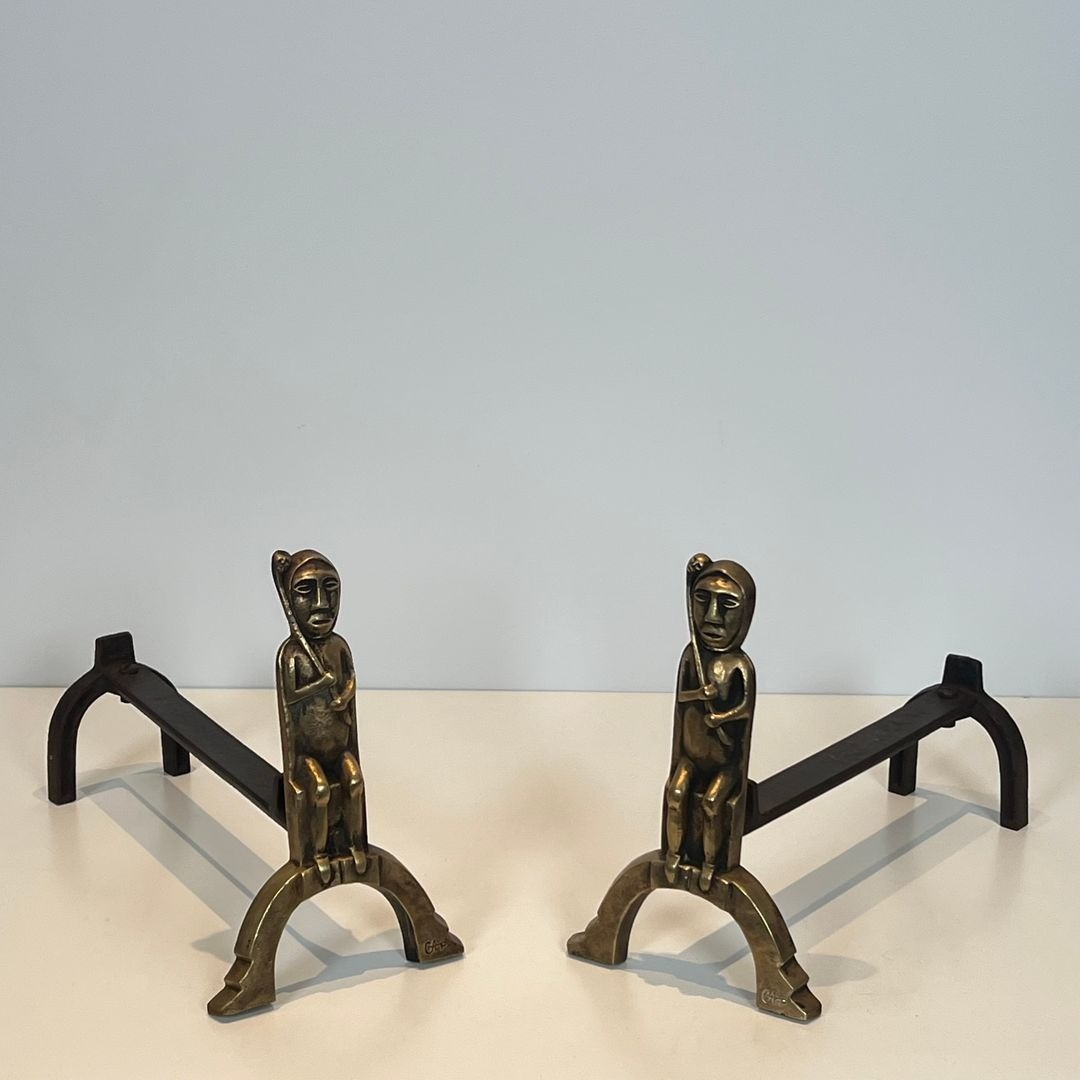
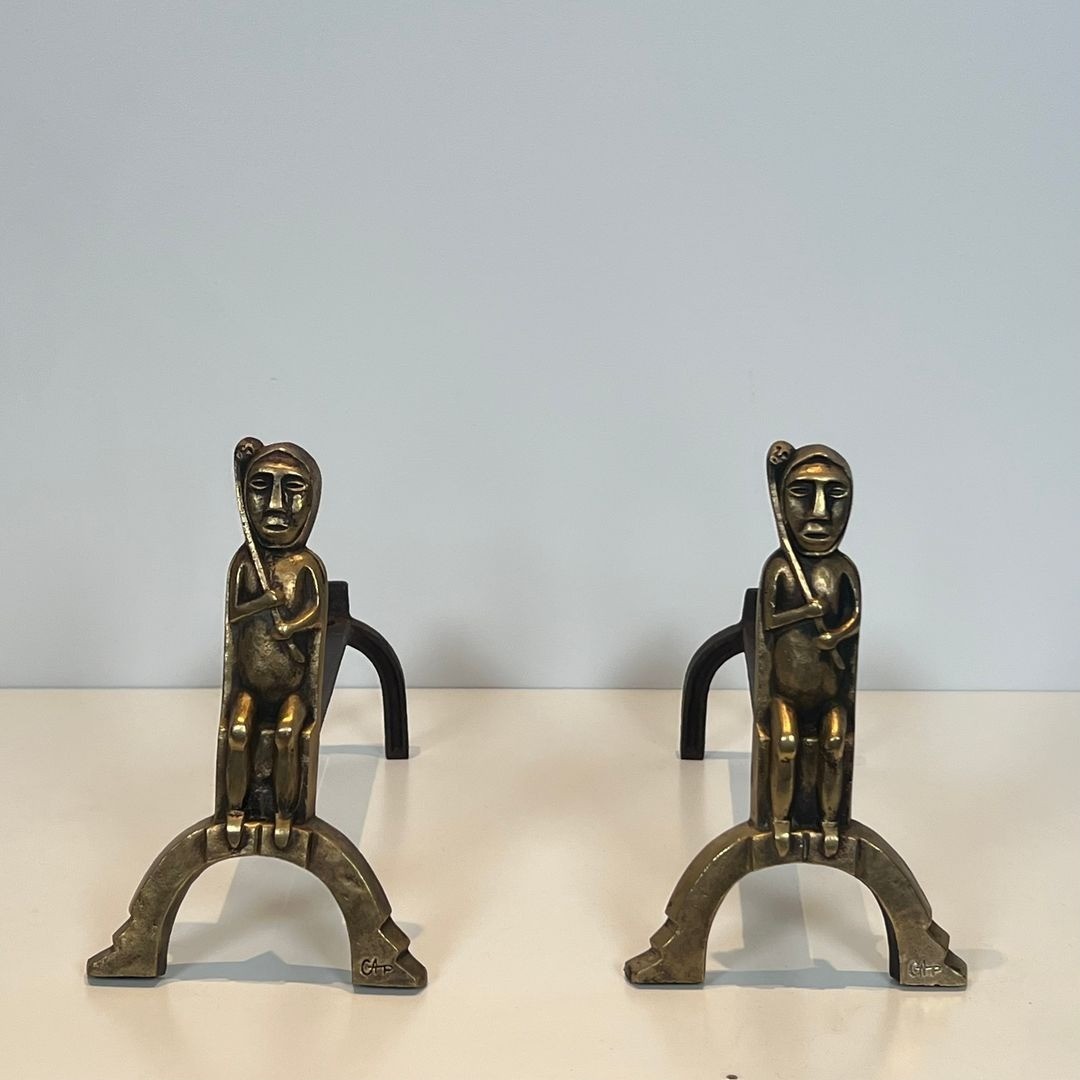
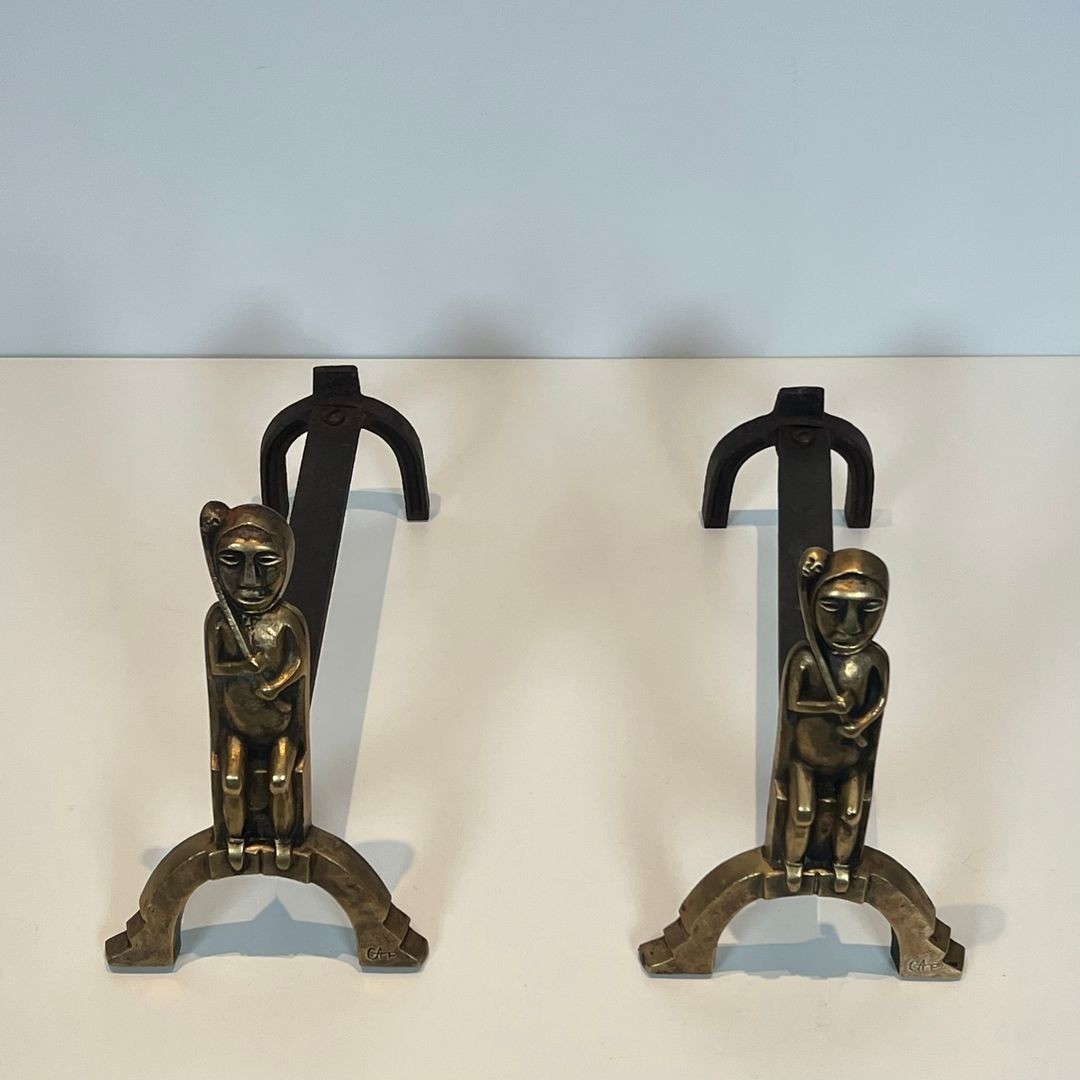
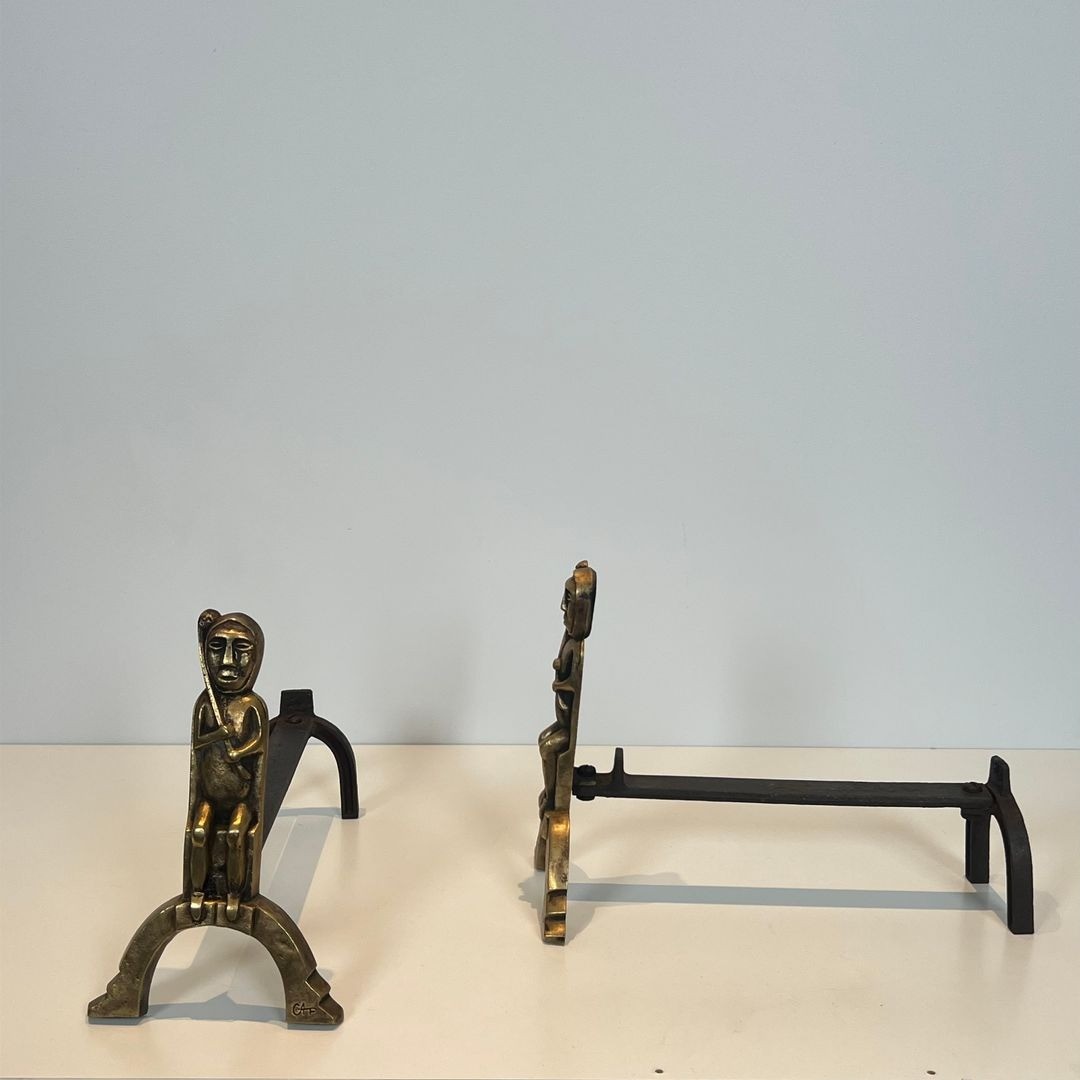
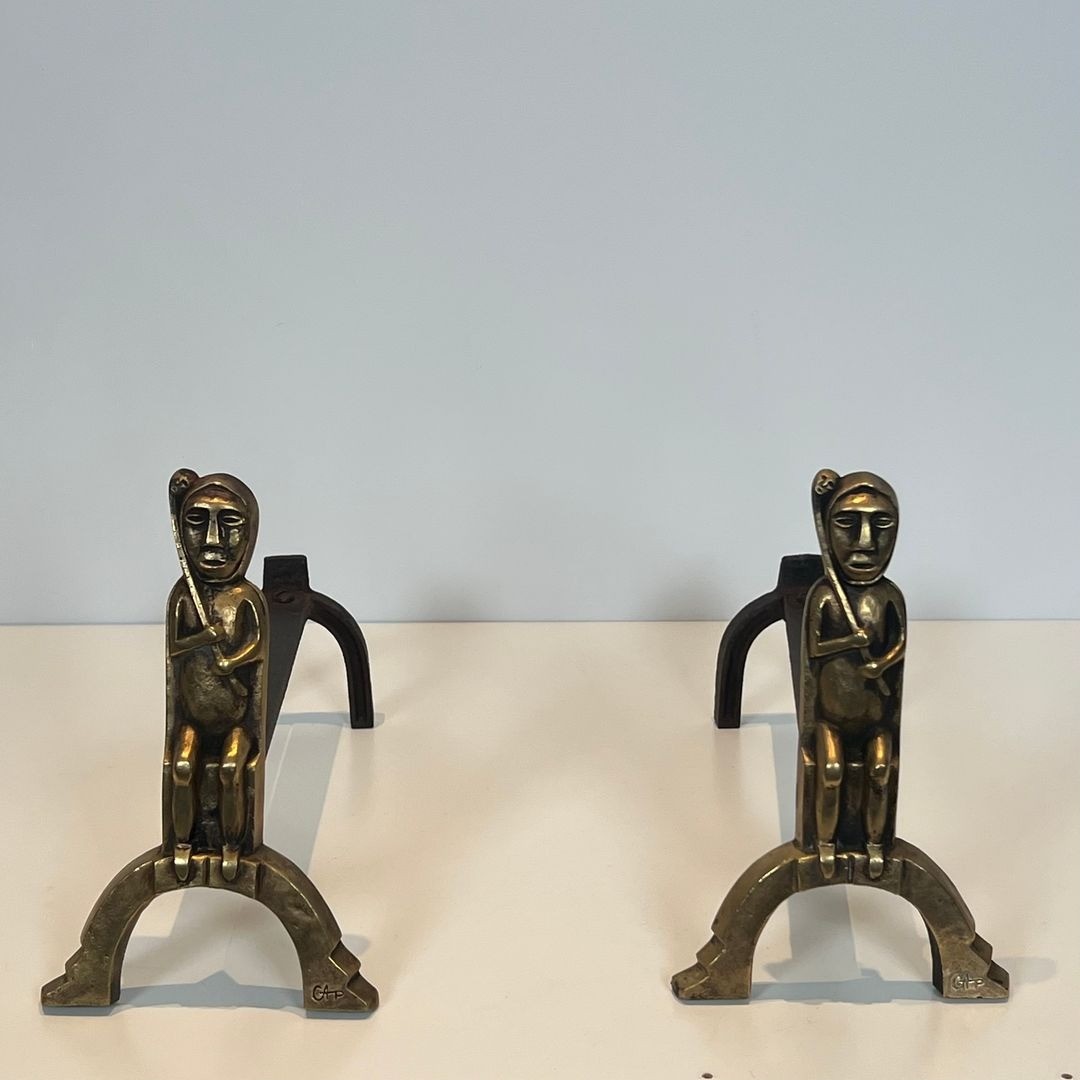
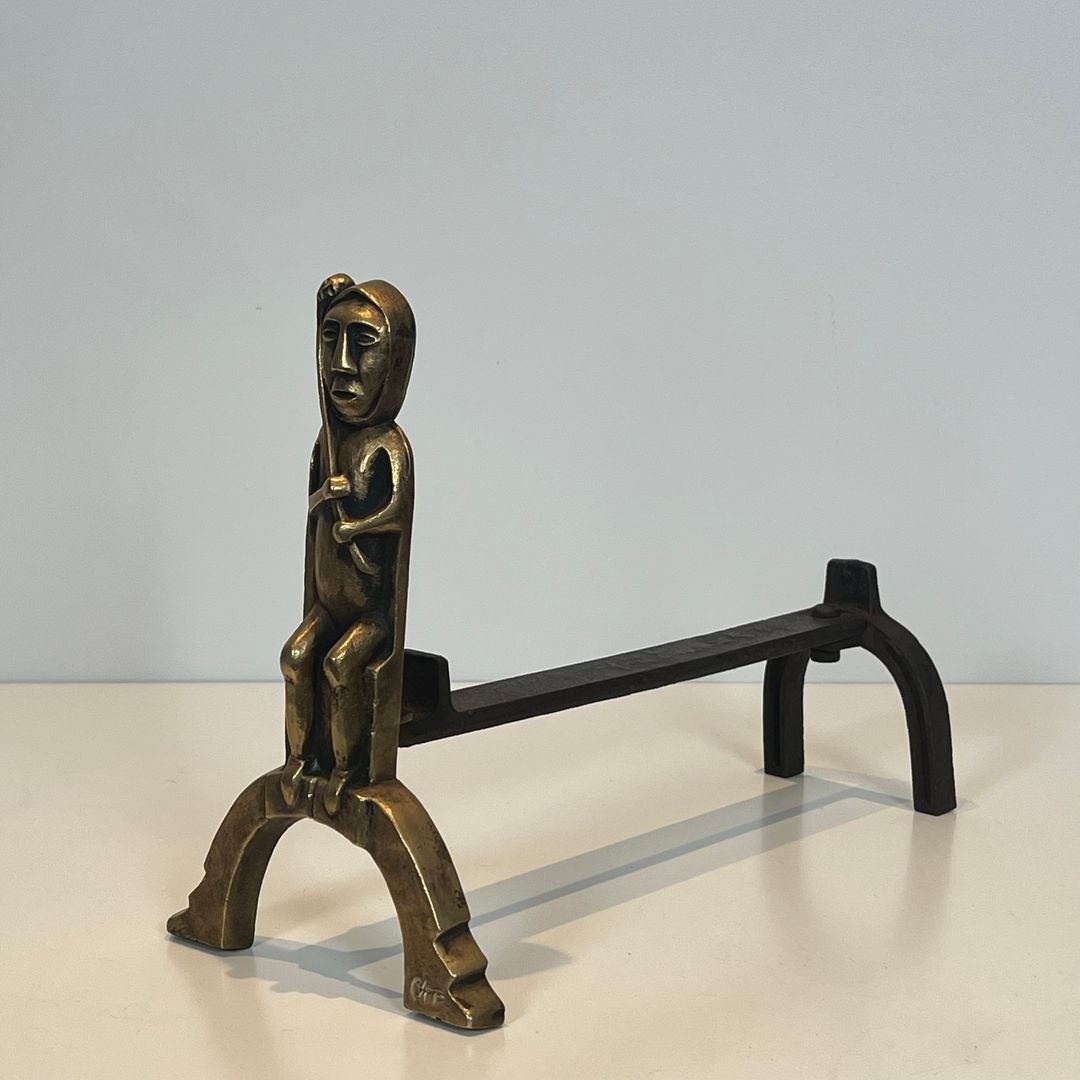
These exceptional bronze andirons represent a rare intersection of the applied arts and the Parisian sculptural avant-garde of the 1930s. Each andiron is surmounted by a compact seated figure — a shaman or ritual personage rendered in a primitivist idiom that speaks directly to the vocabulary of Anton Prinner, the Hungarian-born sculptor (1902–1983) whose monogram these pieces bear. The figures are conceived with the concentrated authority characteristic of Prinner’s work: simplified forms, summary features, a surface quality evoking the roughness of archaic bronze, and a posture of meditative stillness recalling the ritual figures of West African and pre-Columbian art that were so central to the Parisian modernist imagination of the interwar years.
Anton Prinner — born Marianne Prinner in Budapest, and subsequently living and working in Paris under the name Anton — was a singular and underappreciated figure in twentieth-century French sculpture. Closely connected to the Parisian avant-garde, exhibiting at the Salon d’Automne and moving in circles that included Picasso and the surrealists, Prinner developed a distinctive primitivist idiom that fused elements drawn from non-Western art with a deeply personal metaphysical sensibility. His bronzes are characterised by their formal density, their rejection of the academic canon in favour of an ancient and universal sculptural language, and their capacity to inhabit any space with quiet, insistent presence.
That Prinner should have turned his hand to functional decorative objects such as andirons is entirely consistent with the Parisian tradition of the applied arts, in which figures of the first rank — Braque, Giacometti, Lurçat — engaged without condescension in the creation of luxury objects for the fireplace, the table, and the interior. These shaman andirons, conceived around 1930 at the height of the European primitivist moment, translate Prinner’s sculptural language directly into the hearth object, endowing a domestic accessory with the authority and resonance of an original work of art.
Each figure is seated upon an arched bronze base from which the wrought iron log bar extends to the rear. The monogram of Anton Prinner is present on each piece, constituting a significant attribution that places these andirons firmly within the artist’s known corpus. At twenty-five and a half centimetres high, they are modestly scaled but entirely commanding in presence.