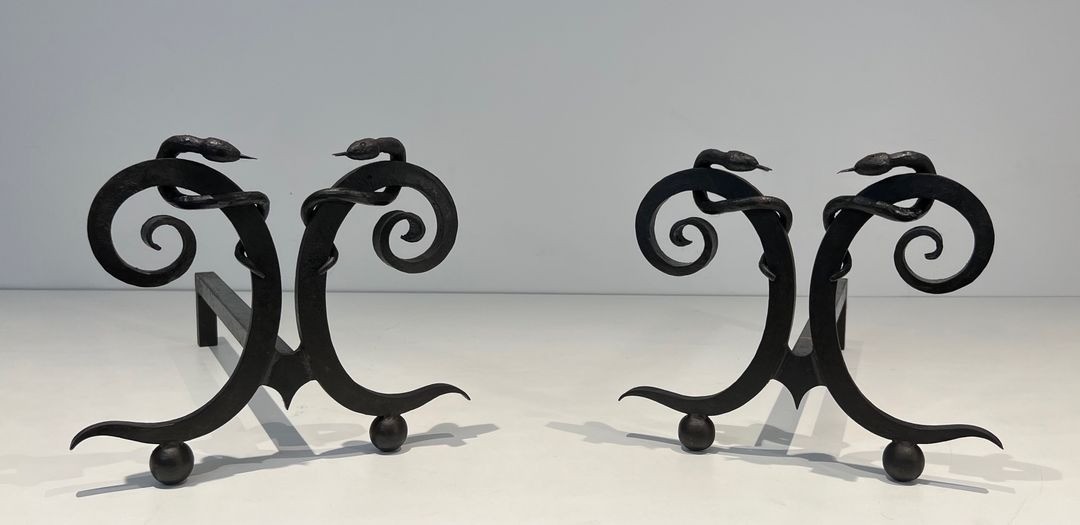
Pair of Art Deco Wrought Iron Serpent Andirons in the Style of Edgar Brandt
Pair of Art Déco wrought iron andirons in the style of Edgar Brandt, with large coiled serpent uprights — the sinuous spiral body of each serpent forming the entire andiron structure — resting on small ball feet. France. Circa 1925. W. 29 × D. 48 × H. 24.5 cm
These andirons are among the most sculptural and dramatically conceived in the French ironworking tradition, their entire form animated by the coiled body of a serpent — each upright describing a single great spiral volute in forged iron, with the serpent’s head at the apex and its tail at the base, resting on a small iron ball. The serpent is rendered with a directness and vigour that speaks to the hand of a skilled ferronniere, coiling through space with an energy that transforms what is typically an angular, static object into something of almost zoomorphic life.
This design belongs to the Art Déco vocabulary developed by Edgar Brandt (1880–1960), the most celebrated French ironworker of the early 20th century, whose work fused the fluidity of Art Nouveau nature ornament with the geometric discipline of Art Déco. Brandt’s serpent motif — appearing in several of his documented works including lamp bases, consoles, and fireplace accessories — was one of his most distinctive personal signatures. Andirons of this type were produced in his atelier during the 1920s and in imitation of his manner for several decades thereafter.
The serpent as a motif in French decorative arts carries rich symbolic resonance, from the mythological serpents of Antiquity to the serpent de la Sagesse of the Masonic and esoteric traditions fashionable among the educated bourgeoisie of the Belle Époque and Art Déco generations.
Objects of rare formal energy and decorative character, these andirons would enrich any interior in which the sculptural power of French ironwork at its apogee is celebrated.