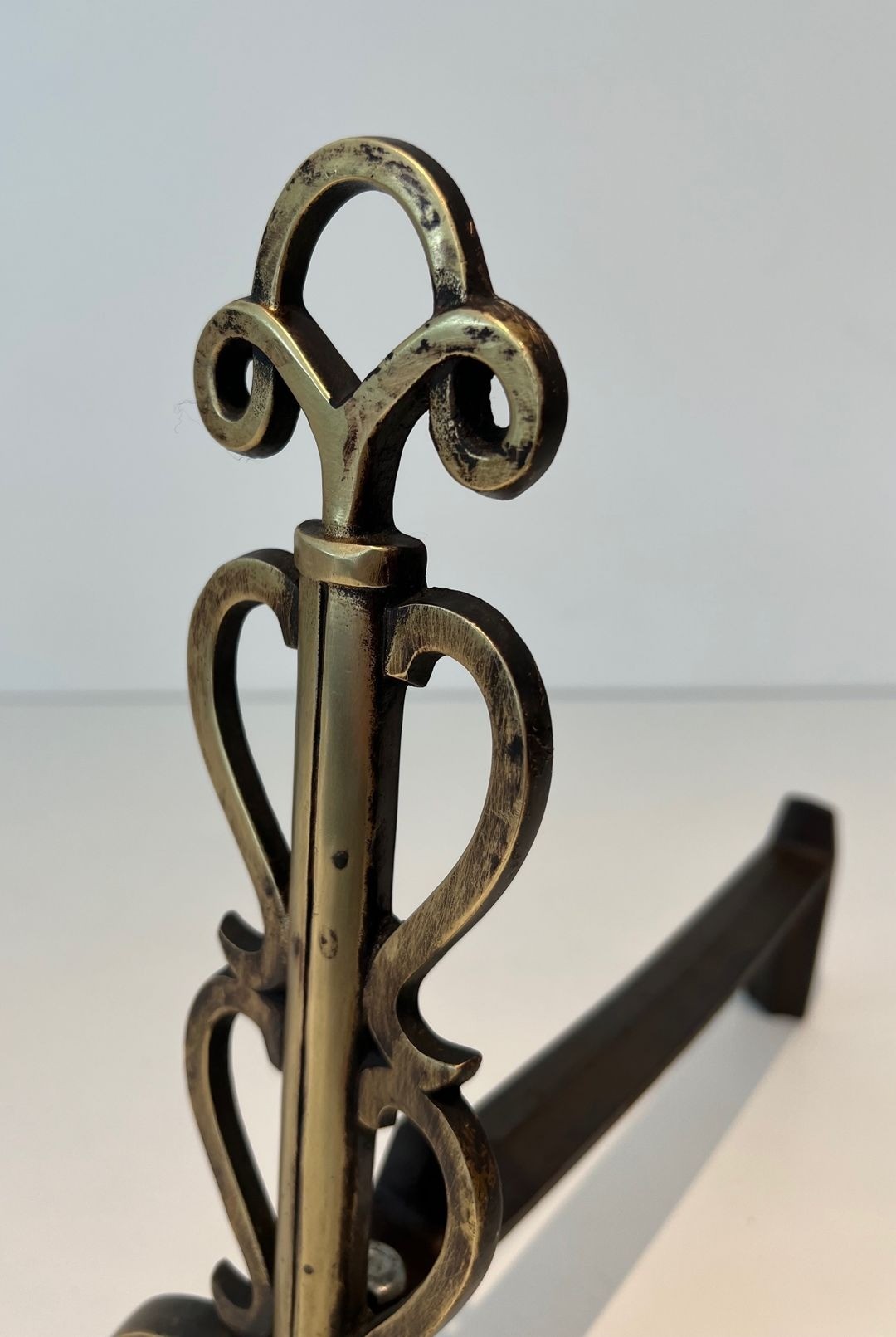
Pair of Brass and Iron Andirons with Triple-Scroll Finials and Lyre-Form Uprights, in the Style of Raymond Subes
Pair of brass and wrought iron andirons in the style of Raymond Subes, each upright featuring a central lyre-form motif with flanking scrollwork and a triple-scroll finial, set on semicircular arched bases. France. Circa 1940.
This refined pair of brass and wrought iron andirons demonstrates the formal intelligence and decorative inventiveness that characterise the finest Art Déco ironwork produced in France in the period around 1940. Each piece is composed around a central vertical upright whose decorative programme unfolds in a sequence of carefully designed motifs: at the base, a semicircular arch rests on the hearth; from this rises the decorated shaft, whose central register features a large enclosed lyre or heart form flanked by paired scrolls; and above this, the shaft continues to a crowning triple-scroll finial of three curling tendrils — a motif of great elegance that echoes the scroll vocabularies of Louis XVI ironwork while remaining unmistakably of its own modernist moment.
The attribution to the manner of Raymond Subes is apt: this is precisely the formal register in which Subes and his circle operated, translating the classical language of European decorative metalwork into a contemporary idiom that was original without being merely fashionable. The enclosed lyre form at the centre of each upright is a device with a long history — from Rococo furniture mounts to Empire ormolu — here stripped of its historicist weight and rendered in the language of controlled organic abstraction that defines Art Déco metalwork at its best.
The material — a combination of brass and wrought iron — is handled with the assurance of a mature craftsman. The brass elements contribute their characteristic warm gilded tone, while the iron provides structural solidity and a formal contrast that prevents the piece from becoming merely decorative. The patina that has developed on the surface of both metals has unified the overall tone, lending the pair a quiet antiquity.
At 33.5 cm high, these are andirons of intimate scale, suited to a domestic fireplace of moderate proportions. Their compact format concentrates rather than disperses the formal richness of the composition, making them as effective as objects of decorative interest as they are as functional hearth furniture.