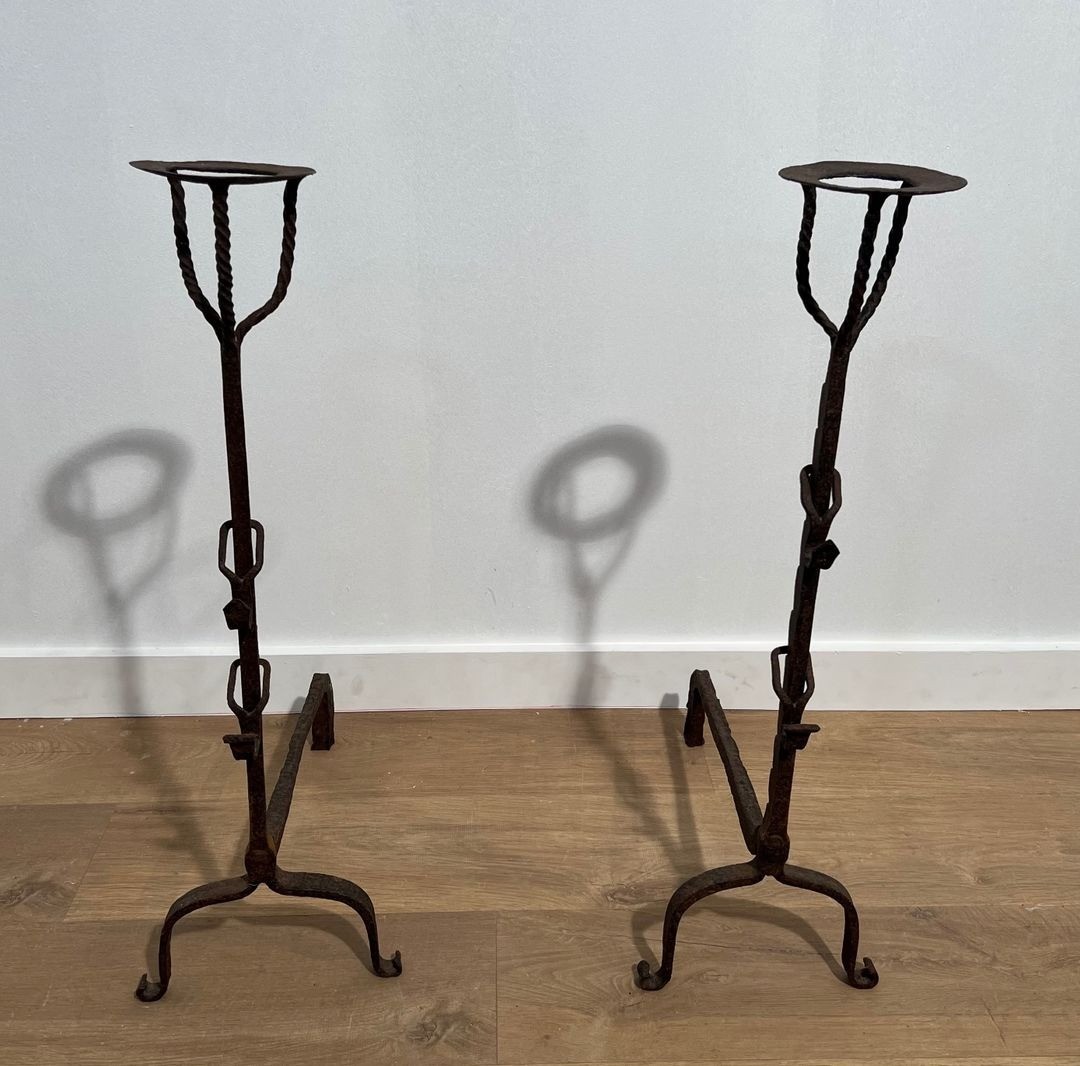
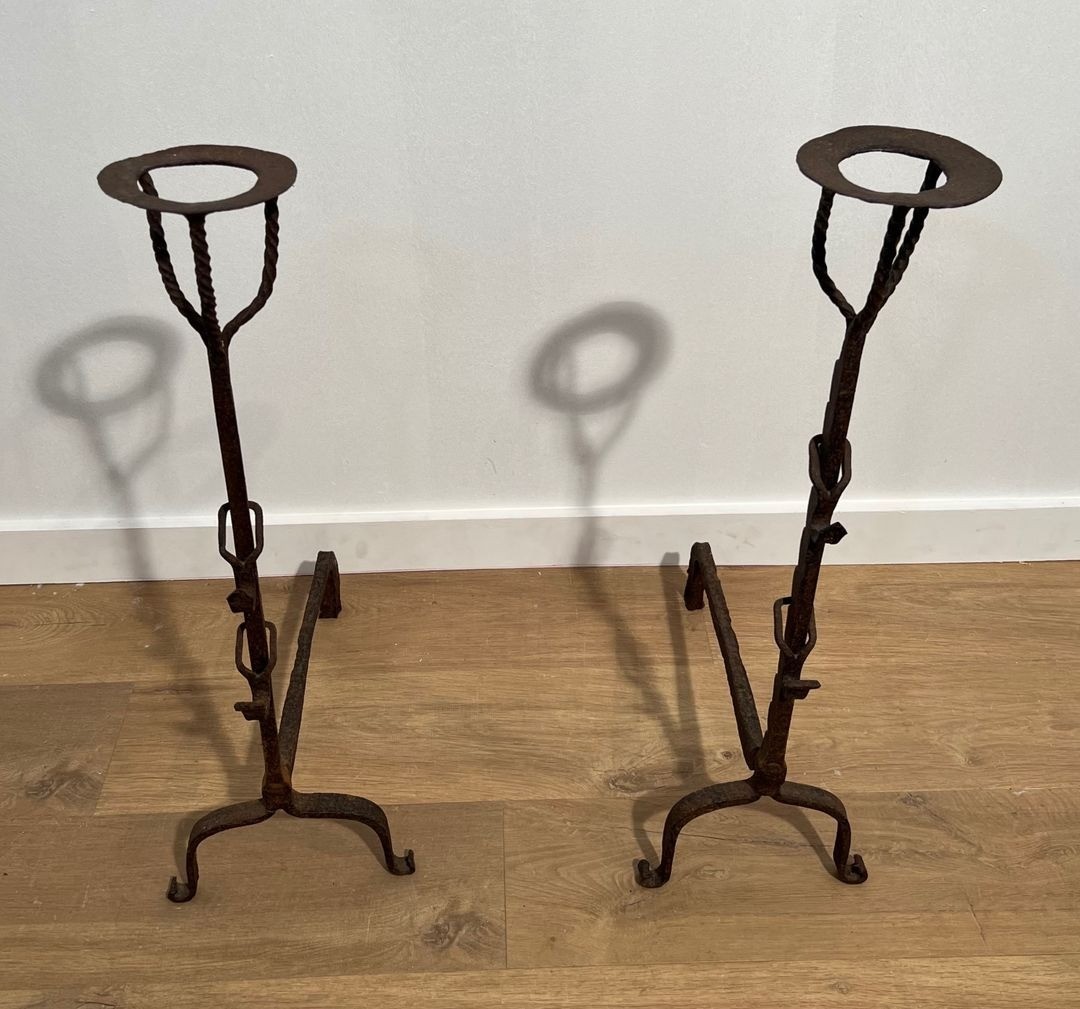
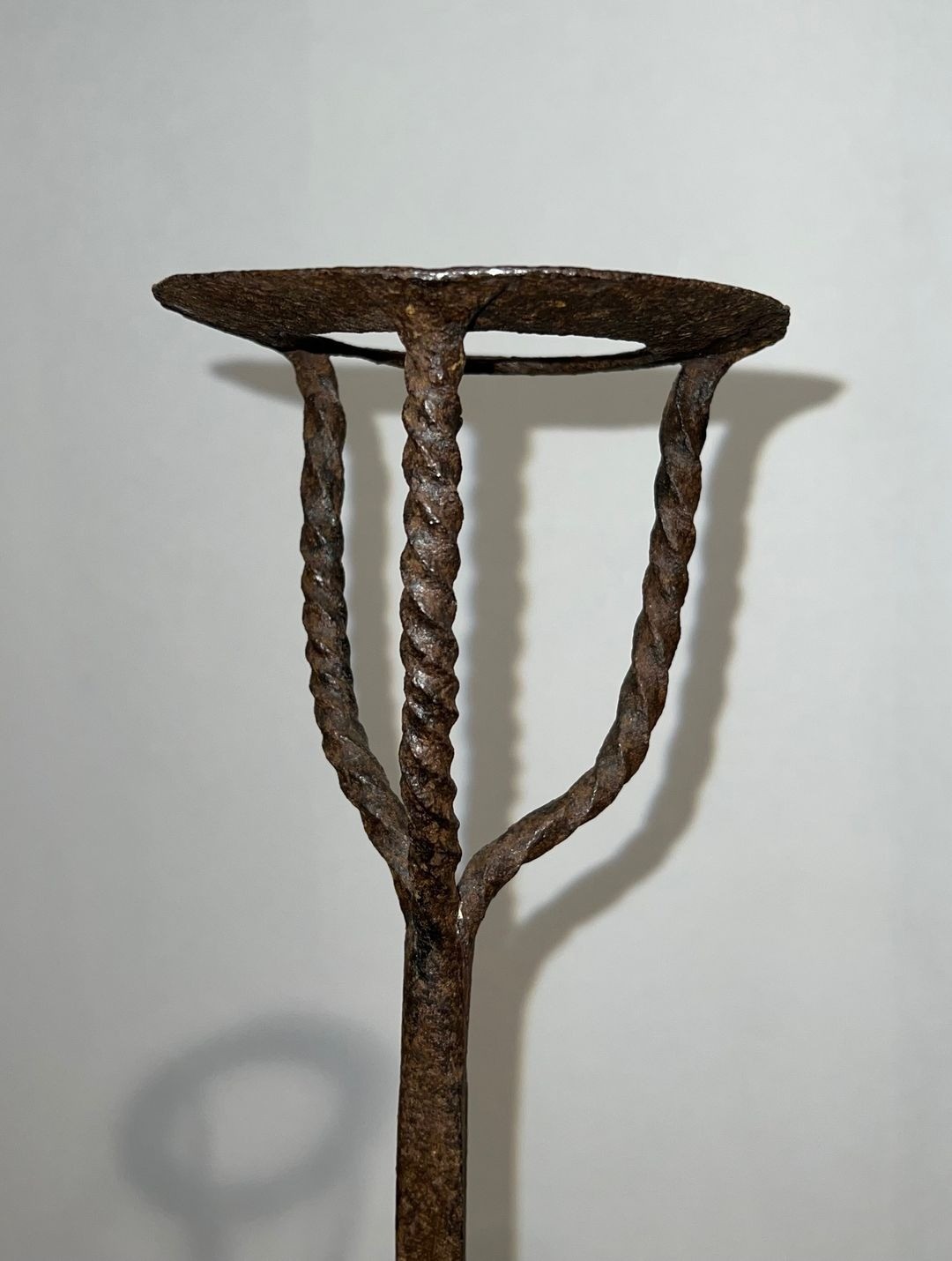
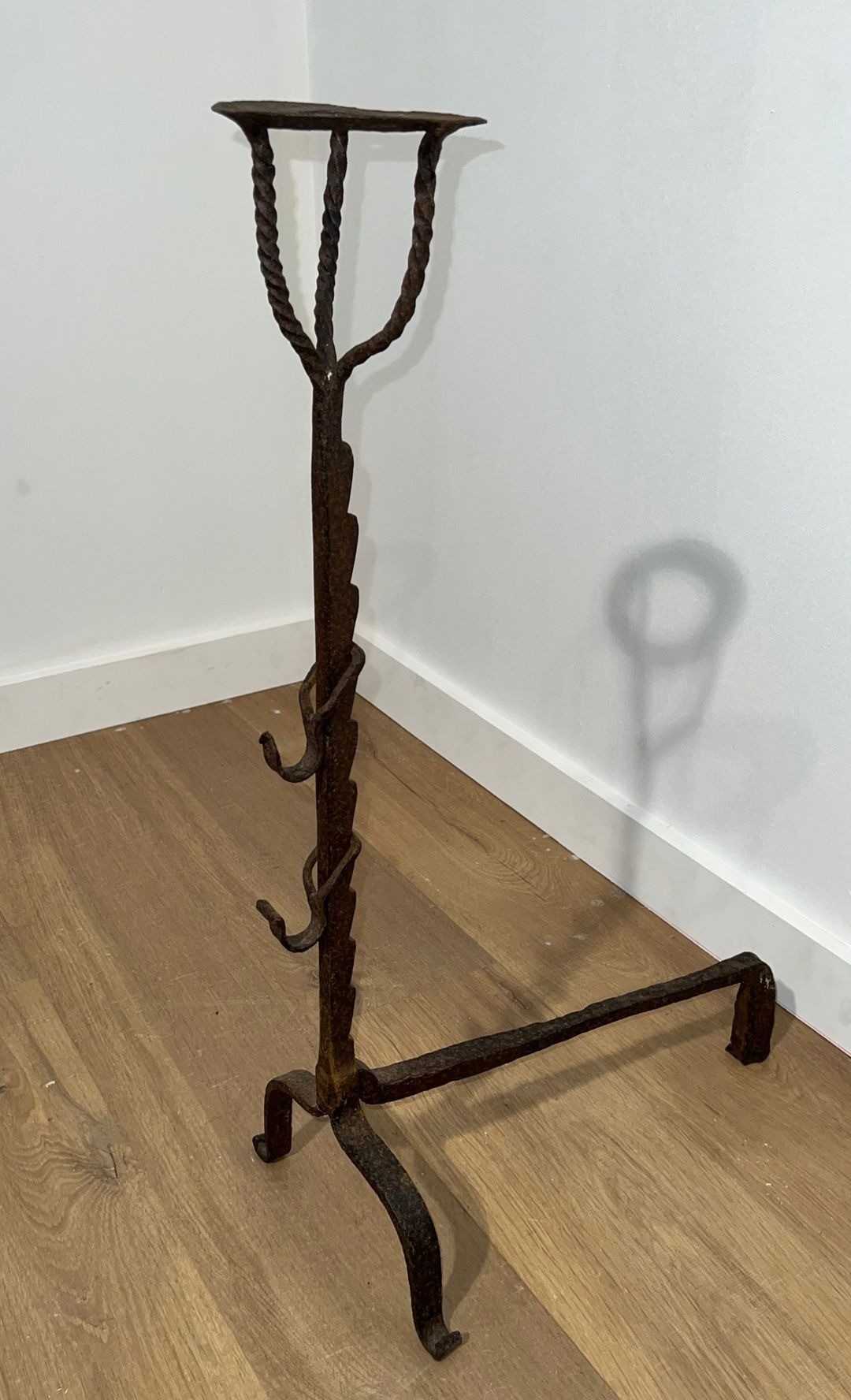
These are landiers in the fullest and most ancient sense of the word — the great working andirons of the French farmhouse and manor kitchen, instruments of domestic economy as much as objects of craft, their architecture determined entirely by the imperious demands of the open-hearth cooking traditions of pre-industrial France. At 74 cm high, this pair commanded the grandest of rural hearths, their tall ratcheted uprights supporting cooking vessels at precisely the height required to achieve the slow simmer or vigorous boil that the preparation of the day’s food demanded.
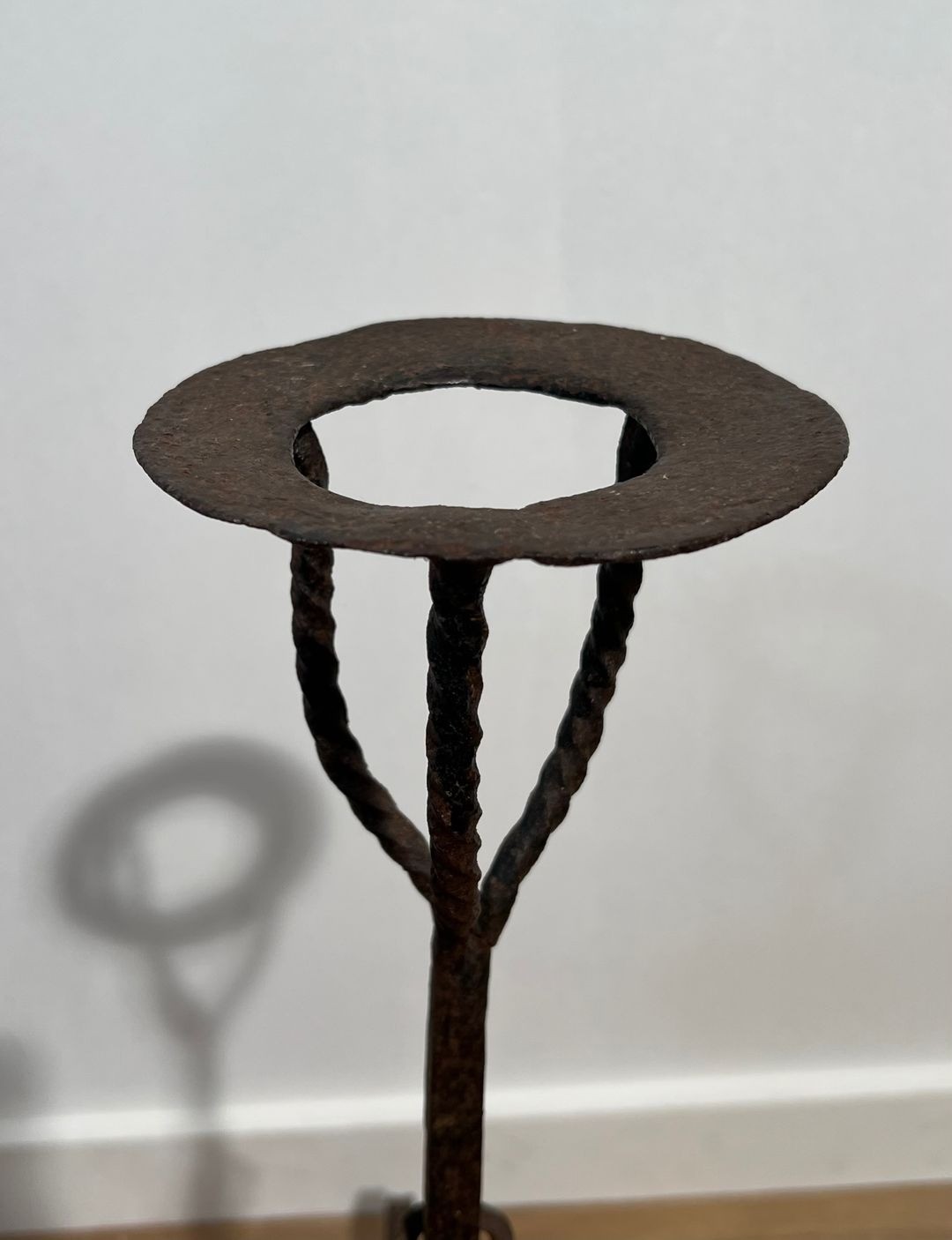
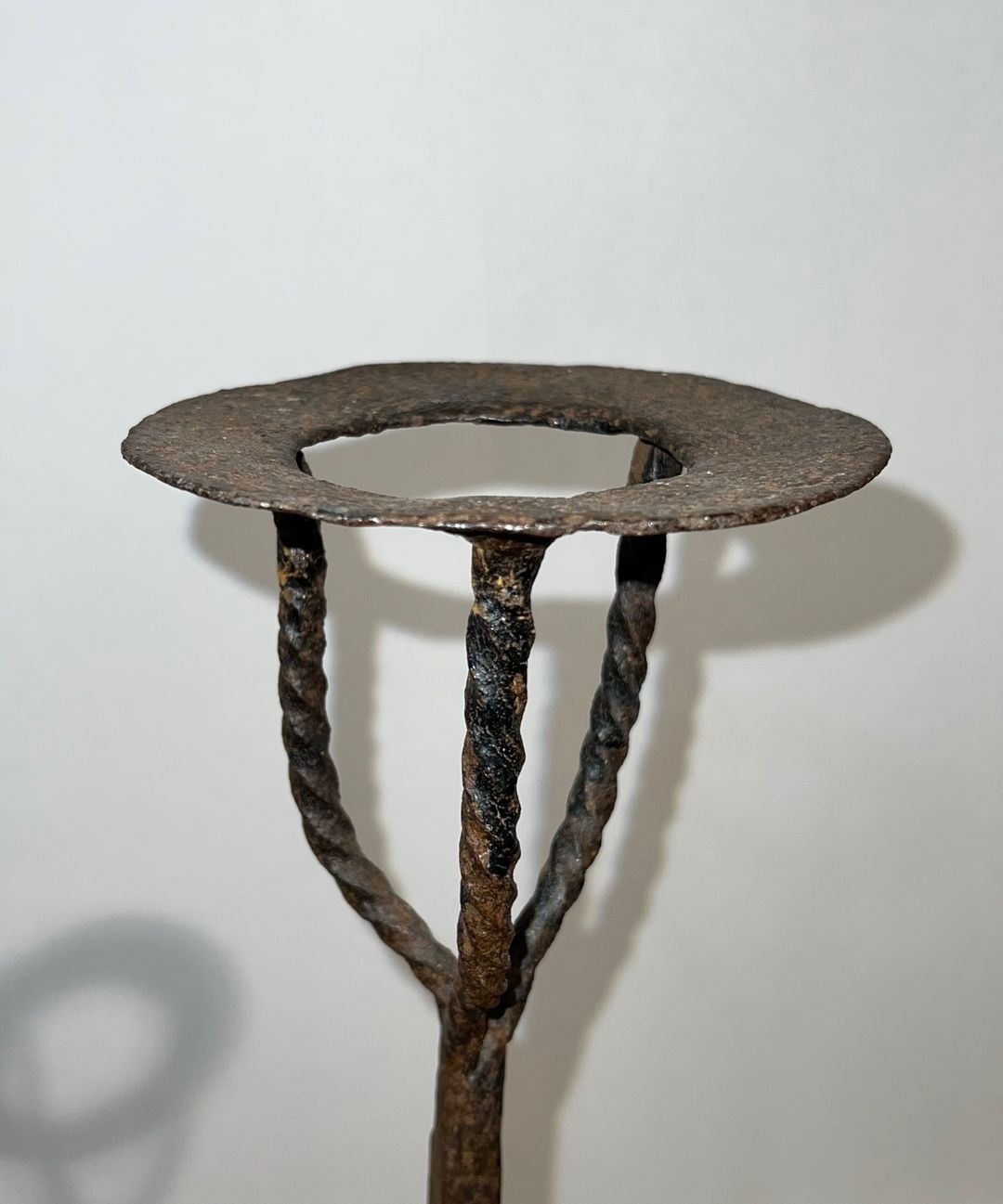
The defining element is the wide circular ring crown at the summit of each upright — the “couronne porte-marmite” or pot-ring — a broad iron disc whose inner aperture accommodated the base of a cauldron, pot, or crock, holding it securely above the flames. This feature, absent from the purely decorative “chenet” that furnished the drawing-room fireplace, immediately identifies the landier as an object of the working kitchen. The twisted uprights serve a dual purpose: their spiral profile gives visual interest and structural rigidity to a shaft that might otherwise deflect under the weight of a laden cauldron, while the ratchet mechanism allows the ring height to be adjusted as needed. An iron hook suspended from the side of each shaft provided a convenient point for hanging ladles, skimmers, and other implements.
Forged in blackened wrought iron, the patina is deep, warm, and entirely consistent with nearly three centuries of use by the hearth — smoke-darkened, heat-hardened, and worn smooth at the points of most frequent contact. This is the authentic surface of a working tool of the ancien régime, untouched by restoration, and all the more compelling for it. The feet splay outward with the confident irregularity of hand-forged work, each slightly different from the other, evidence of a blacksmith who understood both the aesthetic and the functional requirements of his craft.
Rare in their completeness and excellent preservation, these landiers would be extraordinary in a large period fireplace with stone surrounds, particularly in a mas provenal, a maison de maître, or any interior in the French provincial tradition. They are equally compelling as sculptural objects, their silhouettes of considerable graphic authority against a contemporary white wall or within a loft conversion that values the raw power of authentic historical craft.