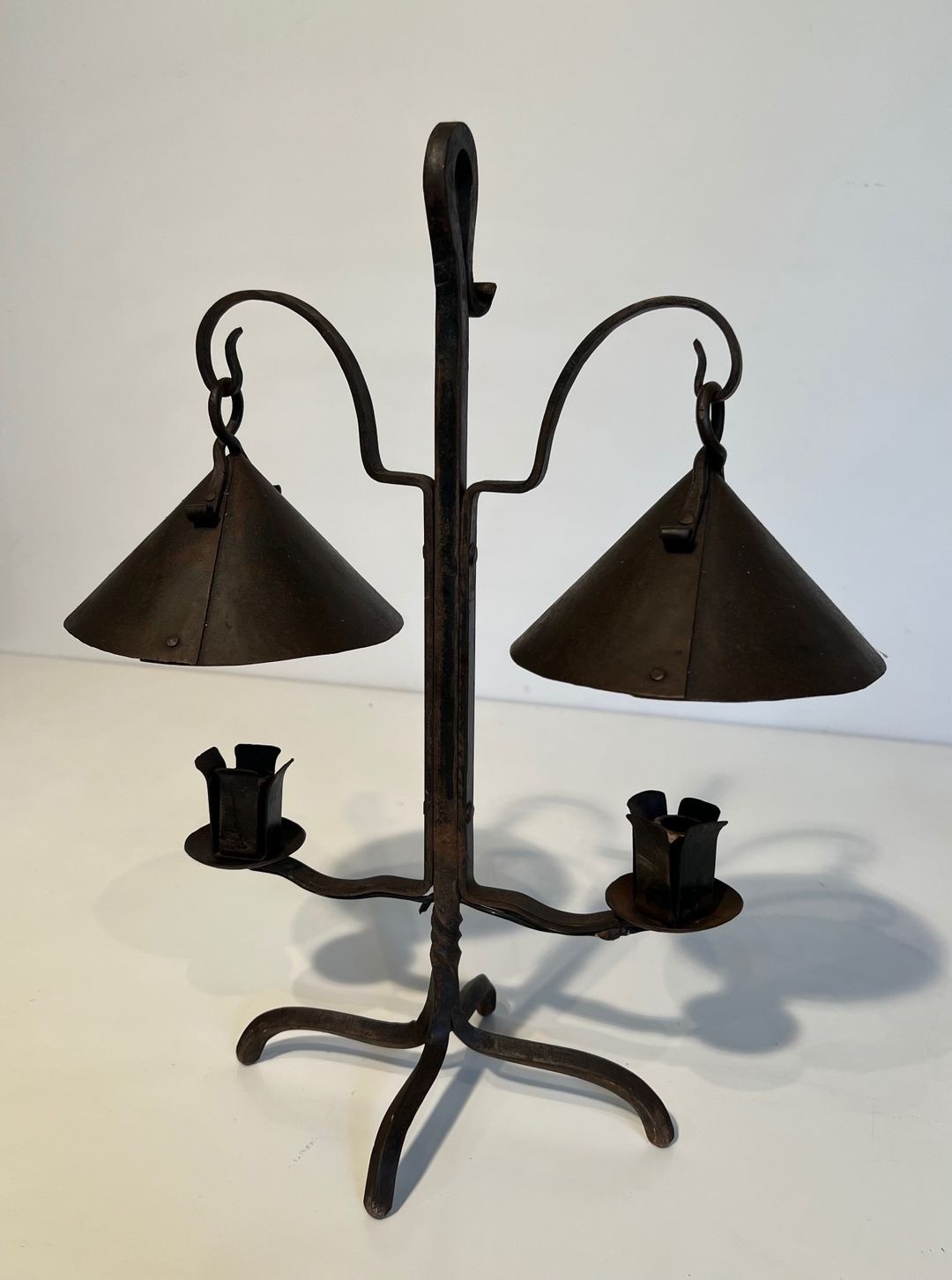
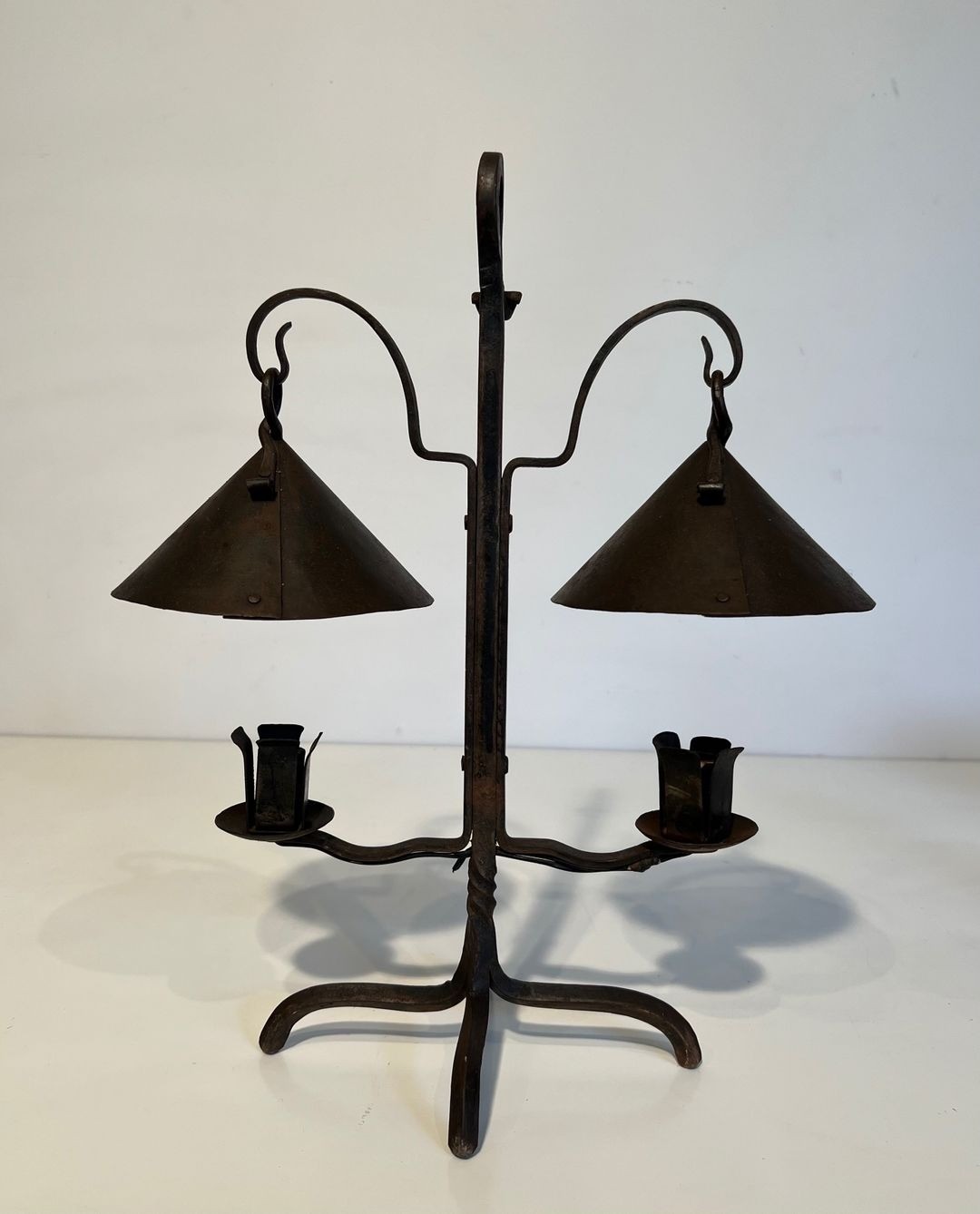
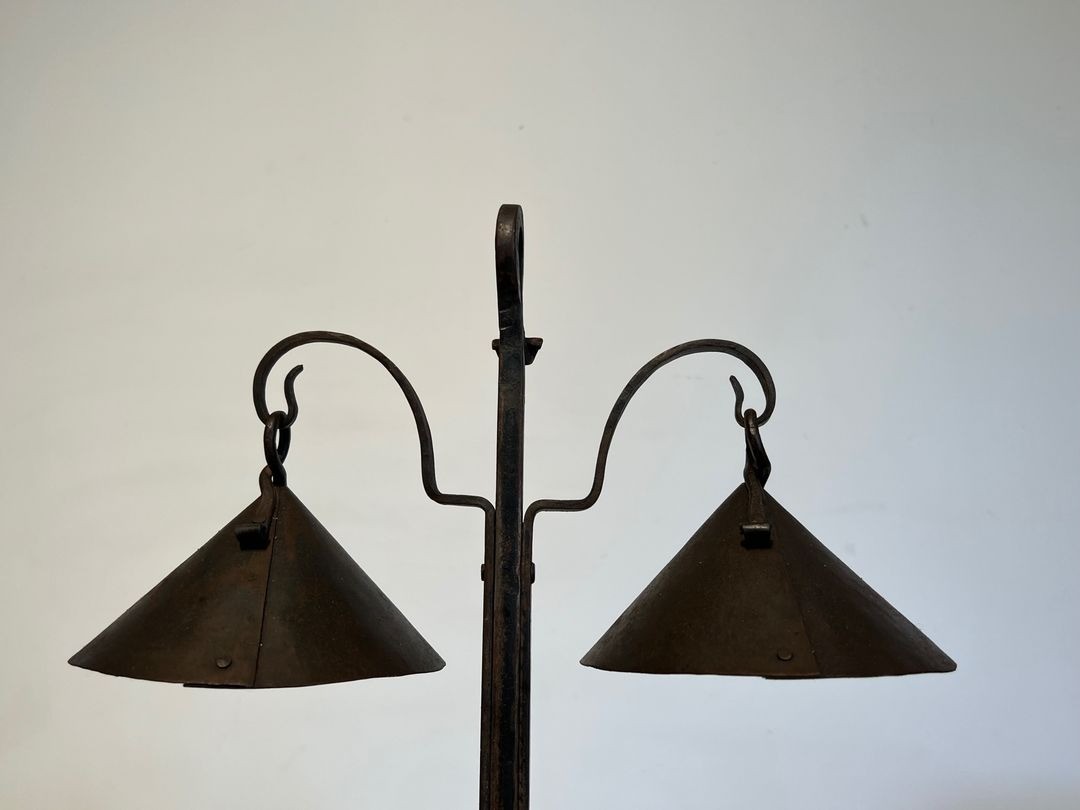
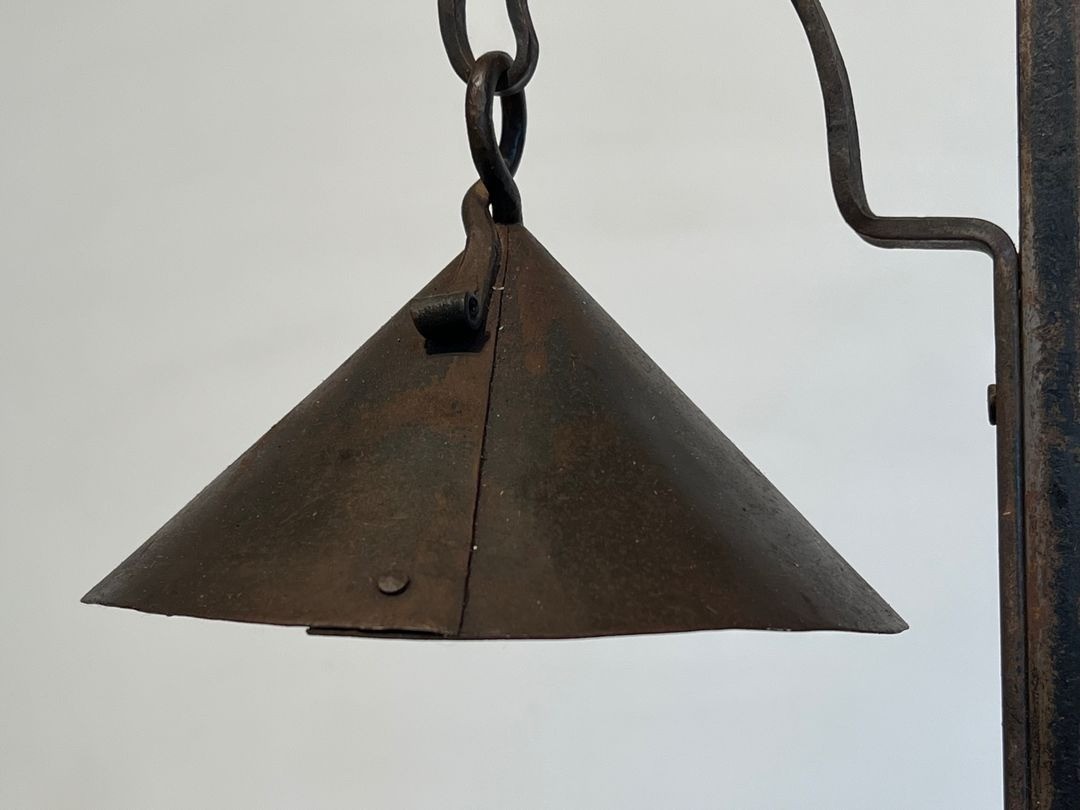
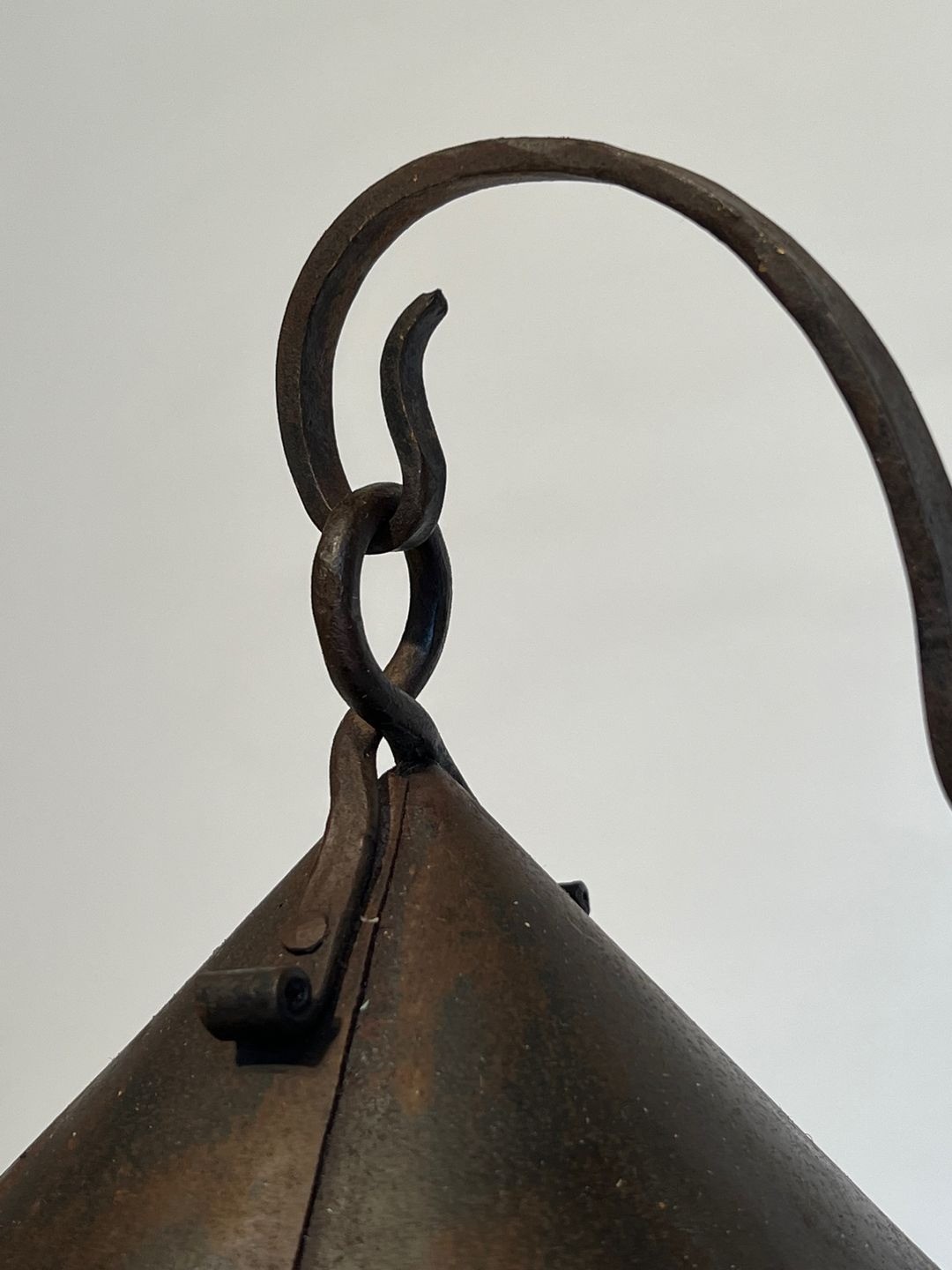
This wrought iron candlestick, its two arms branching symmetrically from a central standard, exemplifies the mid-century French approach to craft metalwork: restrained in its use of ornament, confident in its formal geometry, and precise in its technical execution. Each arm terminates in a conical cup riveted to the branch — the rivets visible, deliberate, and almost industrial in their frankness — a detail that speaks less of the decorative ironwork tradition and more of the modernist conviction that construction itself can be decoration. At 44 centimetres tall it is a piece scaled for intimate spaces: a dining table, a console, a windowsill.
The wrought iron tradition in France experienced one of its great renewals in the decades between the wars and continuing into the 1950s. Under the influence of Art Déco designers such as Edgar Brandt and Raymond Subes — who demonstrated that wrought iron could be a medium for sculptural precision as well as structural expression — and later of the architects and designers associated with French postwar reconstruction, a generation of French blacksmiths produced objects that combined craft authority with a new formal economy. The riveted conical cup that characterises this candlestick belongs to this vocabulary of rational, non-historicist ironwork: a functional answer to the problem of how to hold a candle, arrived at by the logic of the material itself.
A two-light candlestick of this character is one of the most versatile objects in the interior: it provides just enough candlelight for an intimate dinner without the grandeur of a full candelabra; it reads as a pure sculptural presence on a console or mantel; and its blackened iron finish relates effortlessly to every decorative context, from a rustic Norman farmhouse to a minimalist Paris apartment. The riveted conical cups ensure that candles of virtually any diameter can be accommodated. Well-made French ironwork from this period is increasingly appreciated by collectors.