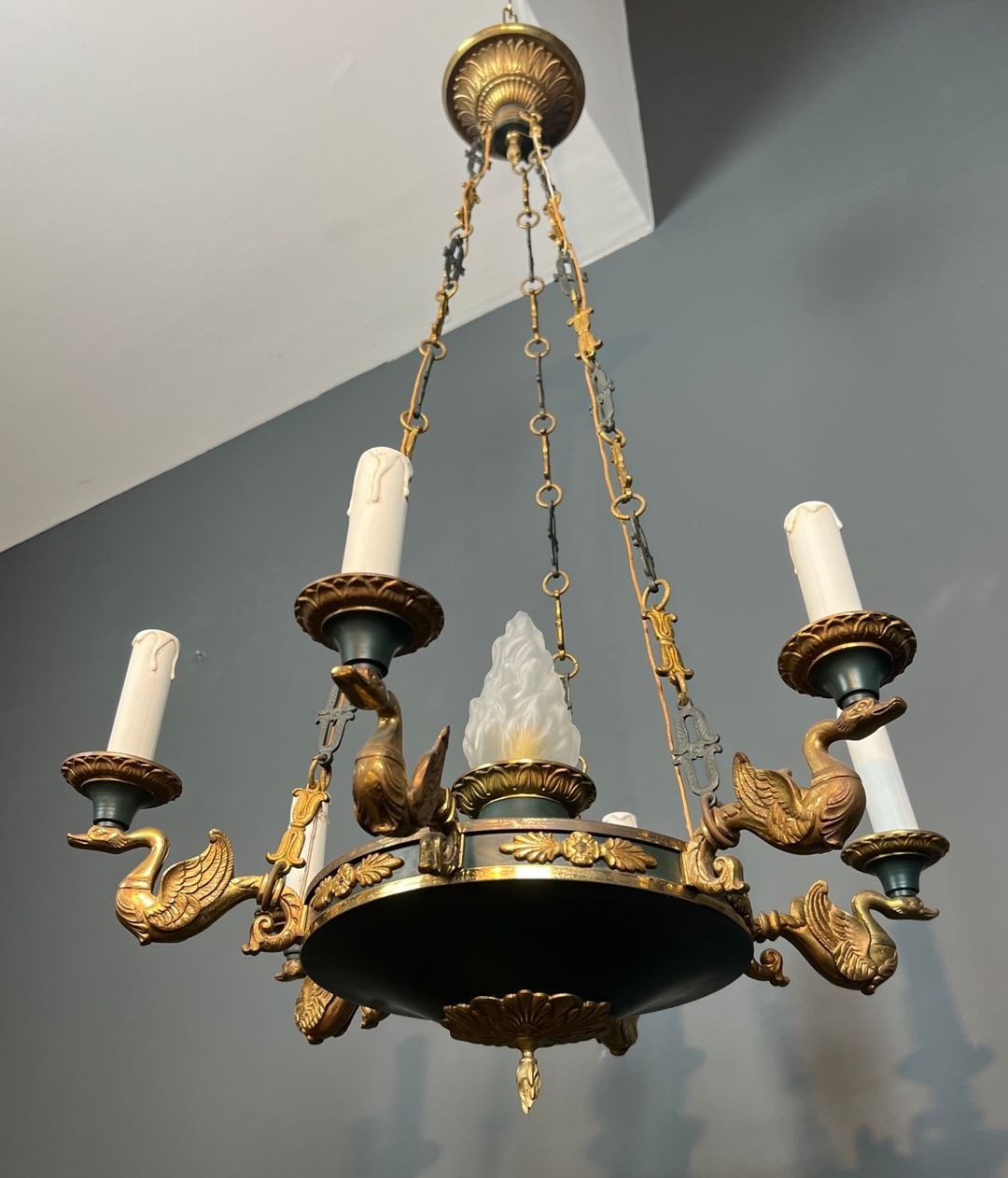
The Empire style, born of Napoleon Bonaparte’s ambition to create a visual language commensurate with the grandeur of his reign, drew heavily on the archaeology of antiquity — Egypt, Greece, and Rome — and translated its vocabulary into a grammar of furnishings of remarkable coherence and authority. Commissioned by the Emperor’s architects Percier and Fontaine and executed by the finest craftsmen of early-nineteenth-century Paris, the style was disseminated across Europe with extraordinary speed and endurance, inspiring wave after wave of revivalist production well into the early twentieth century. This chandelier, dateable to around 1920, belongs to this tradition of sophisticated revival: a French workshop piece faithfully reproducing the forms and materials of the original movement.
The chandelier is composed of green-painted sheet metal — tôle peinte, a material beloved of Empire interiors — combined with gilt bronze mounts of considerable finesse. Swan-neck arms, palmette ornaments, and the characteristic use of antique-derived motifs bespeak a craftsman thoroughly versed in the Empire vocabulary. The whole is surmounted by a moulded glass flame, an elegant neo-classical device that both recalls antique torch finials and discreetly conceals the electrical fitting. At 55.5 centimetres in diameter and 102 centimetres in height, the chandelier commands space with authority.
French Empire revival chandeliers of this calibre occupy a distinguished place in the decorating tradition: they appear in the canonical interiors illustrated by the great early-twentieth-century decorators, and have never ceased to find admirers among those who value the combination of historical rigour with decorative splendour. This example, well-preserved and of fine quality, would serve equally as a centrepiece in a period interior or as a statement accent in a more contemporary setting.