The eagle occupied the supreme position in the symbolic vocabulary of Napoleon Bonaparte’s Empire, drawn simultaneously from Roman imperial iconography — the aquila of the legions — and from the tradition of sovereign heraldry that had made it the emblem of kings and emperors since the Holy Roman Empire. Under the direction of Percier and Fontaine, Napoleon’s court architects, the eagle was applied to every surface and in every medium of the Empire interior: carved in stone on architectural friezes, cast in bronze on furniture mounts, embossed in silver on tableware, and worked in ormolu on the arms of candelabra and chandeliers. Its presence on a piece is thus both a declaration of stylistic allegiance and a direct quotation of the most assertive visual culture of early-nineteenth-century France.
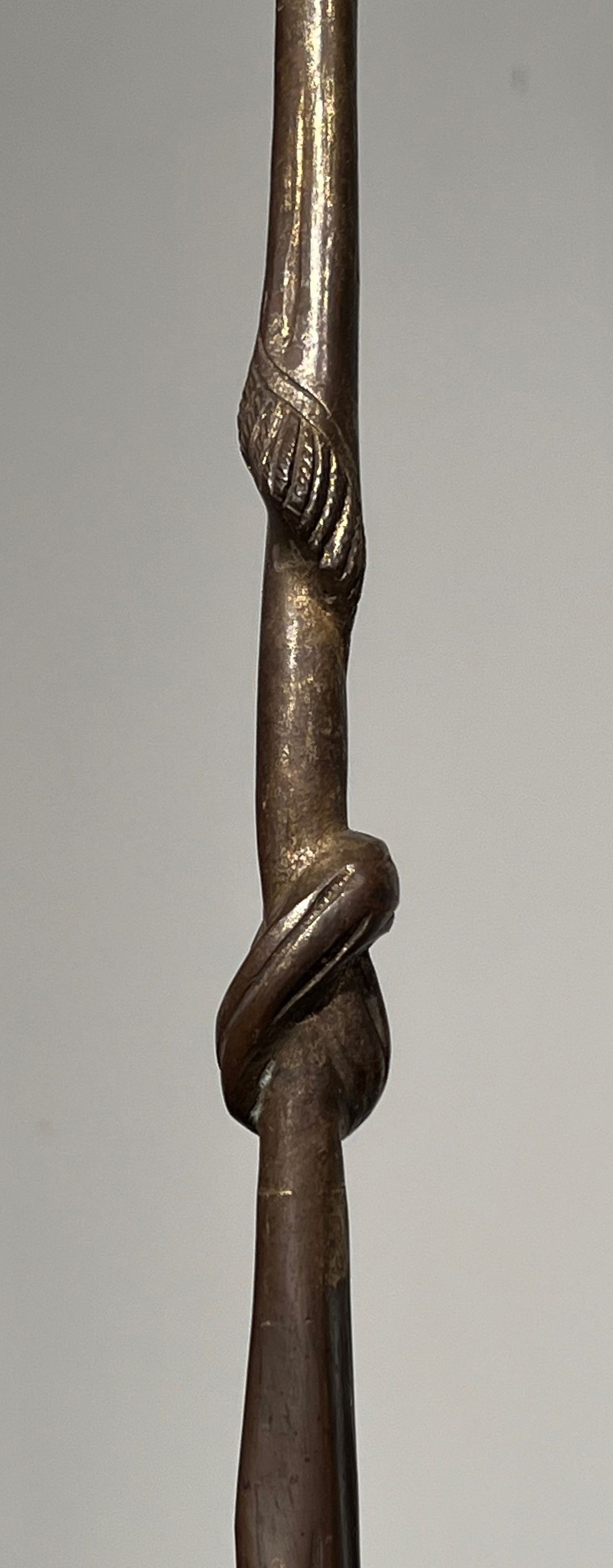
This three-light bronze chandelier, with eagle-head finials crowning each arm, represents the Empire revival tradition at its most characteristic and refined. The bronze casting is of evident quality — the eagle heads naturalistically modelled, each seizing its arm with appropriate authority — while the overall composition, tall and slender at 35 by 76 centimetres, has the vertical elegance that distinguishes the finest French Empire pieces from heavier Continental interpretations. The three-light form, intimate yet complete, is well-suited to a study, dining alcove, or small salon.
French Empire revival bronzes of the period 1900–1920 represent a sustained and technically accomplished production, drawing on the same foundries and artisans who had produced some of the greatest objects of the previous century. Collected for their combination of historical intelligence and material quality, they bring to any interior a sense of the French decorative tradition at its most disciplined and authoritative.