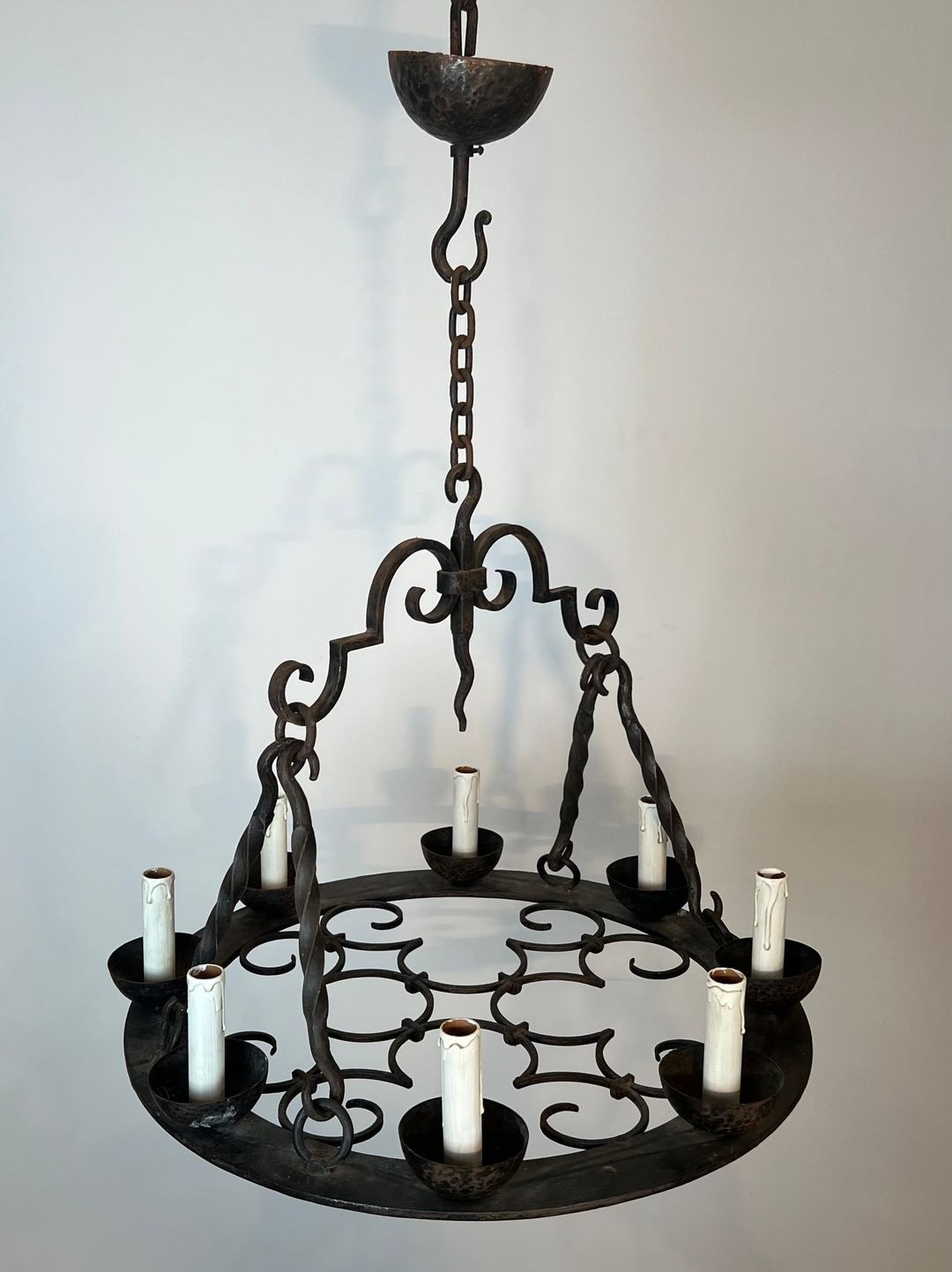
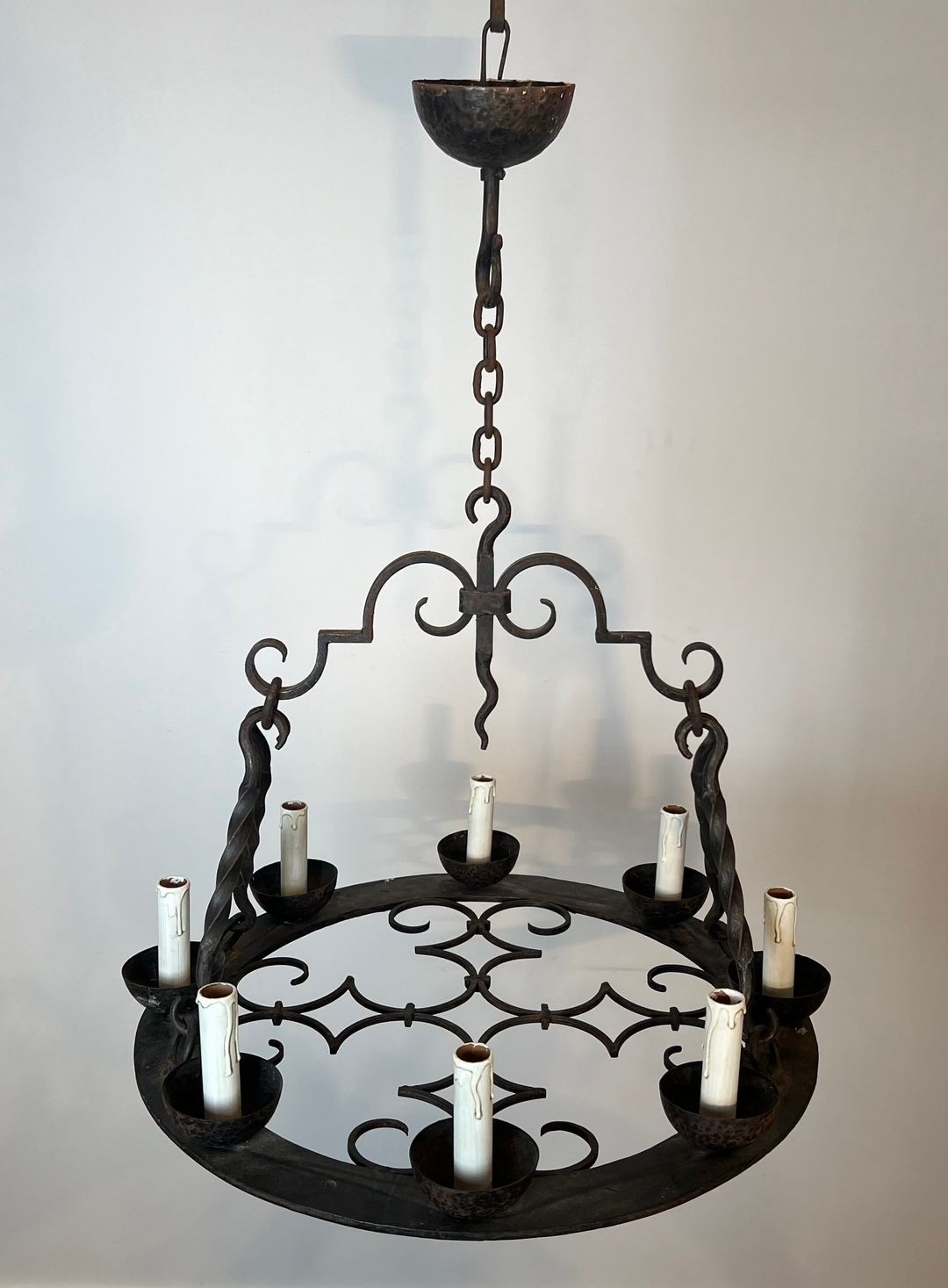
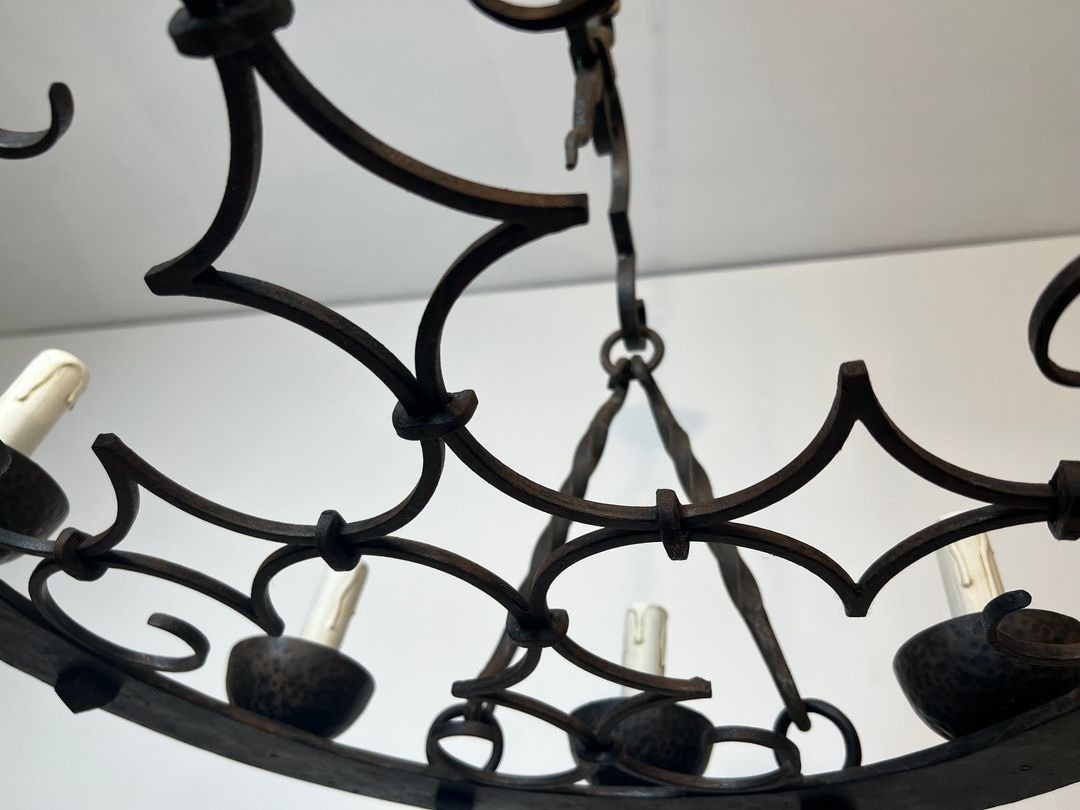
Formed as a circular wrought iron ring from which eight candle-arms radiate in the manner of a medieval corona, this chandelier from circa 1950 draws directly on one of the most ancient forms of European communal lighting. The round horizontal body, hand-forged in iron with the slightly irregular surface texture that distinguishes artisan work from industrial production, supports a series of outward-curving arms in the Gothic manner, each terminating in a simple candle cup. The composition has the spare, honest authority of medieval ecclesiastical furnishings: no ornamentation beyond what the forged metal itself provides, yet complete and assured in its visual effect.
The circular ring chandelier — known in medieval Latin as the corona lucis, or crown of light — is among the oldest forms of interior lighting still in continuous production. First documented in Carolingian manuscripts and surviving in magnificent examples at the cathedrals of Hildesheim and Aachen, the corona lucis became the standard chandelier form of Romanesque and Gothic churches across Europe. By the Gothic revival of the nineteenth century, the form had been reintroduced into French domestic and religious interiors, its austere elegance providing a counterpoint to the more ornate bronze chandeliers favoured in aristocratic settings. The mid-twentieth century saw French ironworkers continue this tradition with particular conviction, producing ring chandeliers of great refinement for the châteaux, abbeys and rural manor houses that embodied the aspirational ideal of French country living.
This chandelier presents with the pleasingly honest character of genuine hand-forged ironwork: the metal dark and warm, the surface carrying the subtle marks of hammer and anvil that no reproduction can simulate. The height of 80 cm combined with a width of 62.5 cm gives the piece impressive vertical presence, well suited to an entrance hall, a staircase landing or a medieval-spirit dining room where it will cast its eight pools of warm light with timeless simplicity. A distinguished example of mid-century French Gothic revival ironwork.