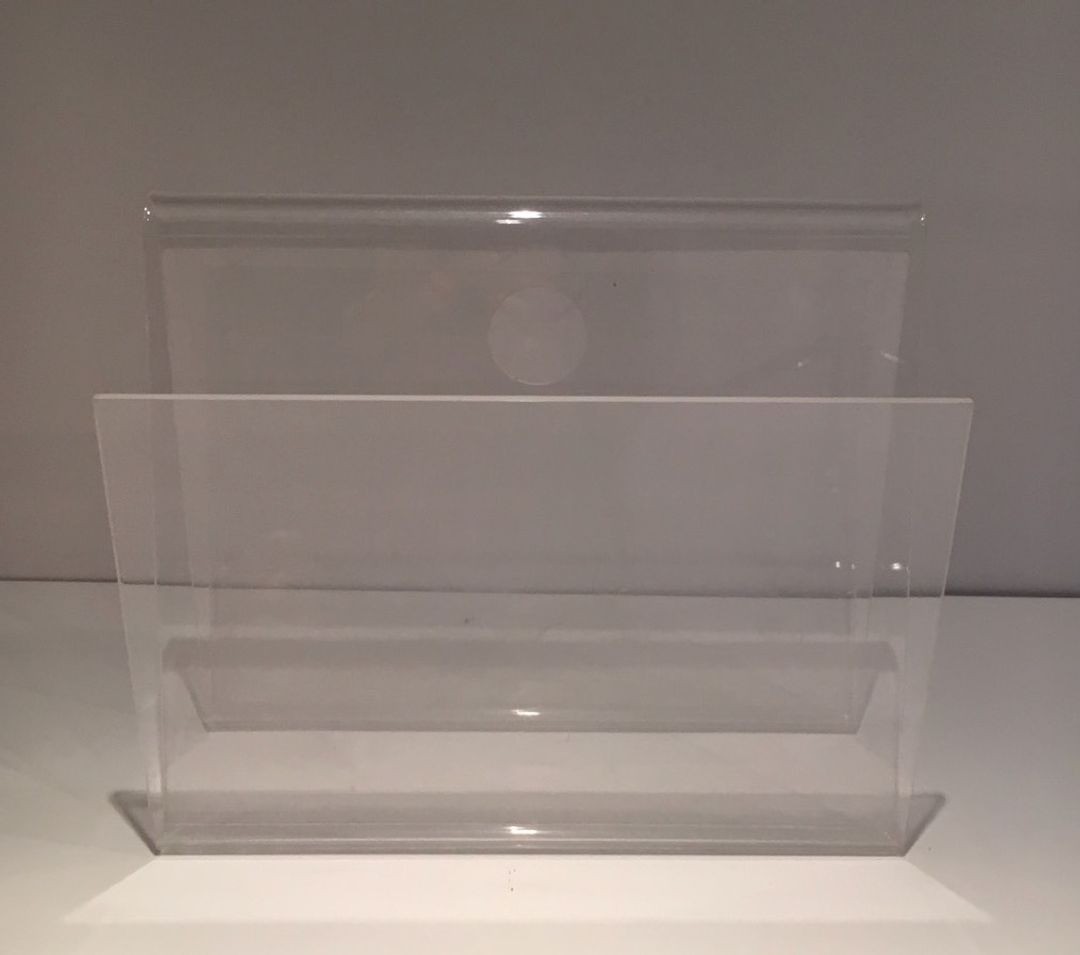
In the 1960s and 1970s, plexiglass — the synthetic transparent acrylic that had been developed for industrial purposes in the 1930s — was embraced by French and international furniture designers as the material of choice for a Space Age domestic aesthetic. Applied to every category of household object, from seating and lighting to storage and accessories, it promised a modernity that was both literal and philosophical: literal in its newness as a material, philosophical in its denial of the object’s own visual weight.
Applied to a magazine rack, transparency acquires a particular elegance of logic. The magazine rack exists to hold printed matter — objects whose entire raison d’être is visual communication, whose covers and headlines are designed to attract the eye. A transparent plexiglass rack erases the container so that the contents step forward unimpeded: the object steps aside, and the magazines float in space, held but invisible. This self-effacement of the functional object in favour of its cultural contents is the defining conceit of this piece.
The compact proportions (W. 40 × D. 24 × H. 34.5 cm) suggest placement beside an armchair or on a low table, its contents within easy reach of a seated reader. The flat format suited the broadsheet periodicals of the era — Paris Match, L’Express, Jours de France — whose vivid illustrated covers, seen through the transparent walls of the plexiglass, became the object’s only ornament.