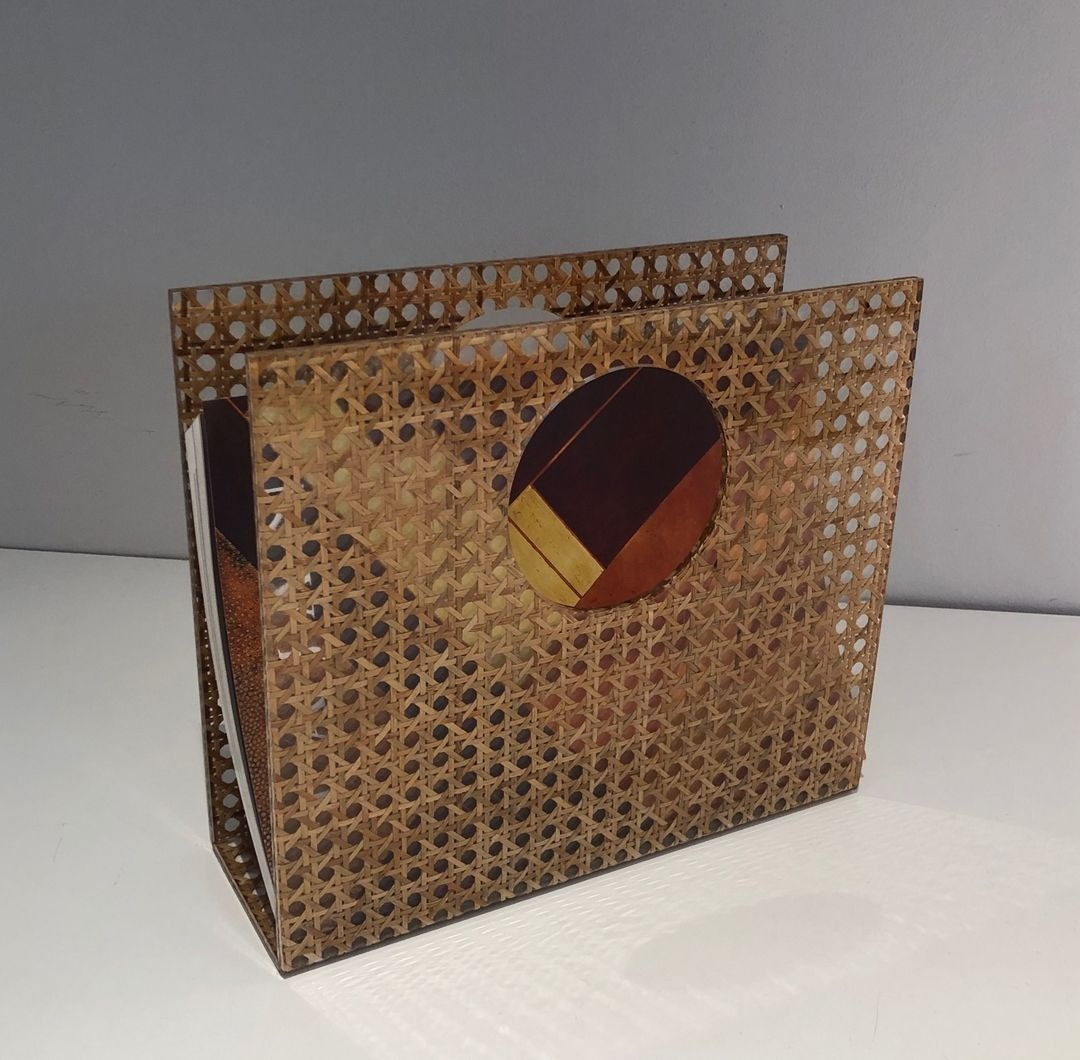
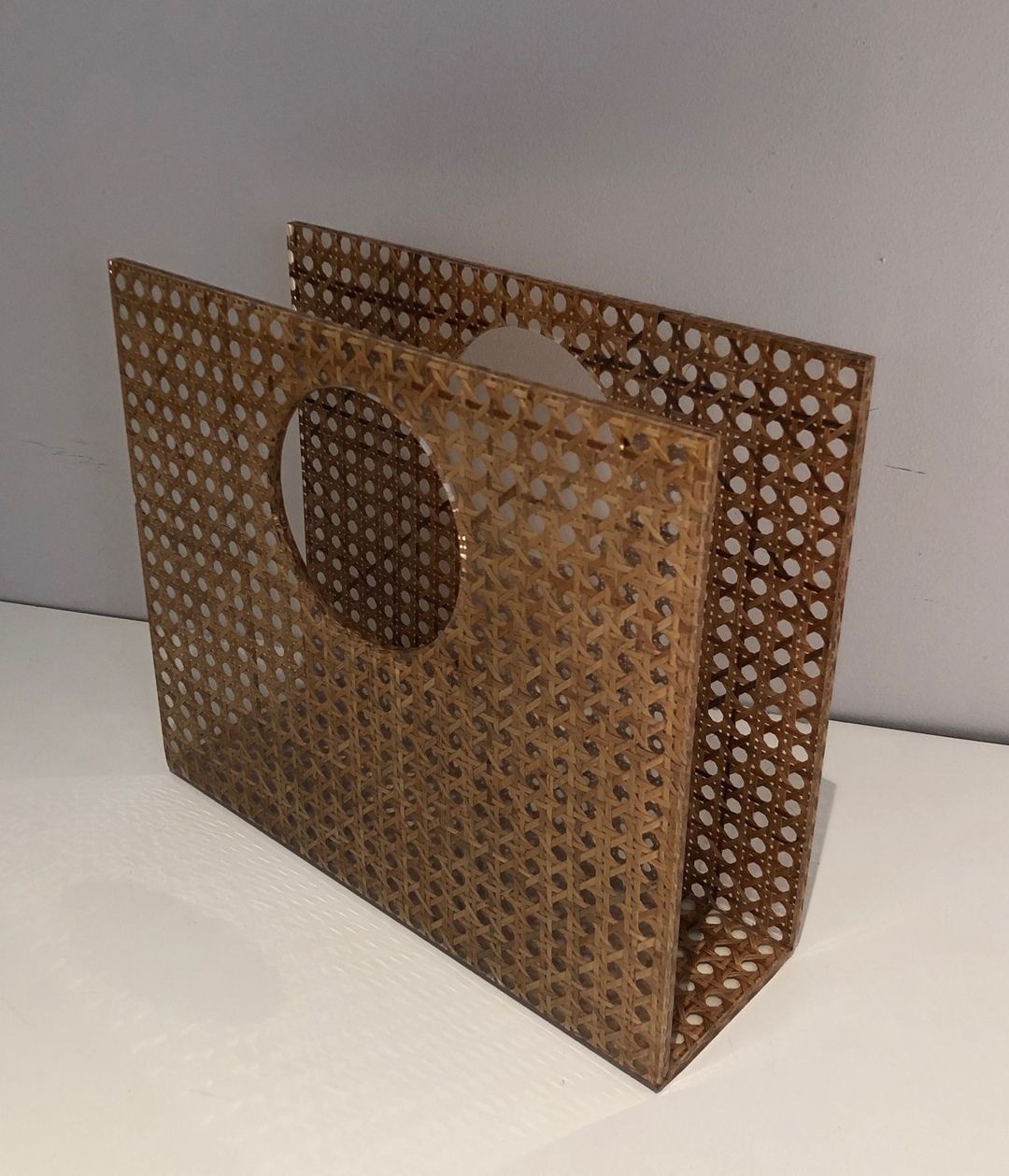
When Christian Dior launched his revolutionary “New Look” in 1947, he did not merely transform women’s silhouettes — he inaugurated a new grammar of luxury that would colonise every domain of French decorative life. This small magazine rack, conceived in the unmistakable form of a structured handbag, stands as testament to that colonisation: the rigid plexiglass frame, articulated with panels of finely encrusted cane, translates the architectural vocabulary of the Dior atelier’s most iconic accessory into a piece of domestic furniture. At once a functional object and a sculptural quotation, it belongs to that fertile current of 1970s French design in which the boundaries between fashion and the decorative arts were productively dissolved.
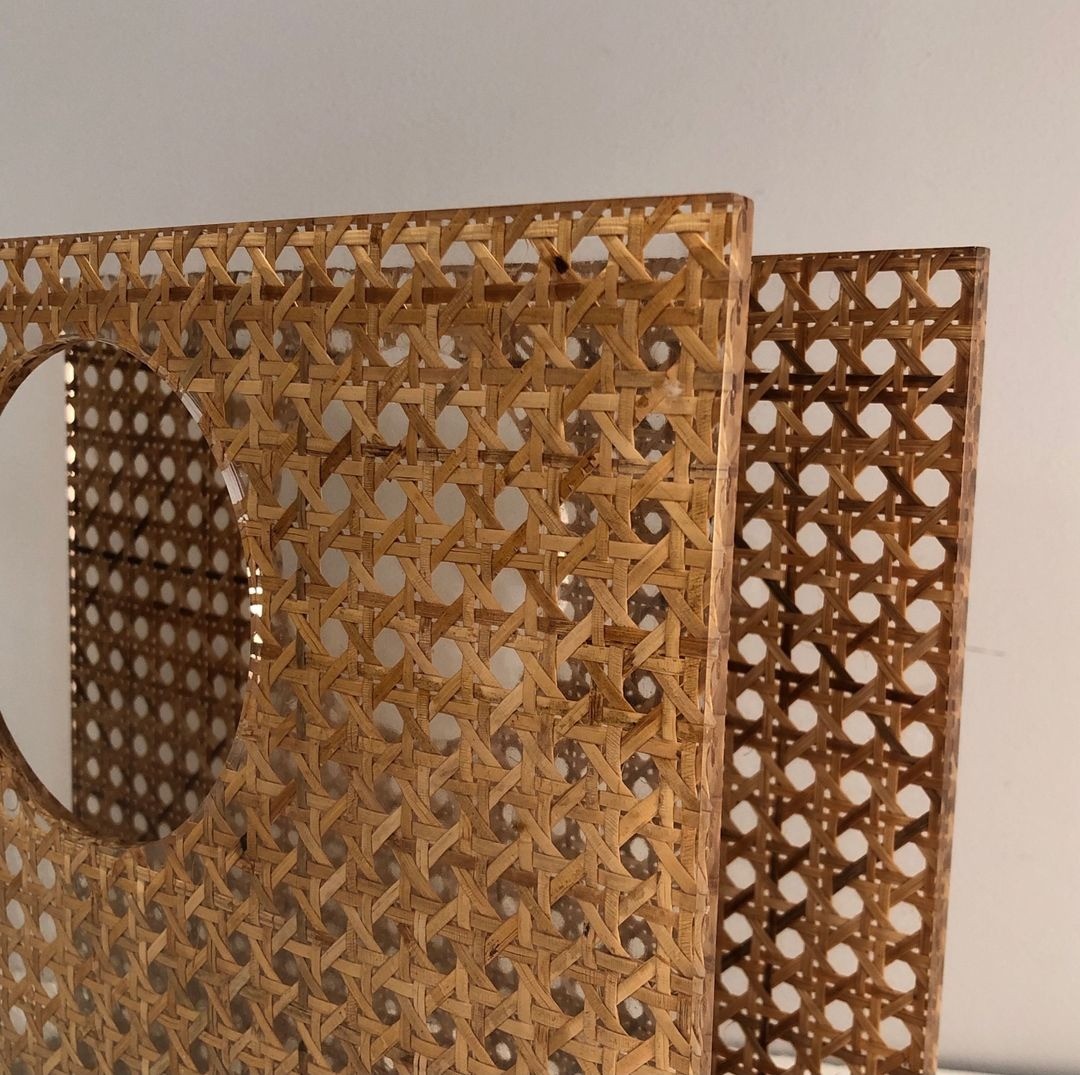
The reference to Gabriella Crespi (1922–2017) places the piece within a distinguished tradition of crossover creativity. The Milanese designer, who trained as a sculptor before turning to the decorative arts, made her name in the 1960s and 1970s by combining natural materials — bamboo, rattan, straw marquetry — with refined metalwork and modern plastics, often in forms drawn from fashion and travel accessories. Her magazine racks, jewellery boxes and occasional tables were collected by the great international houses and the fashion-conscious European bourgeoisie precisely because they refused any hierarchy between use and beauty. The encrusted cane panels here — a technique recalling Napoléon III cabinetry as much as Crespi’s own tropical exoticism — are set within a plexiglass armature that renders the structure simultaneously solid and immaterial.
The convergence of two such potent references — Dior’s Parisian haute couture and Crespi’s Milanese design genius — makes this object a compelling example of the transnational luxury culture that animated the European decorative arts in the years of the grand revival. The scaled-down proportions (29.5 × 10 × 25.5 cm) suggest an intimate domestic use, placed perhaps upon a writing desk or low console as an elegant receptacle for correspondence, catalogues or illustrated periodicals. For the collector of 1970s design at the intersection of fashion and furniture, few objects condense so much cultural richness in so spare a form.