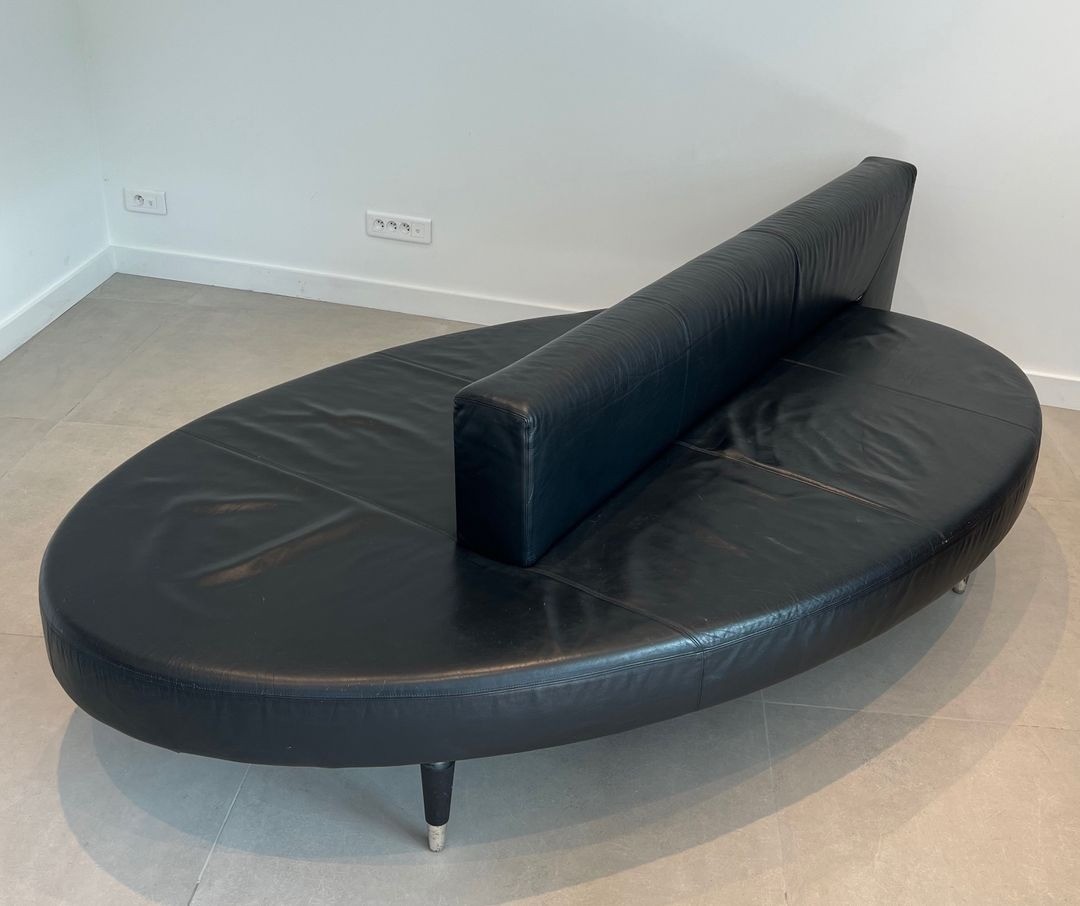
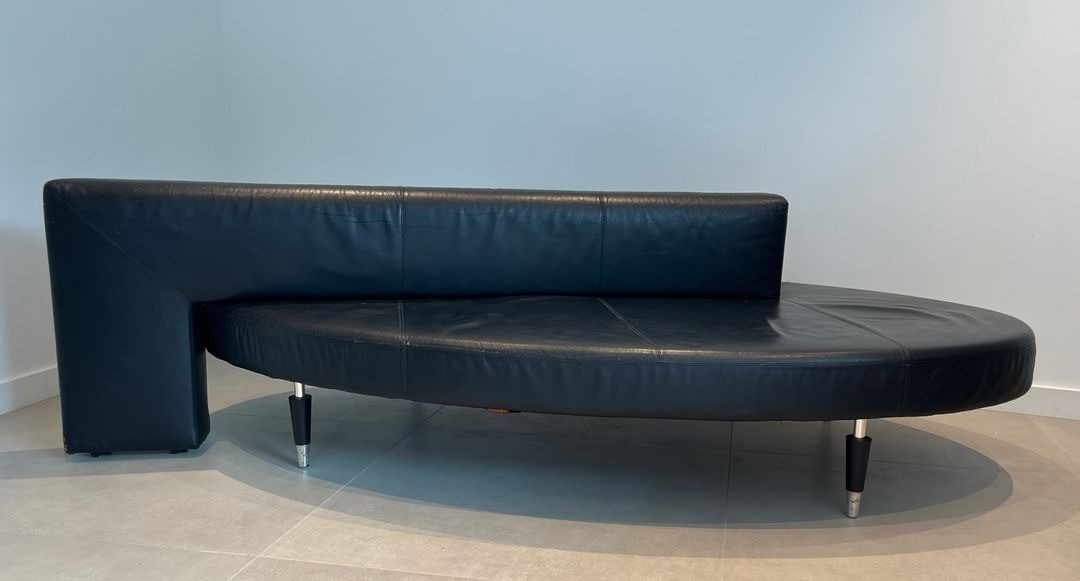
In 1968, Olivier Mourgue designed the Djinn series for Airborne International; in 1967, Pierre Paulin created his low organic seating for Artifort; in those same years, the workshops of the Parisian avant-garde produced oval and circular sofas that announced a new spatial philosophy. The oval form — continuous, self-enclosing, free of the right angle that had governed furniture design since the Renaissance — was a spatial manifesto: it declared that the room belonged not to architecture but to those inhabiting it. This rare oval sofa, in black leather with chrome legs, belongs to that extraordinary moment of French design freedom.
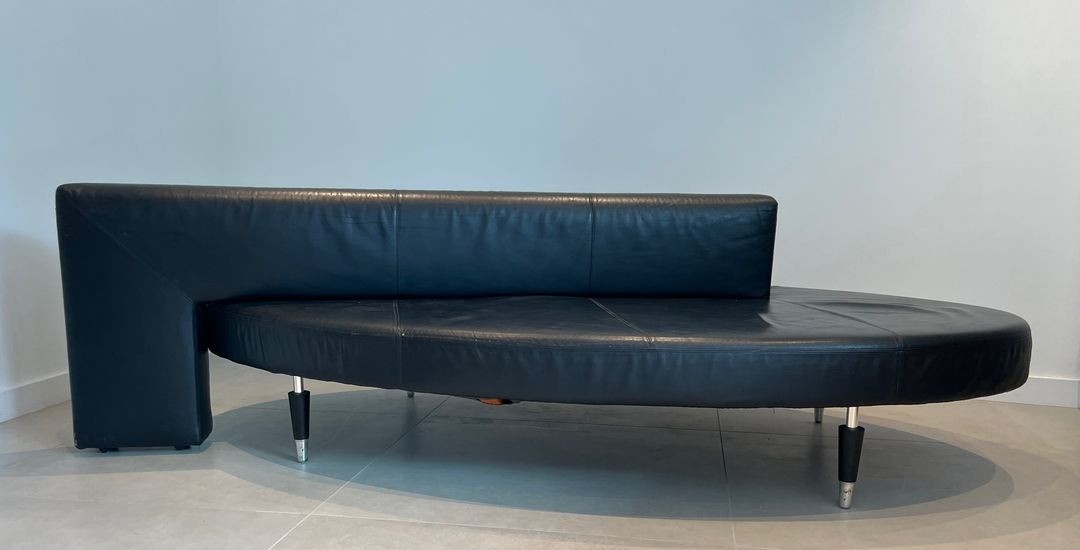
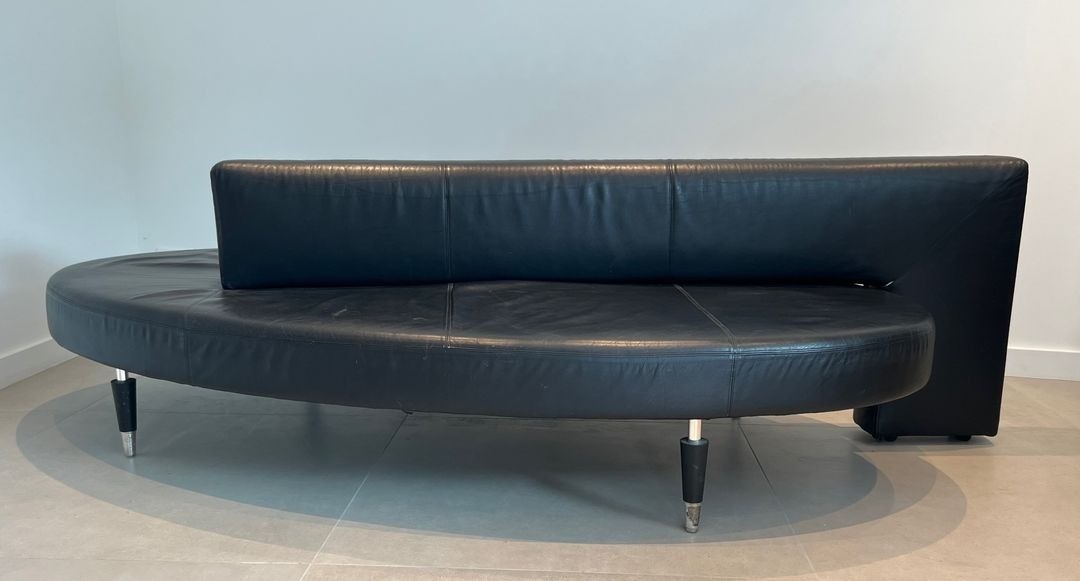
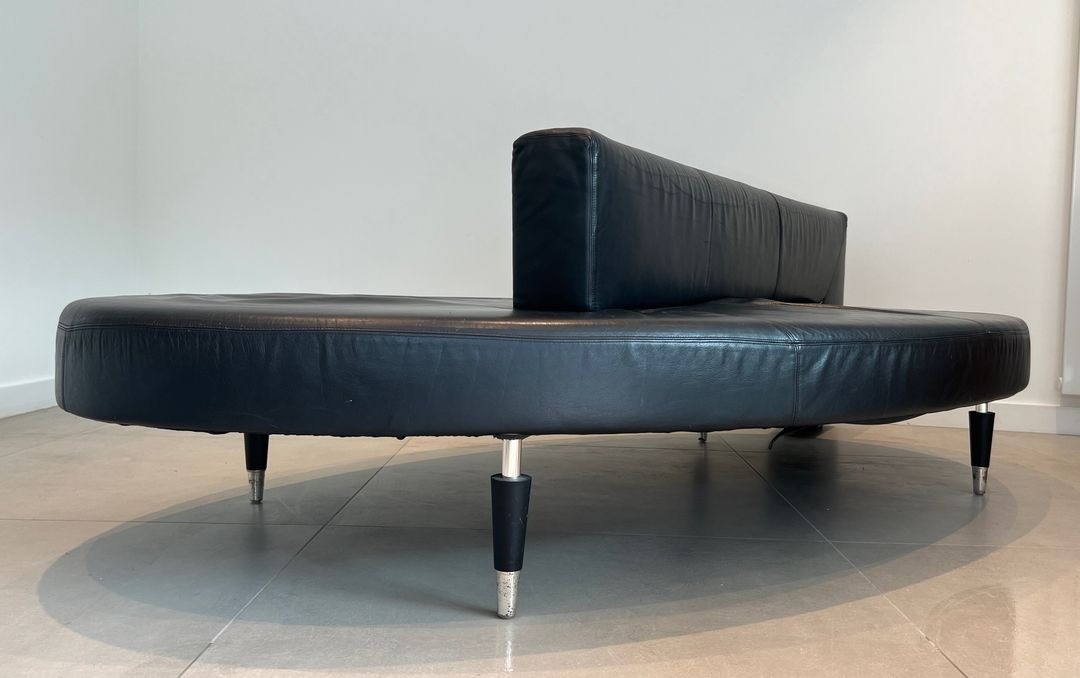
At 243 × 128 × 70 cm, this sofa is not merely furniture: it is a room within a room. The oval plan creates a zone of intimacy within a larger interior, an enclosed world whose curved perimeter is simultaneously invitation and boundary. The seat height places it in the low, relaxed register that the late 1960s preferred — a deliberate break from the upright posture demanded by bourgeois seating, a physical expression of a generation that sat differently, thought differently, lived differently. The black leather, stretched smooth over the oval form, gives the piece the visual weight of a monolith and the chromatic authority of a period that had learned to use black as a statement of absolute modernity.
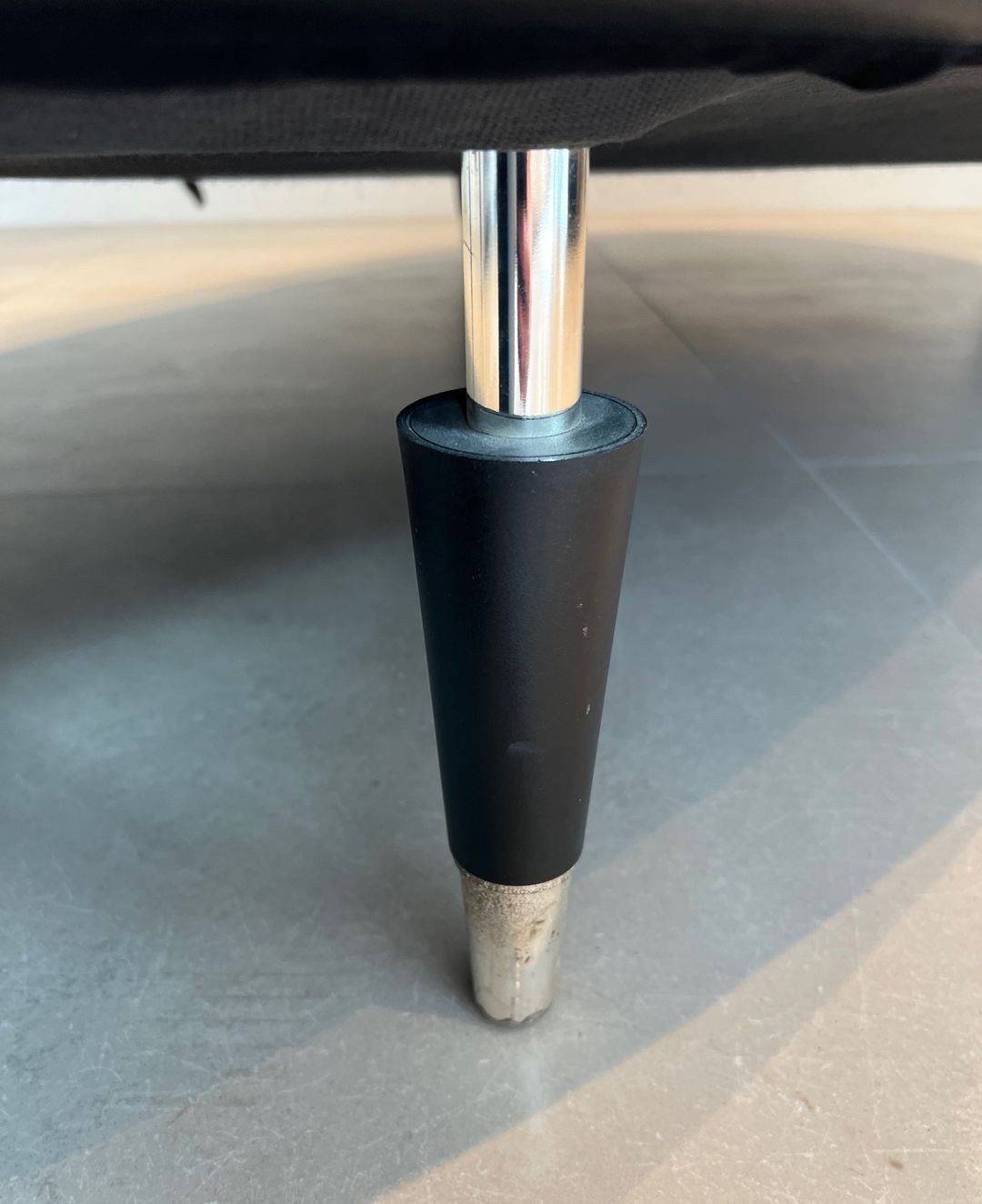
Chrome legs on a leather sofa of this scale are not merely structural: they create the visual impression that the mass above floats free of the floor — a levitation that is one of the great formal achievements of the Space Age aesthetic. This suspension of weight, solid black leather above and thin chrome below, produces the same visual paradox that Mies van der Rohe explored in his Barcelona Chair of 1929, here reprised in an organic vocabulary far removed from the German rationalist tradition. That this sofa has survived with its leather intact, its chrome unoxidized, and its form uncollapsed testifies both to the quality of the French atelier that produced it and to the patience of those who preserved it across half a century.