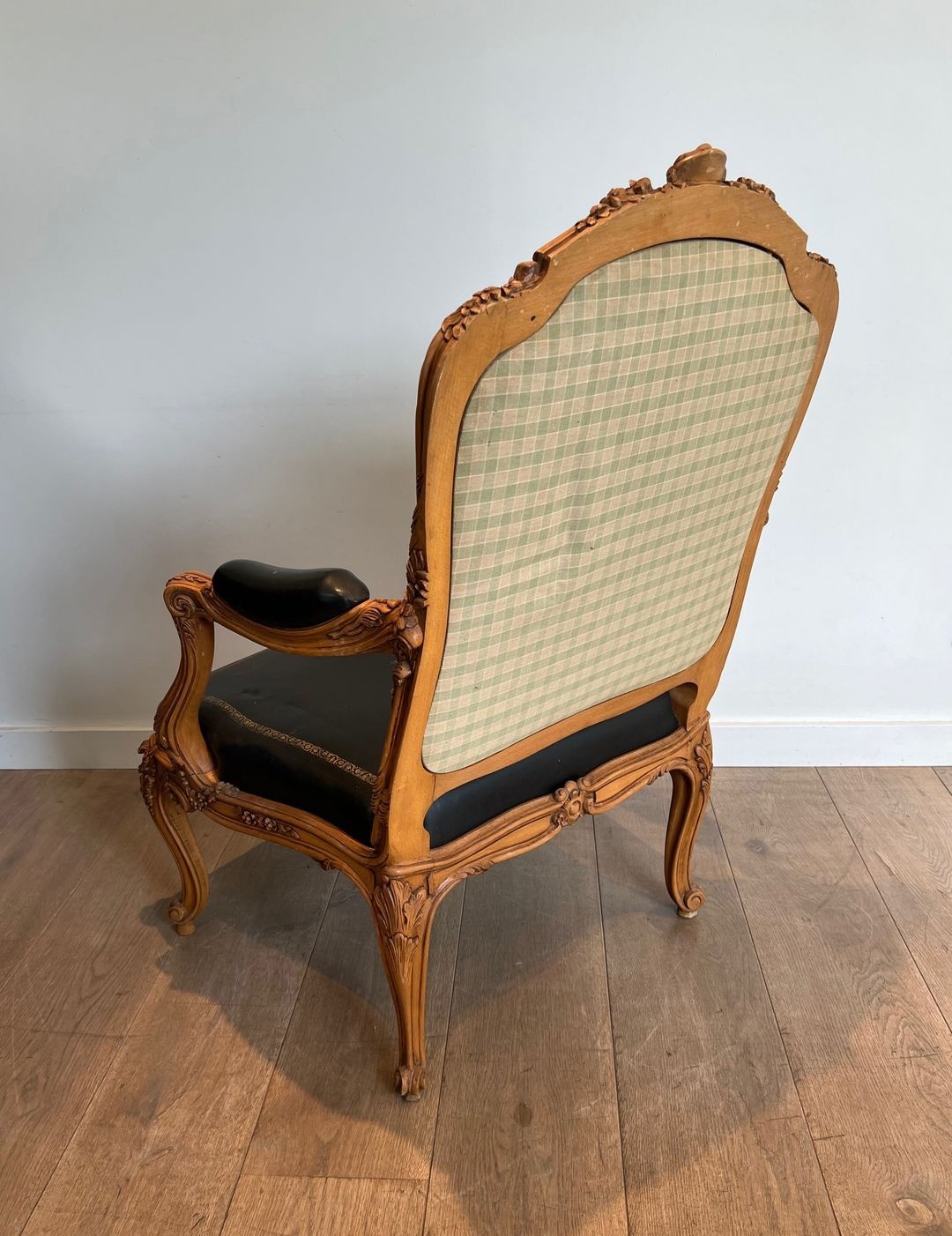
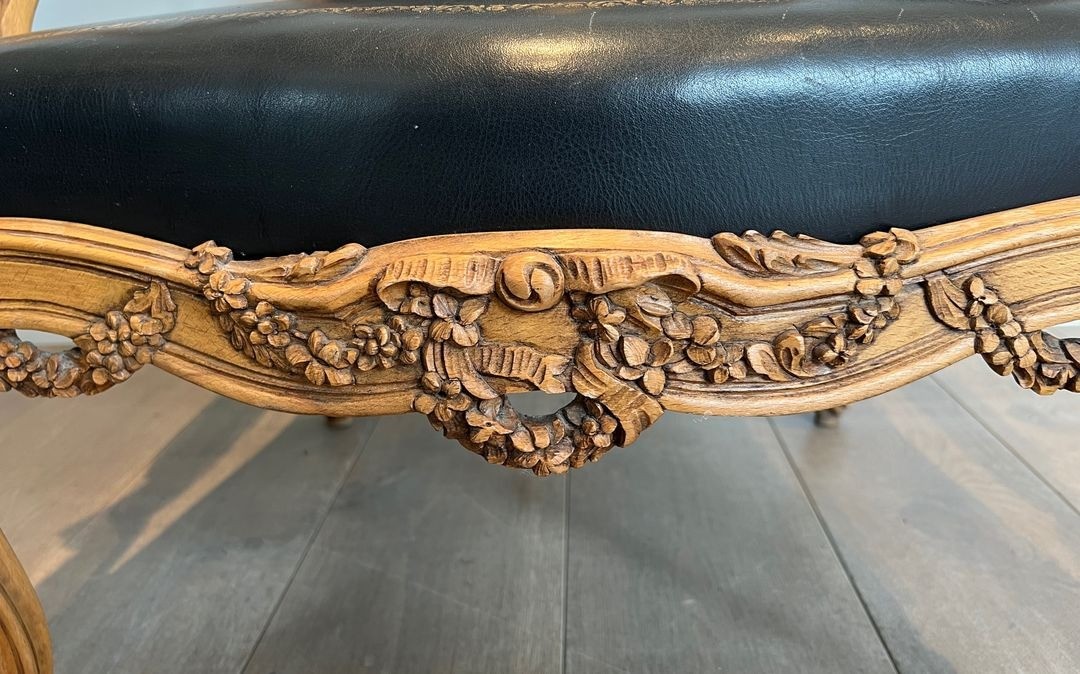
Of all the seating forms codified by the French monarchy, the fauteuil à la reine — the flat-backed armchair — carries the most precise social history. Unlike its curved-back cousin, the fauteuil en cabriolet, which invited informal ease, the fauteuil à la reine was designed to stand against the wall of a grand salon and be seen from the front: its flat back was not a comfort-oriented solution but a ceremonial one, providing a perfectly vertical plane for carved ornament. It was the chair of formal occasions, brought forward from the wall only when rank required it — a piece of furniture in which social hierarchy was encoded in wood.
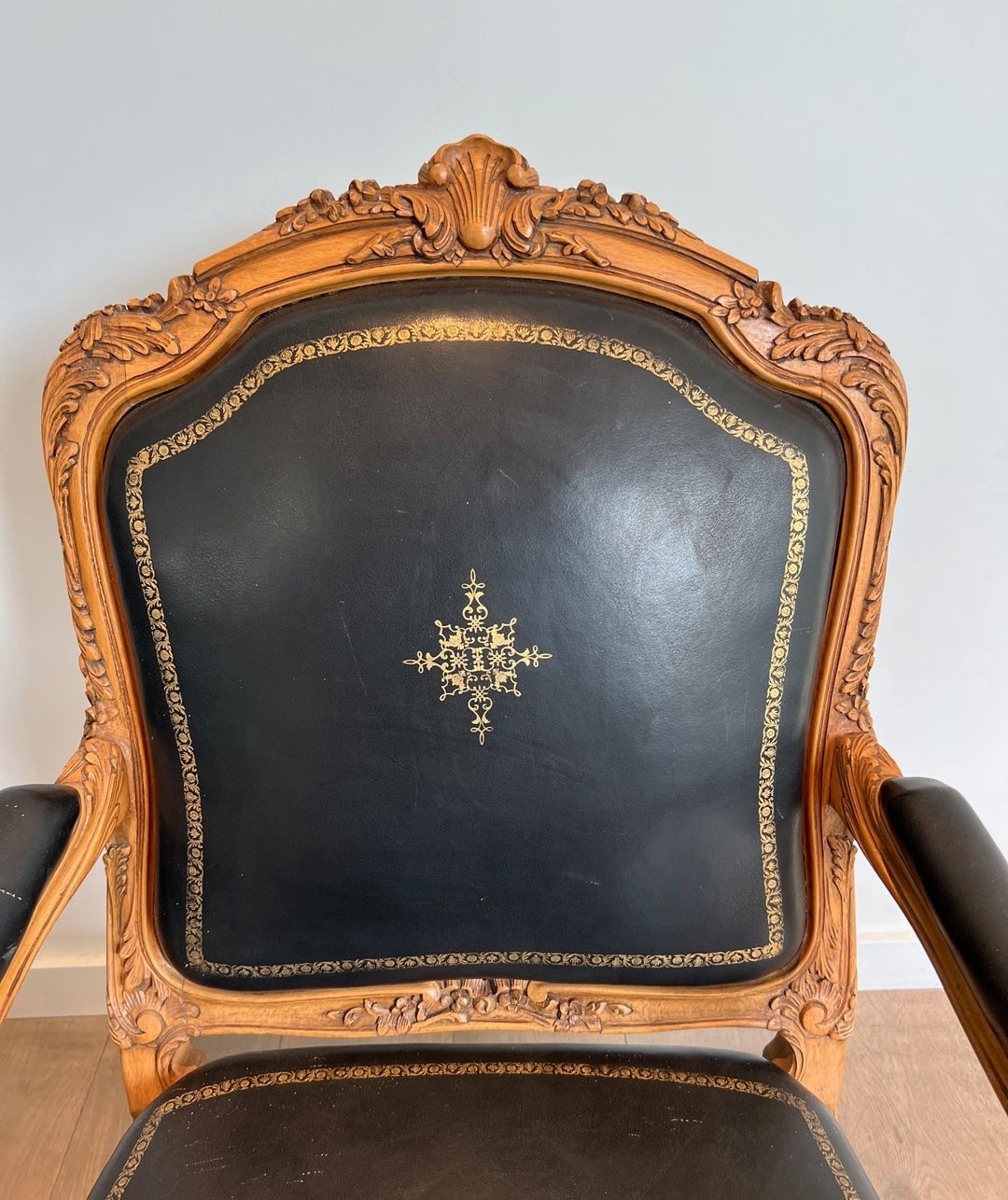
The material choices of this mid-century example are among its most distinguished features. Carved walnut — the wood of the French province, robust and finely grained — provides the frame with a warmth that gilded beechwood, so common in the period’s luxury trade, rarely achieved. Against this, the black leather upholstery works a chromatic paradox: the material of the masculine study and the library transforms the armchair’s Rococo ornament into something simultaneously more severe and more contemporary. The gold-tooled border — the fer doré technique borrowed from the bookbinder’s art — restores the dialogue with tradition, tracing along the edge where leather meets wood a fine line of aristocratic affirmation.
That a post-war French atelier chose to reproduce the fauteuil à la reine around 1950 was not mere academic nostalgia. The French decorative arts of the 1940s and 1950s maintained a living relationship with the eighteenth century that no other national tradition equaled: the workshops of the Faubourg Saint-Antoine continued to produce pieces of a quality, precision, and cultural density that testified to the unbroken transmission of a craft. At 73.5 × 78 × 104 cm, this armchair has the presence of a period original — the proportions, the carved ornament, and the formal authority that only centuries of accumulated expertise can produce.