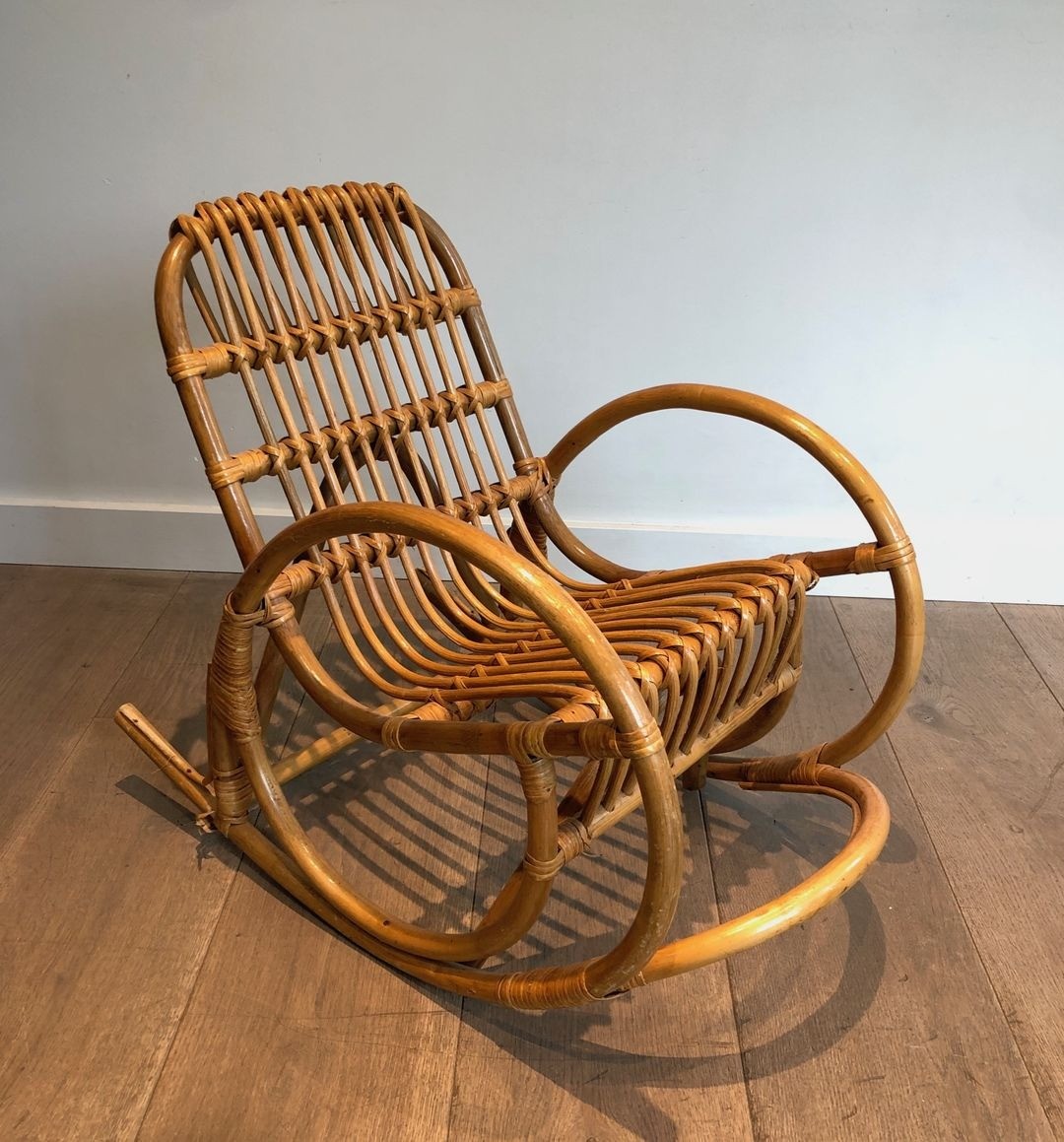
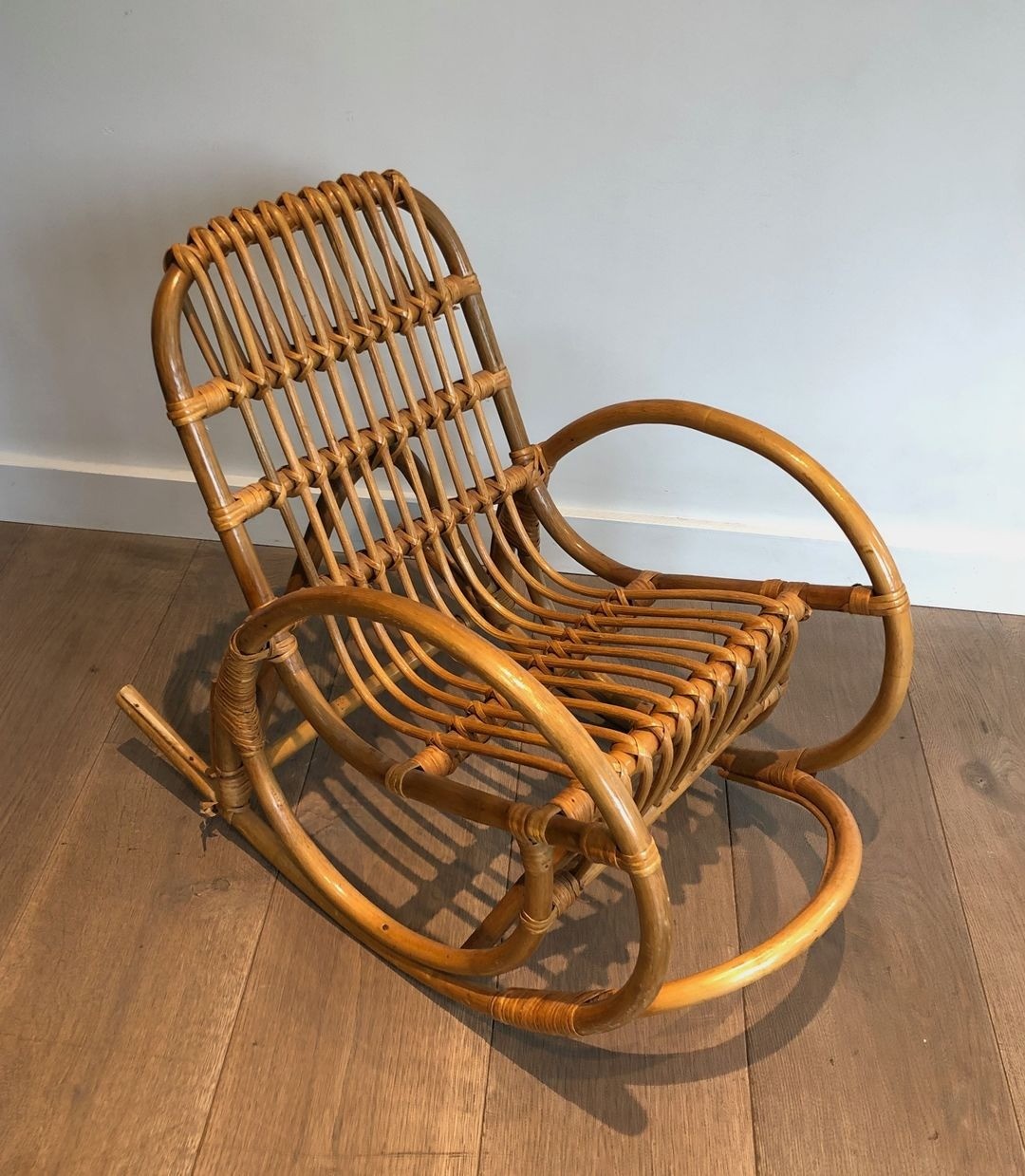
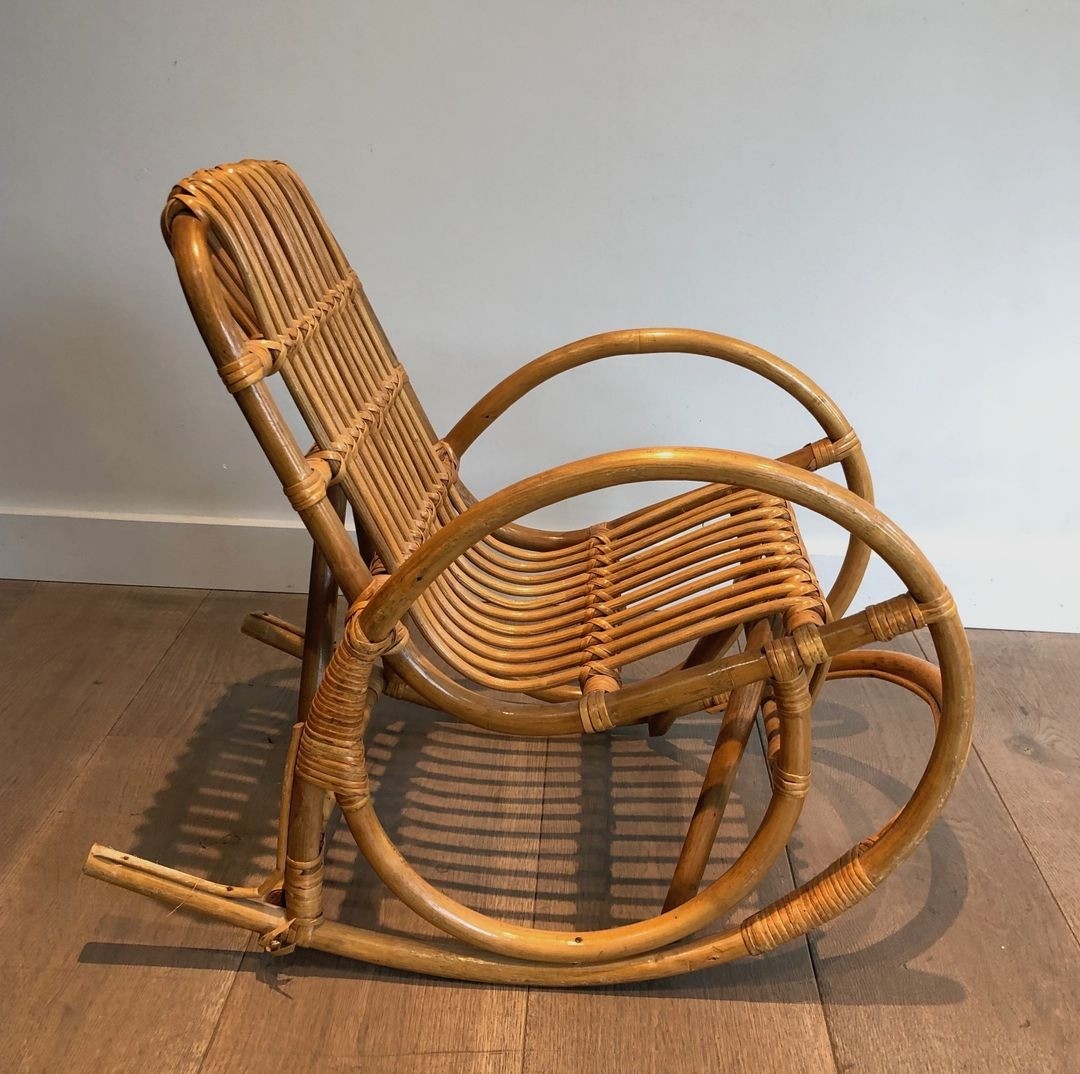
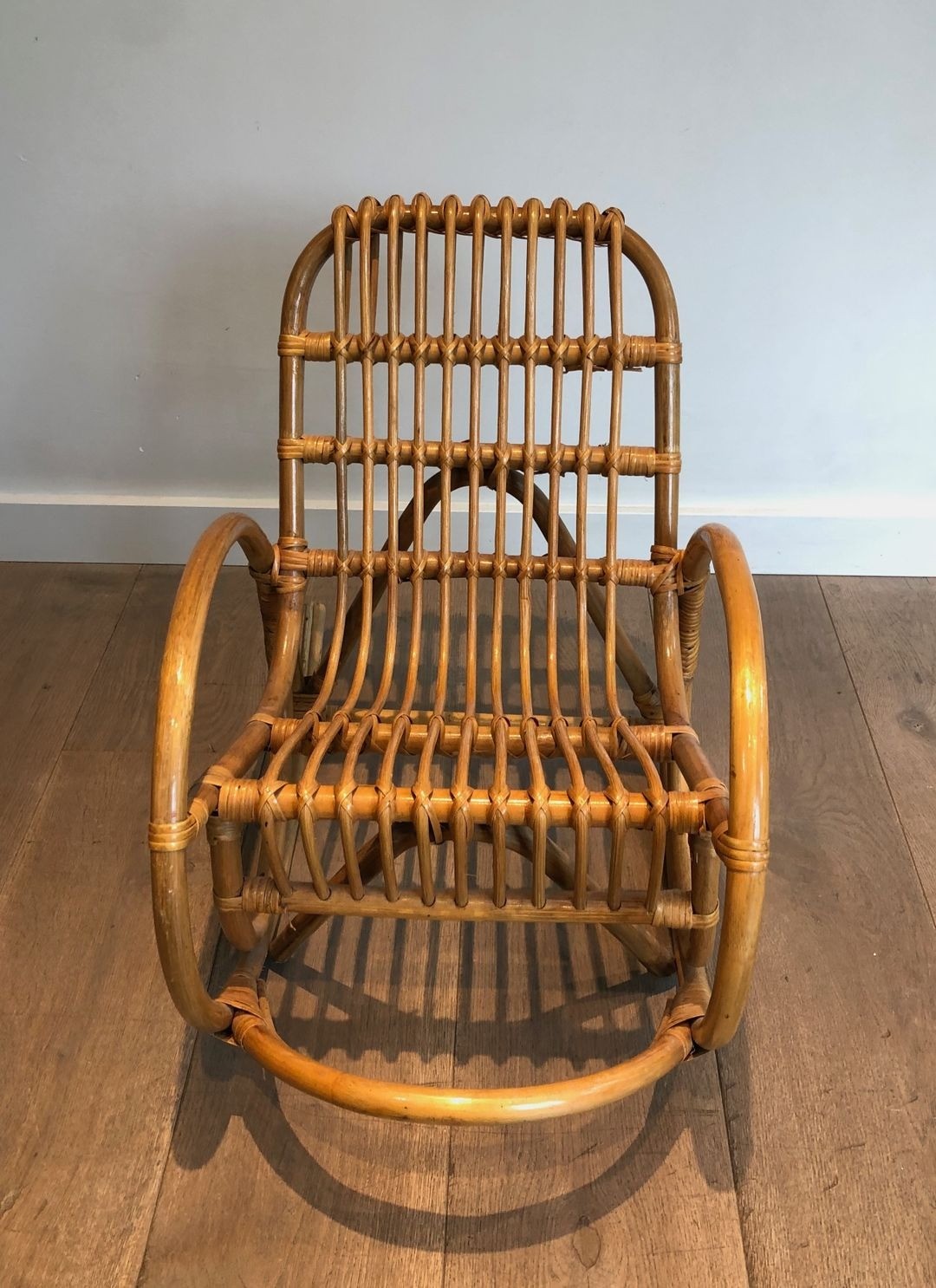
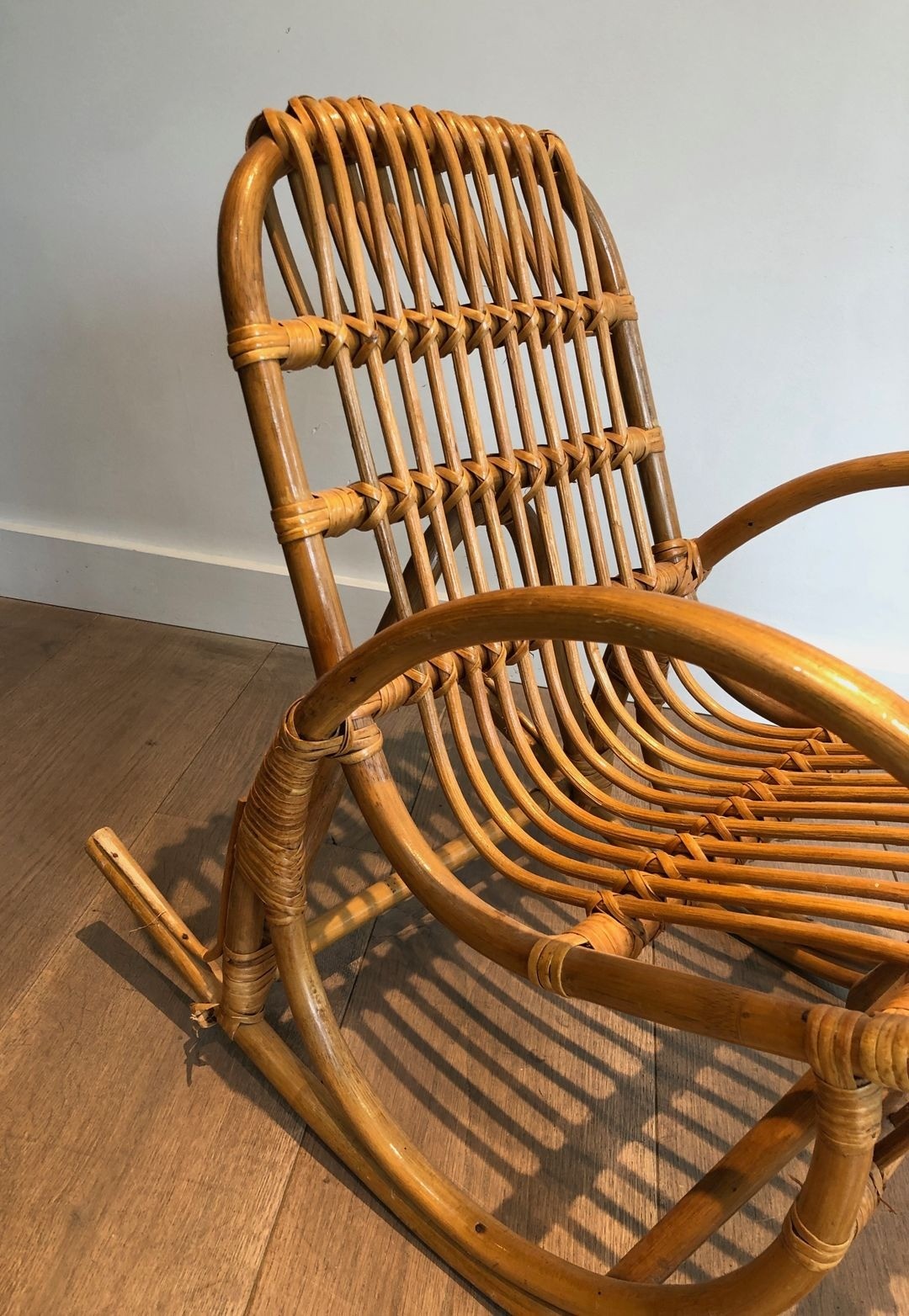
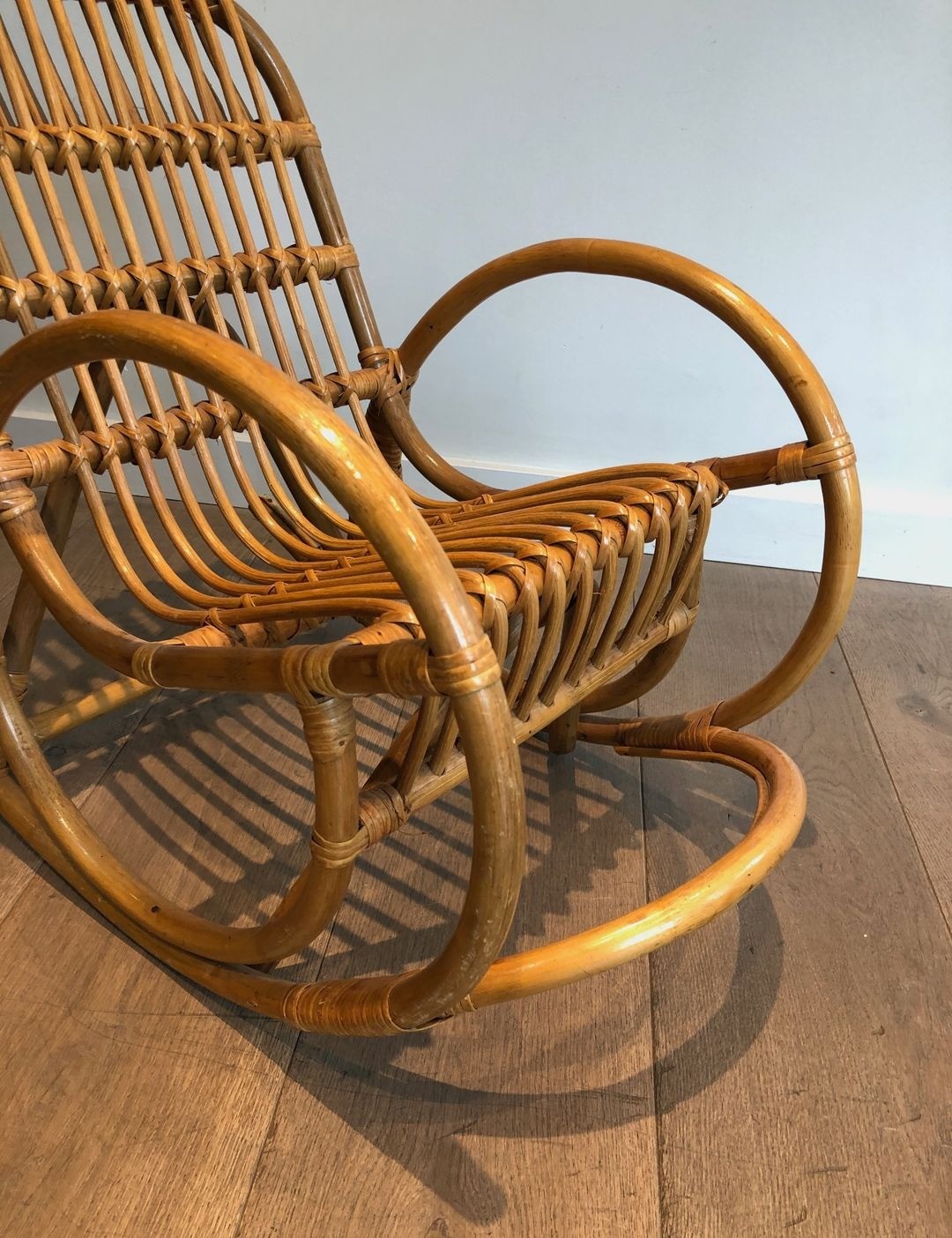
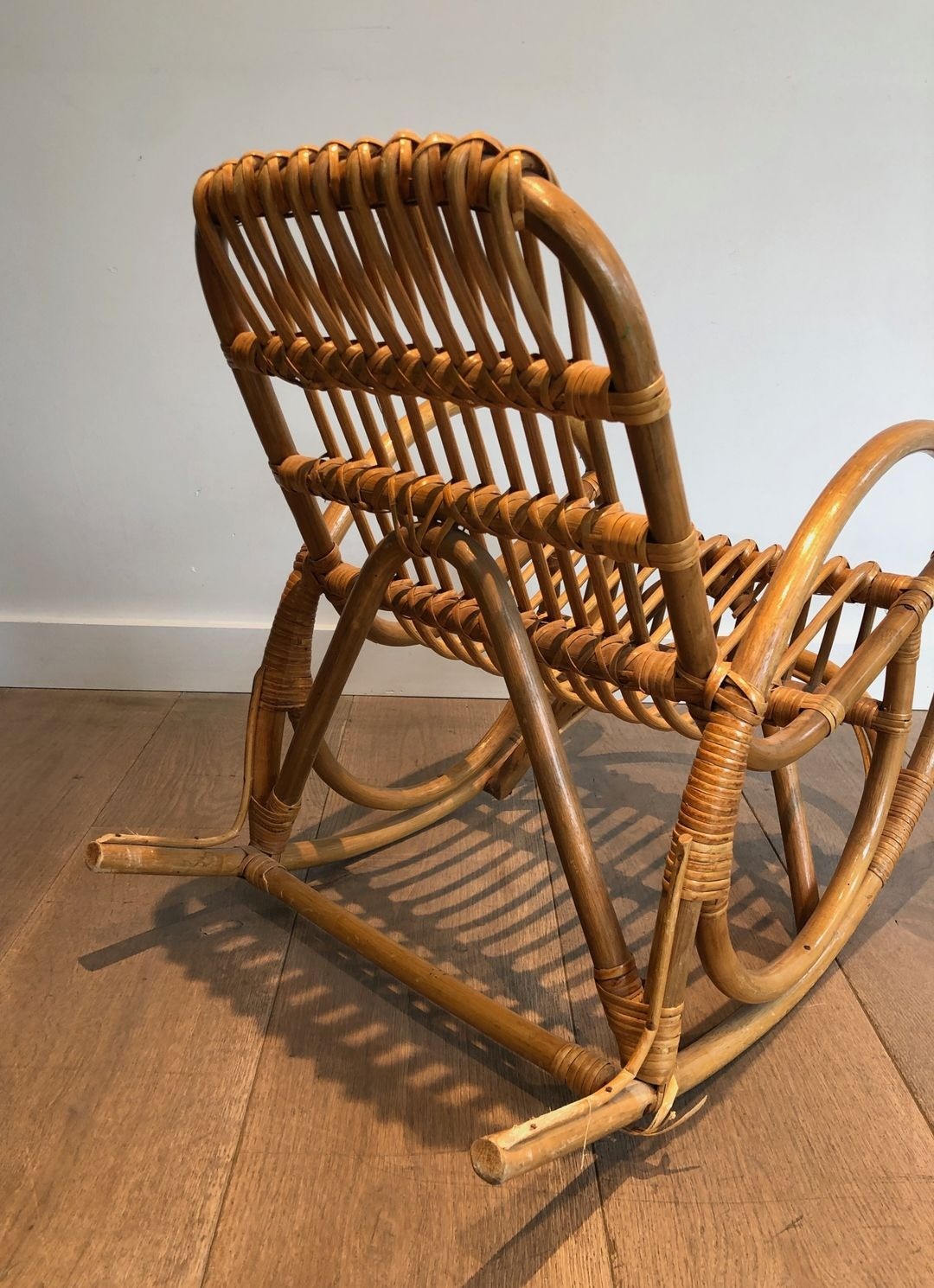
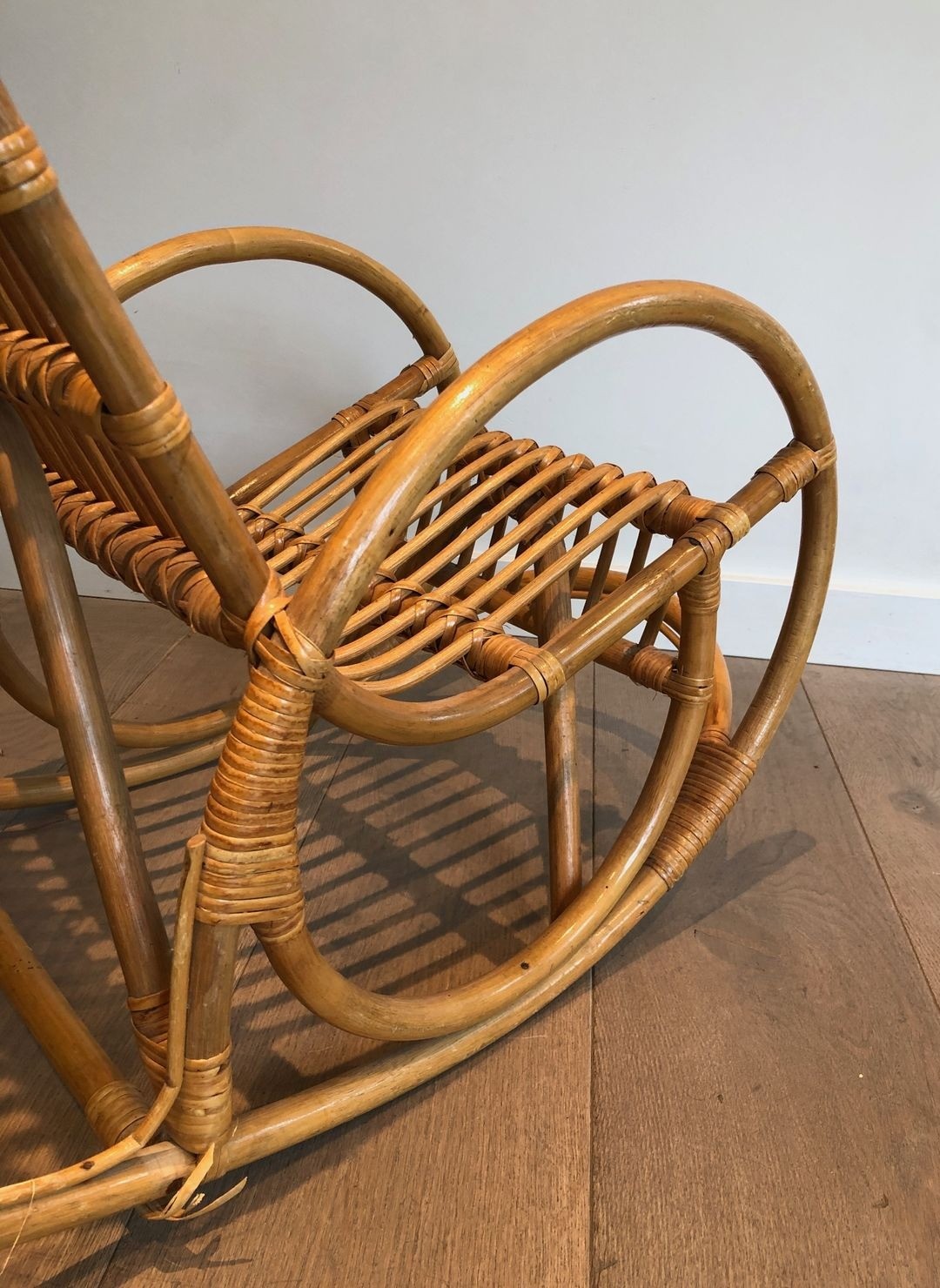
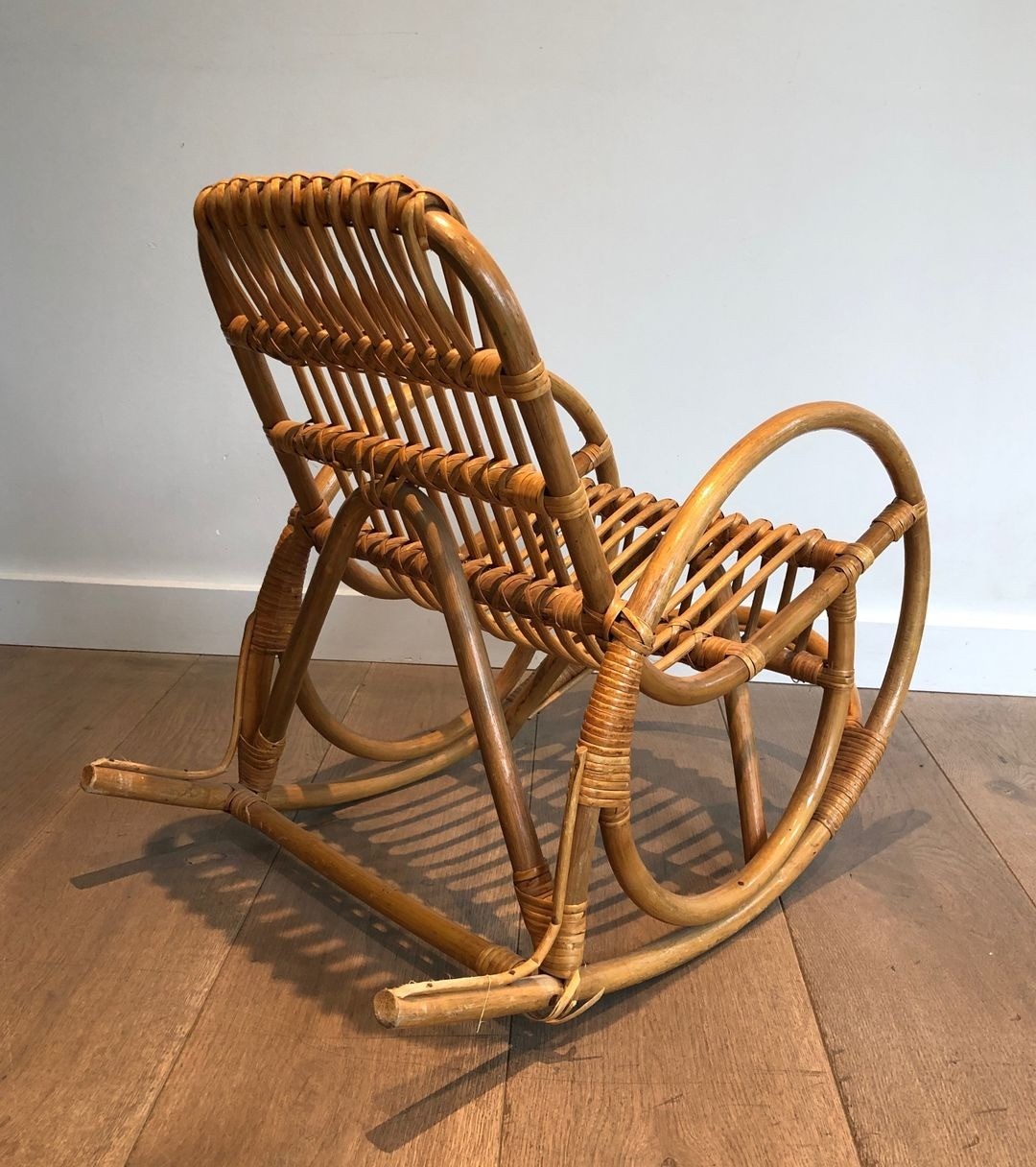
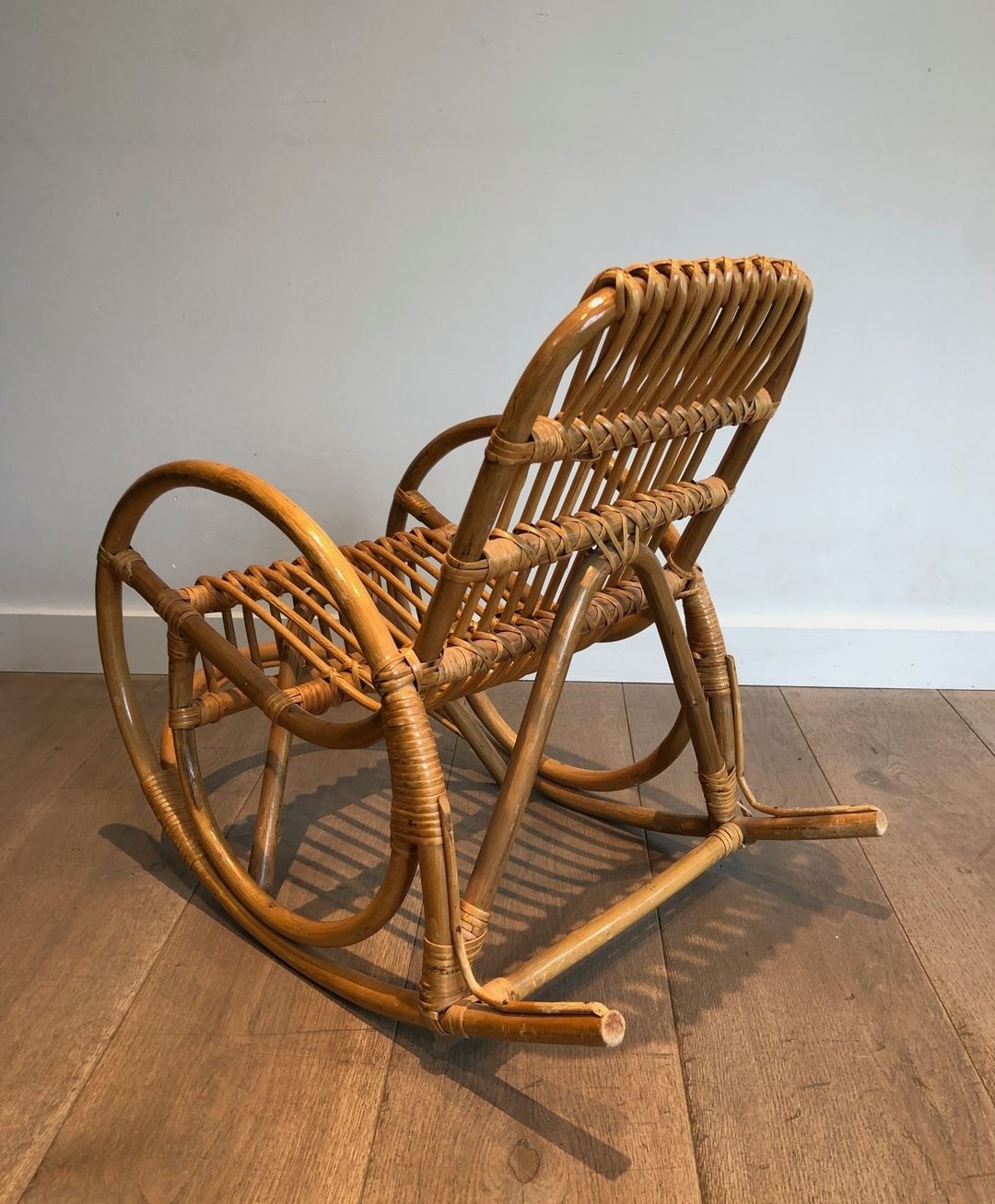
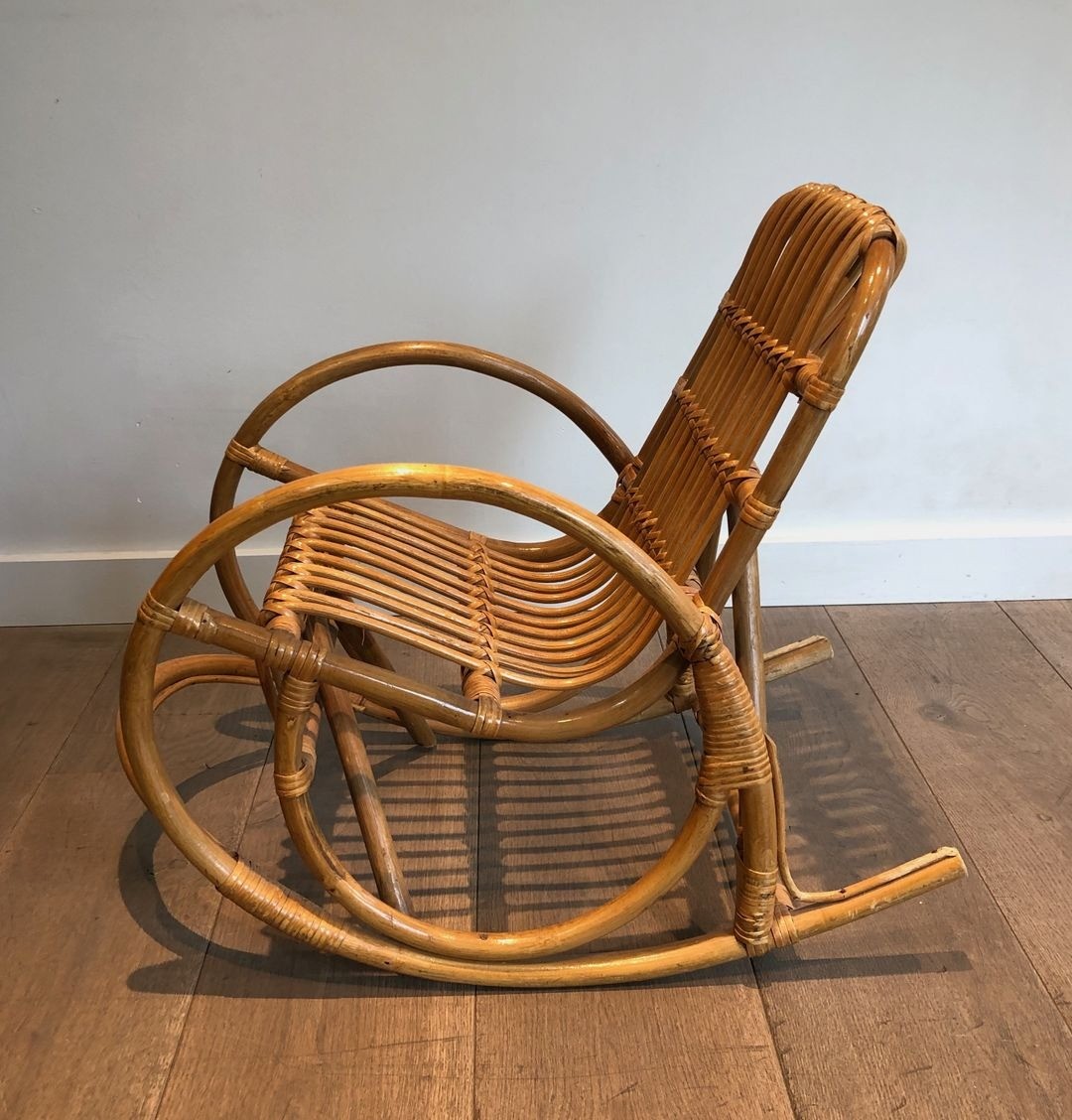
The rocking chair occupies a singular position in the taxonomy of seating: it is the only chair that moves. All other chairs are essentially static architectures that receive the body; the rocking chair envelops it and then initiates a rhythm. For adults, this rhythm is meditative — a mechanical lullaby, an externalization of inner rocking. For children, it is something more fundamental: an education in oscillation, in the discovery that the body can simultaneously be passenger and engine, that a seated person can generate momentum, feel its consequences, arrest it, and begin again. This child’s rocking chair in rattan, made in France in the 1970s, addresses that discovery with a directness that much children’s furniture ignores.
The proportions — 42.5 cm wide, 60 cm high, 69 cm deep — are not simply an adult rocking chair miniaturized. The centre of gravity, the arc of the rockers, the relationship between seat depth and back angle: these require recalculation at child scale. A chair that rocks gracefully at adult proportions would be unstable or sluggish at half size without compensatory adjustments. The rattan construction is similarly well-considered: light enough that a child can feel the chair’s own weight as part of the rocking dynamic, yet resilient to the rough usage that characterizes childhood. The woven surface offers a grip that smooth lacquered wood cannot, keeping a child planted through vigorous rocking without the need for armrests that constrain.
French rattan craft of the 1970s occupied a specific cultural moment. The decade was one of return — to natural materials, to craft, to objects that showed their making — in conscious reaction against the anonymous industrialism of postwar modernism. Rattan, which had been embraced in the 1950s as a modernist material and then somewhat eclipsed by plastics in the 1960s, returned with a warmer valence: natural, renewable, visibly hand-worked. A children’s rocking chair in this context was not merely furniture but a small manifesto of tactile, organic domesticity — an object that placed childhood at the centre of the home’s material culture.