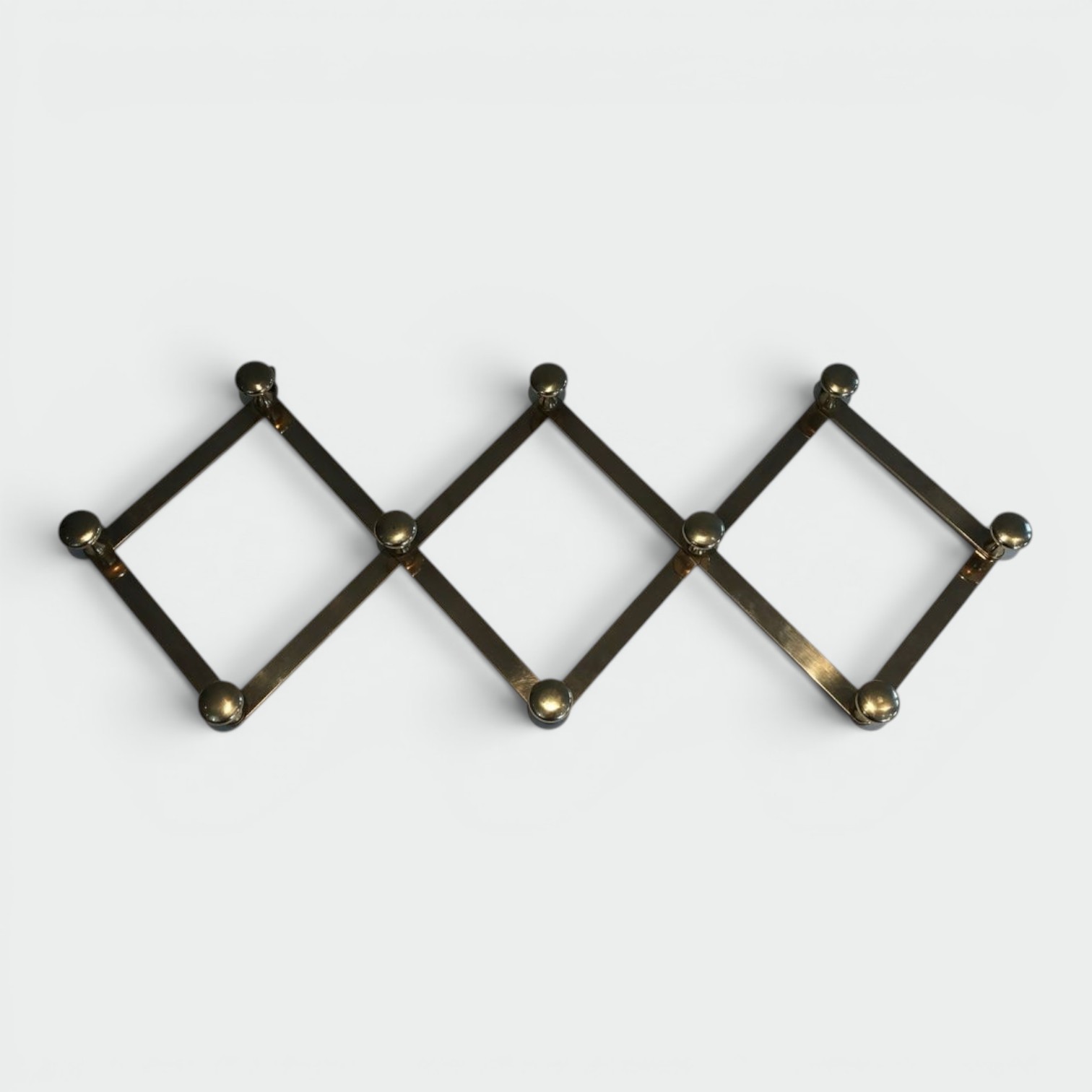
The accordion coat rack embodies a characteristically French approach to the problem of spatial economy : an object that changes its own geometry according to use. Unlike a fixed rack that occupies a permanent footprint, the accordion or pantograph coat rack is architecture in miniature — a wall-mounted structure that compresses to near-nothing when unloaded and extends gracefully outward when brought into service. In the hands of French ateliers working through the 1970s, this fundamentally mechanical concept was elevated through the choice of brass, a material whose warm luminosity transforms a simple scissor-joint mechanism into an object with the quiet presence of sculpture. The result is a coat rack that justifies itself twice over : functionally, through its ingenious economy of space, and aesthetically, through the golden geometry it traces against the wall.
This example, measuring 110 cm in width, 5 cm in depth when folded flat, and 20 cm in height, achieves a remarkable compression ratio that speaks to the precision of its construction. The brass links are joined at their pivot points with a regularity that has both a functional and a visual logic : each joint is a moment of articulation, a place where the object breathes. The warm patina of brass, developed over decades of use, gives the surface a depth that bare steel or aluminium could not achieve. Wall-mounted, the rack disappears almost entirely when unloaded, leaving only a shallow golden lattice against the wall — an echo of the pantograph drawing instruments that likely inspired its geometry.
Brass accordion coat racks from the 1970s occupy a distinct position in the collecting of French functional objects. They represent the moment when the geometric rigour of the post-war decade — exemplified by designers such as Matégot and Prouvé — gave way to a warmer decorative register without abandoning the underlying logic of industrial form. The choice of brass signals an intention to endure, and pieces of this quality, with their precise pivot joints and uniformly developed patina, are increasingly sought by those furnishing interiors where functional objects must also serve as considered decorative statements.