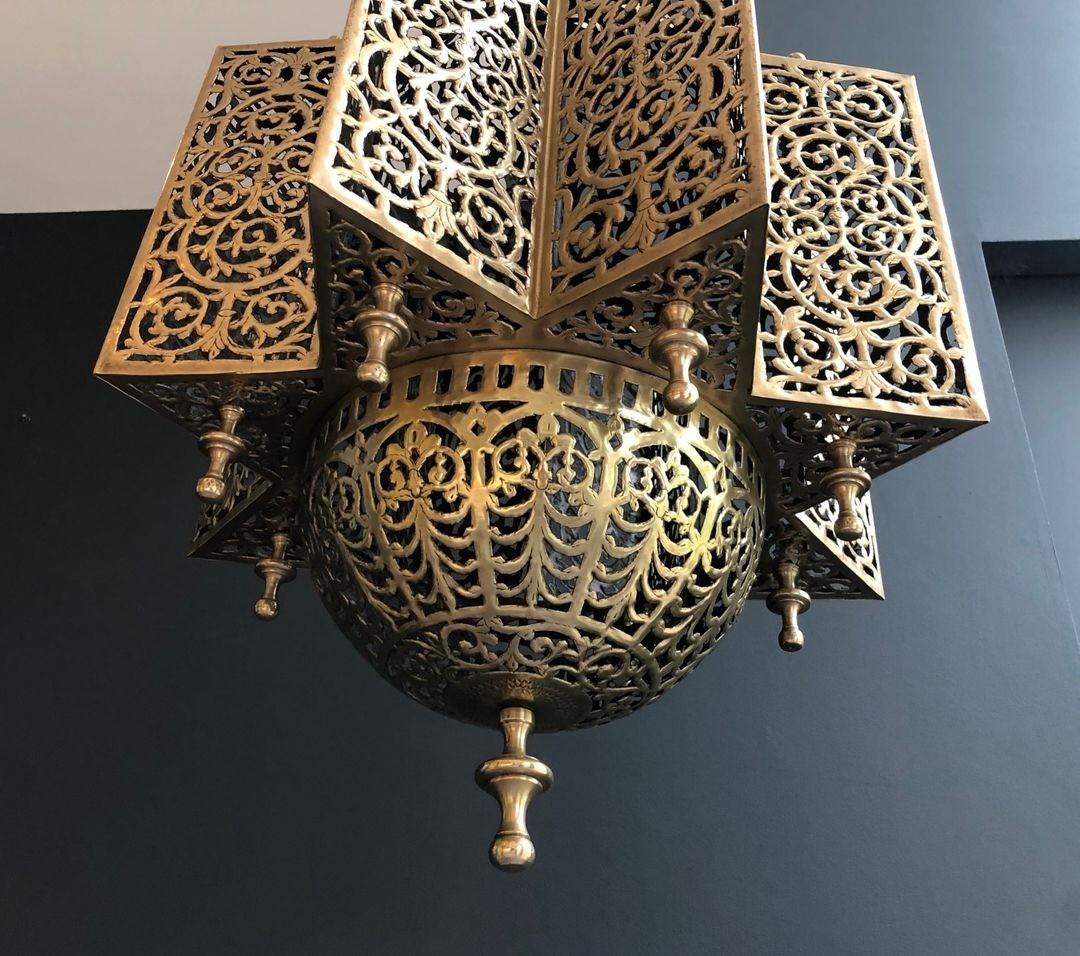
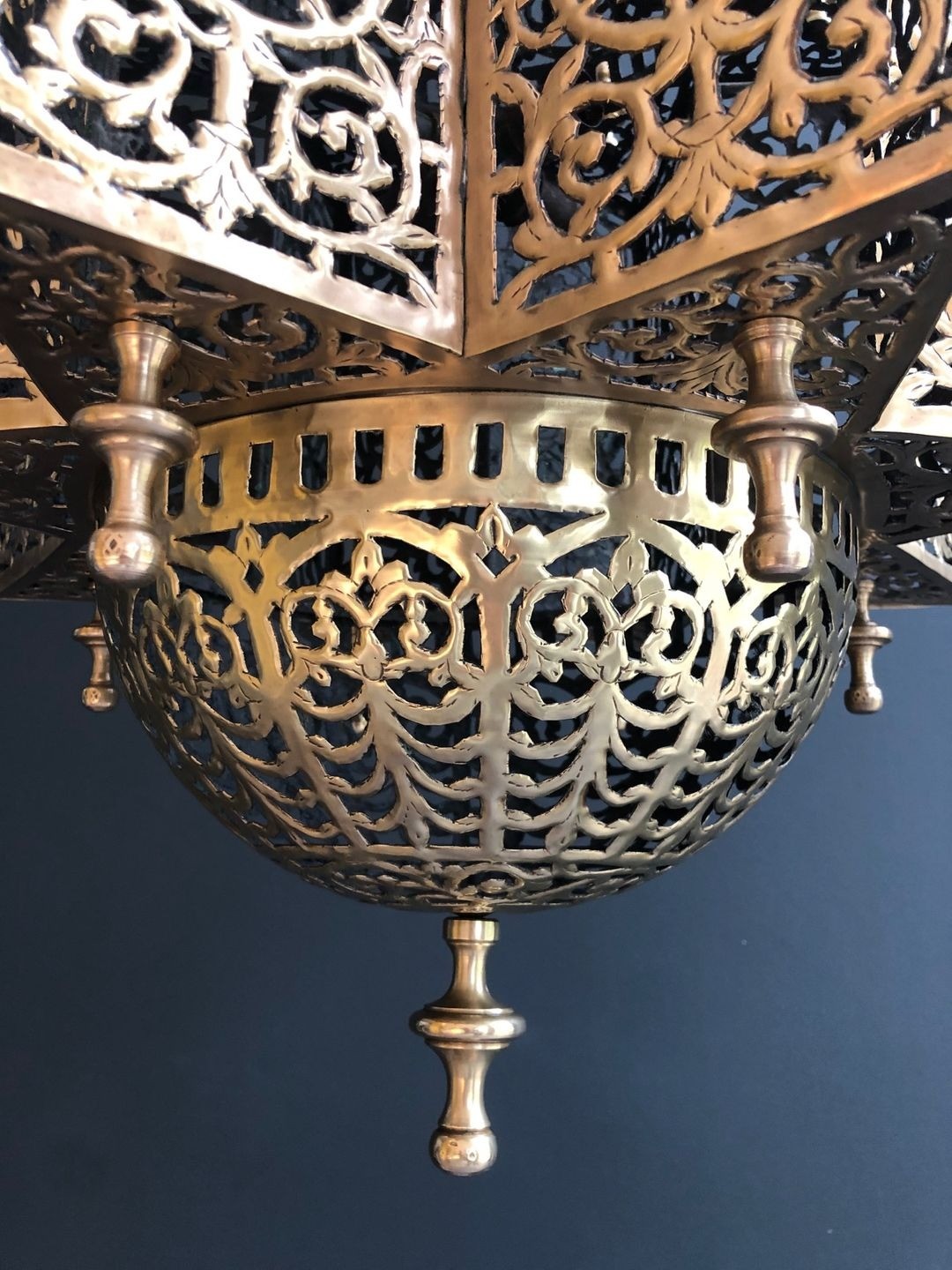
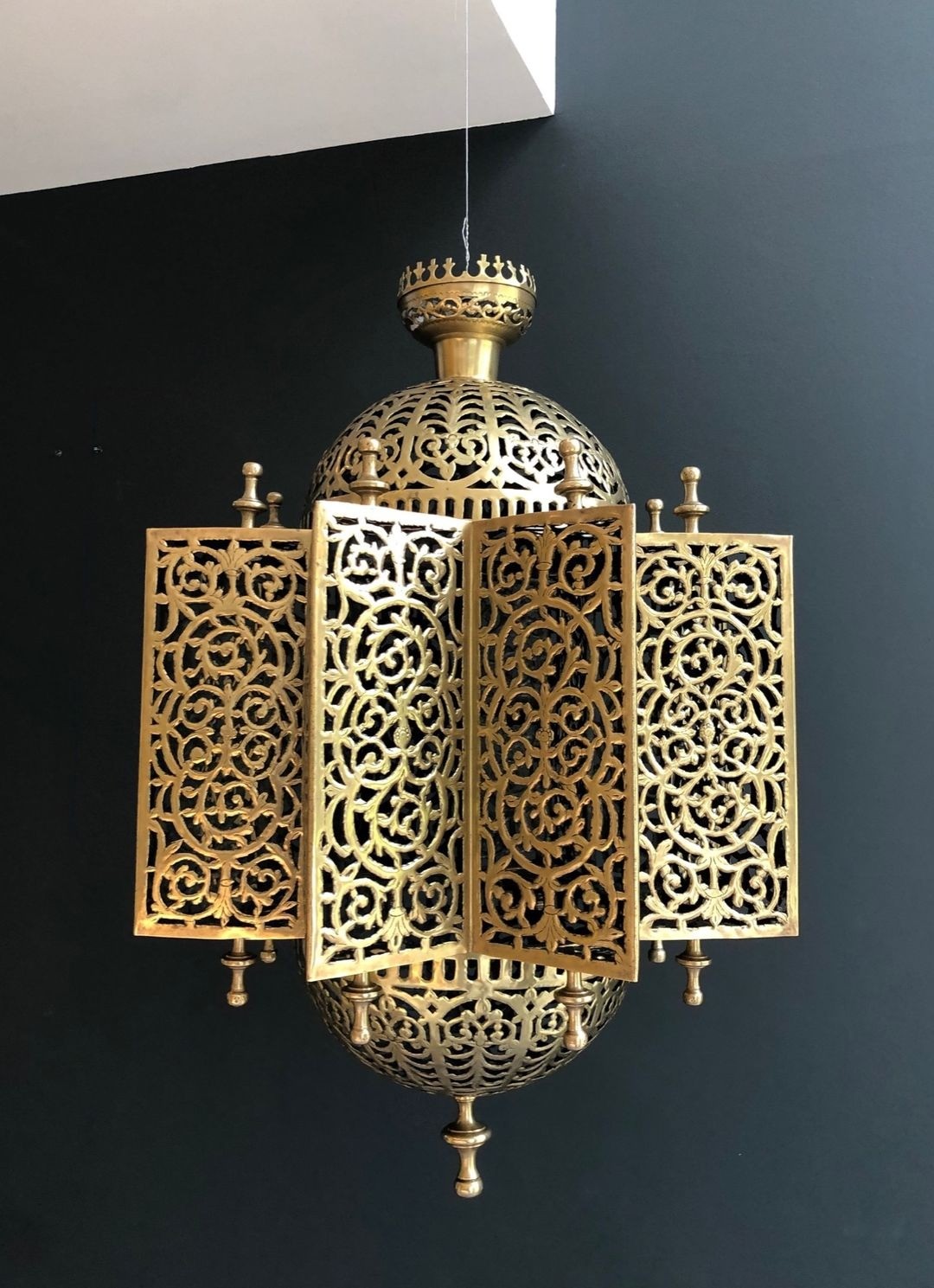
At fifty-seven centimetres across and eighty-two centimetres in height, this brass lantern belongs to a great tradition of Oriental metalwork that reached its height in the nineteenth century across North Africa, Egypt, Turkey, and Persia. The lantern form — a brass body pierced, chased, or filigree-worked to filter light through a complex pattern of apertures — has deep roots in Islamic decorative arts, where the transformation of functional lighting into geometric ornament was a matter of both aesthetic principle and spiritual resonance. When lit, such lanterns project patterns of shadow and light onto the surrounding surfaces, creating an environment that is inseparable from the object itself: the room becomes the lantern’s completion.
The nineteenth century was the great period of European fascination with and collection of Oriental metalwork. French collectors, decorators, and museums acquired pieces from across the Ottoman Empire and North Africa; the Expositions Universelles held in Paris from 1855 onwards introduced Oriental art to a mass European audience; and the trade in authentic oriental objects flourished as the century progressed. Brass lanterns of this type — large, imposing, and technically accomplished — were among the most prized objects of this collecting vogue, acquiring a new life in French and British interiors as centrepieces of the Orientalist style that suffused the decorative arts of the later nineteenth century.
The scale of this lantern — fifty-seven centimetres across and over eighty centimetres in height — gives it a presence appropriate to the grandest settings. It would have hung originally in the reception hall of a palace or a significant private residence, or within a richly decorated mosque; in a European context, it found its place in the great halls of Orientalist-influenced châteaux, in winter gardens, and in the fumoirs and bibliothèques of collectors who furnished their environments with the particular seriousness that the late nineteenth century brought to the question of taste.