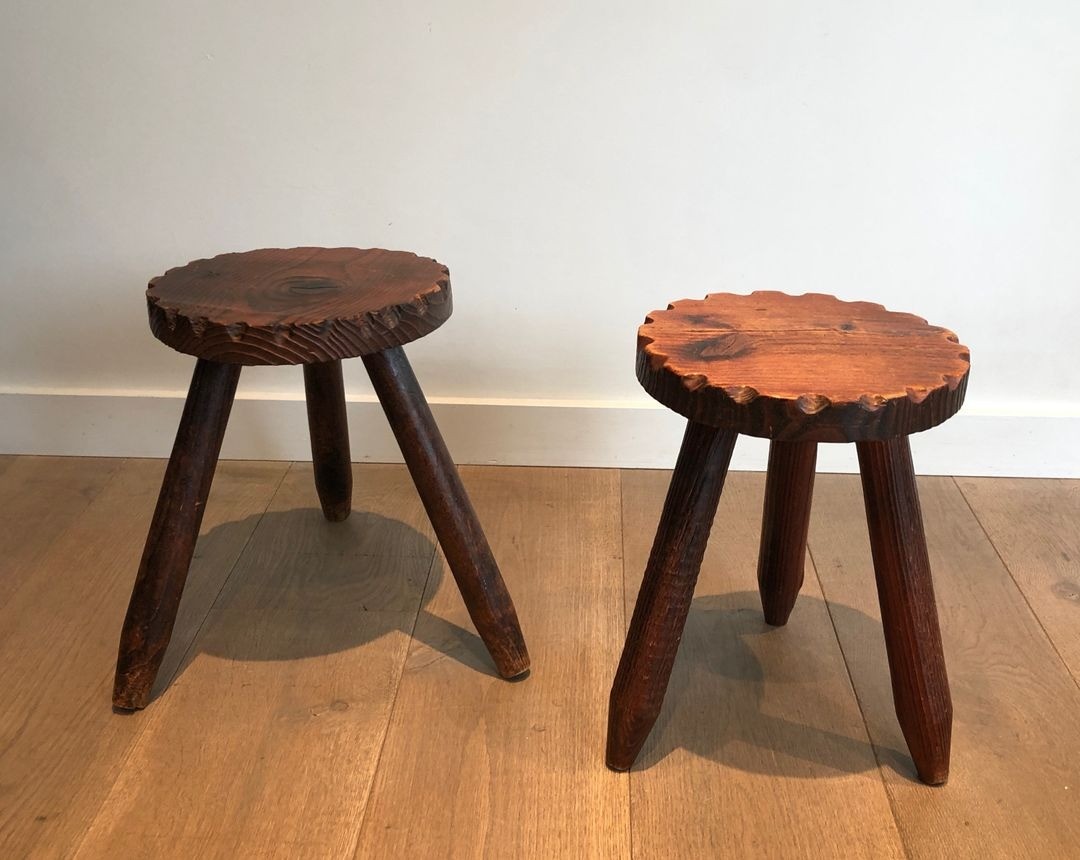
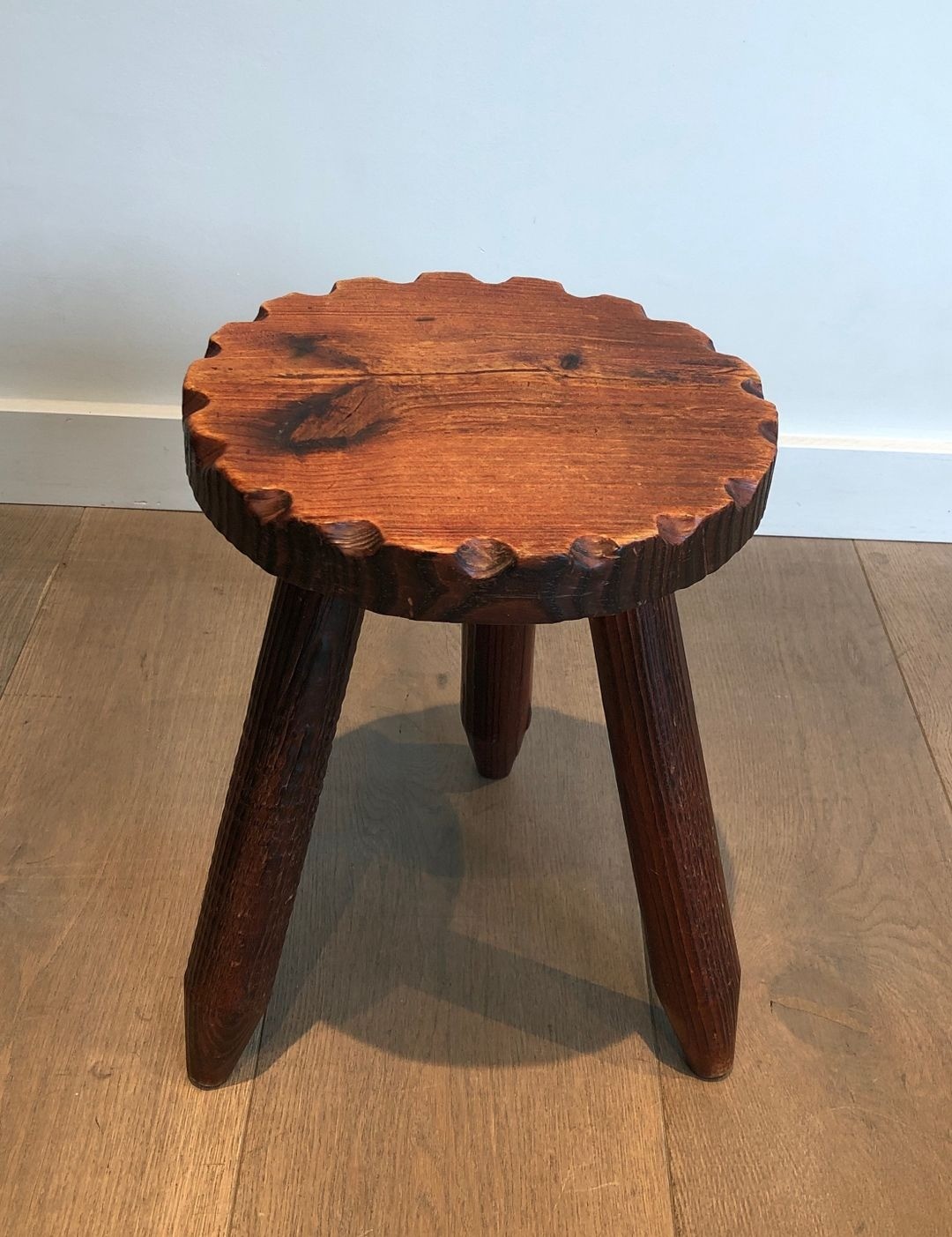
In French cabinet-making, the pine knot is a defect: a circular irregularity where a branch once grew, resin-dense, hard to work, liable to fall out after cutting and leave a hole. The classical tradition excluded it; the ébéniste avoided timber that carried it. In brutalist furniture of the 1940s and 1950s, the knot is rehabilitated as the central visual event — not concealed but celebrated, placed at the centre of the visual composition as evidence that the wood was once a tree. Each knot maps a moment in that tree’s life: the annual rings surrounding it record its growth, the density change reveals the branch’s angle of attachment, the colour contrast shows the difference between heartwood and the branch’s wood chemistry. It is the tree’s autobiography inscribed into the furniture.
These two pine stools, French work of circa 1950, embrace that logic. They are not attributed to a known designer, and the brutalist aesthetic they express — visible joinery, rough-worked surfaces, the presence rather than the concealment of the material’s character — was widely practised in the decade following the Liberation. The post-war moment in France was ambivalent about luxury: the refined Parisian decorating tradition had flourished during the Occupation’s uneven economy, associating elegant finish with collaboration and compromise. Against this backdrop, rough pine and exposed construction carried a different moral weight — the weight of honesty, of work, of the village carpenter rather than the Paris atelier.
The proportions are those of the low working stool: 42 cm wide, 40 cm deep, 37.5 cm high — a height that places the seated occupant closer to the floor than the conventional stool, suited to workbench tasks, hearth-side seating, or the informal domestic situations of the mid-century French home. As a pair, the two stools mirror each other without being identical: different knots, different grain patterns, the paired asymmetry that only natural material can produce. They age with the dignity of pine, darkening gradually and acquiring the patina of decades of domestic use.