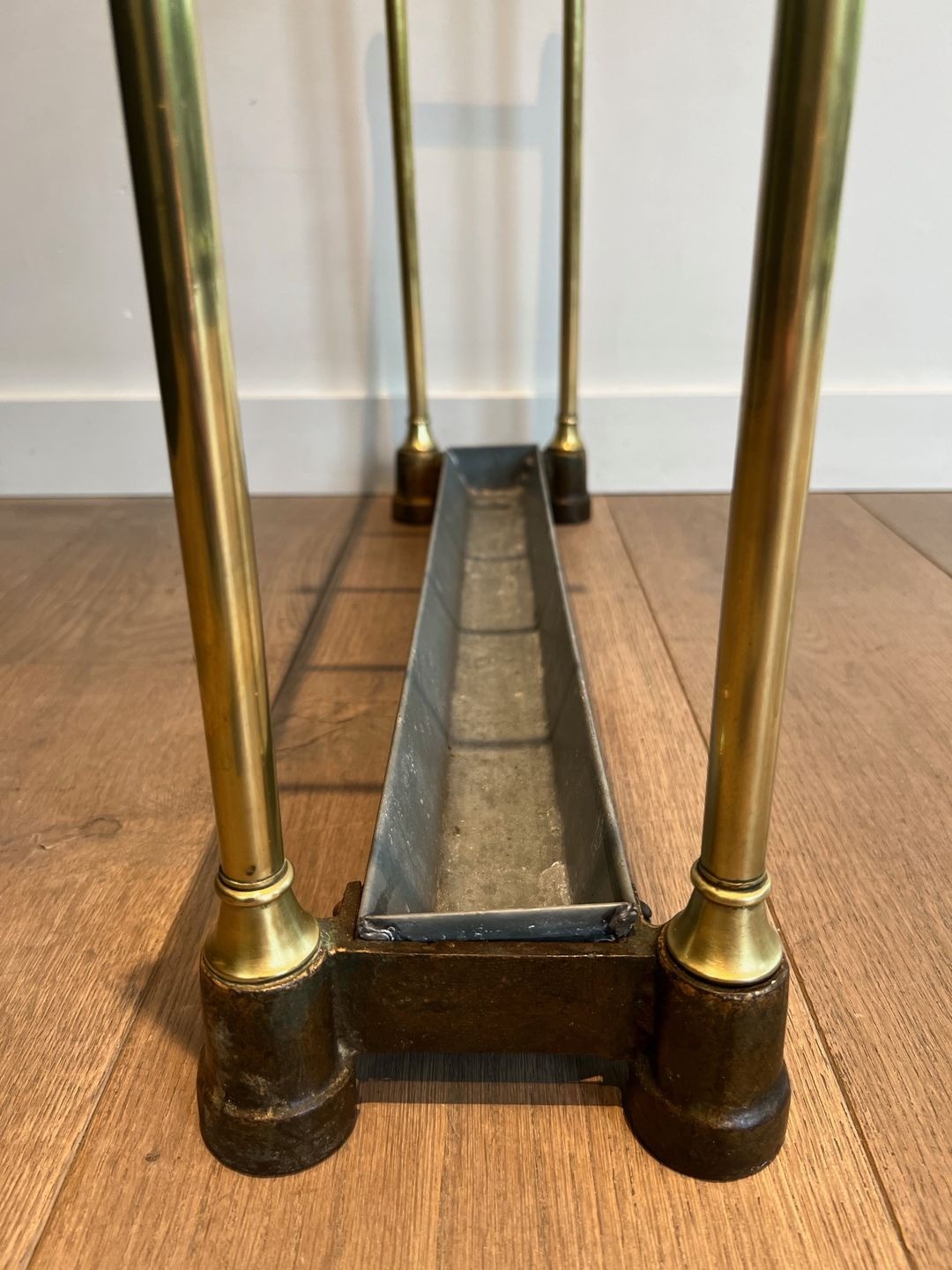
The juxtaposition of brass and cast iron in a single piece of decorative furniture is one of the characteristic gestures of the French Art Nouveau atelier at the turn of the twentieth century. Cast iron arrived in the French decorative vocabulary through the nineteenth-century tradition of municipal and industrial design — railings, street furniture, factory gates — bringing with it the authority of mass production and structural endurance. Brass, by contrast, was the metal of interior luxury, of instrument-makers and goldsmiths. To combine them was to perform an act of democratic aesthetics : to elevate the industrial material through proximity to the precious, and to ground the precious in structural necessity. This umbrella stand is a refined example of that productive encounter, brought to bear on an object whose purpose was to greet the visitor at the threshold of a considered interior.
Measuring 63.5 cm in width, 15.5 cm in depth, and 58 cm in height, the piece presents an elongated horizontal profile that distinguishes it from the more common tall cylindrical umbrella stand of the period. This wider-than-tall proportion allows the stand to accommodate a generous collection of walking sticks and umbrellas arranged along its length, while the shallow depth ensures it occupies minimal space against a wall or in an entrance recess. The Art Nouveau detailing in brass — curvilinear ornament, the organic grammar of the style — plays against the solidity of the cast iron structure, creating a dialogue between the decorative and the structural that characterises the movement at its most resolved.
Umbrella stands combining brass and cast iron represent a more specialised category than either material alone, and surviving examples in good condition with intact ornamentation in both materials are correspondingly less common. The piece serves equally well as a functional object — daily use was its original and intended purpose — and as a display piece representative of the sophistication that French artisans brought to the domestic entrance at the height of the Art Nouveau movement. For the collector interested in this period, it offers the particular satisfaction of an object that is both materially interesting and historically specific, anchored in the productive tension between industry and ornament that defines its era.